CCSD principals describe Warrior Wednesdays, flexible pacing and project-based teams as pilot programs report early gains
November 06, 2025 | CLARK COUNTY SCHOOL DISTRICT, School Districts, Nevada
This article was created by AI summarizing key points discussed. AI makes mistakes, so for full details and context, please refer to the video of the full meeting. Please report any errors so we can fix them. Report an error »
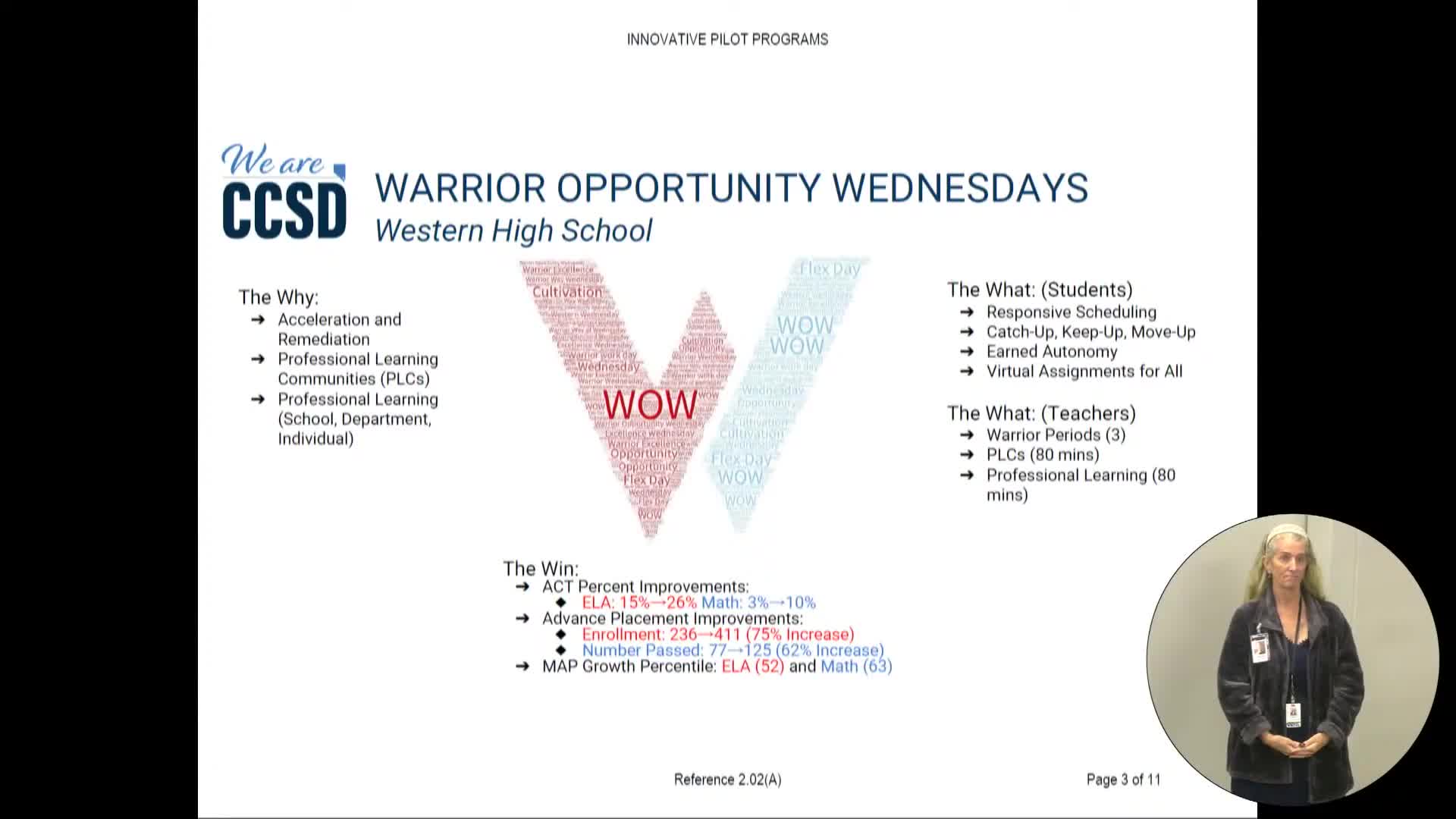
Western High School principal Antonio Rael said his school’s ‘Warrior Opportunity Wednesdays’ were designed to give students targeted instruction and teachers extended professional time.
"The idea for Warrior Opportunity Wednesday was really born out of us realizing that the traditional education model did not meet the needs of our students," Rael said. On Wednesdays, roughly 60% of students attend campus for between one and four "warrior" periods matched to short-cycle assessment data, Rael said; teachers get two 80-minute blocks for professional learning community and professional learning time. Smaller in-person class sizes — Rael described them at about 10 students — allow more targeted remediation and acceleration.
District presentations linked the schedule change to several early measures of improvement. Rael reported the school’s ACT math pass rate "has tripled percentage-wise in the two years we’ve done the program," ELL growth has about doubled, AP course participation rose roughly 75–78%, and AP exam passing increased by about 65%. He also said MAP fall-to-spring growth for ELA and math outpaced national peers.
At Northeast Career & Technical Academy, Principal Ryan Cordia described a mastery-learning, flexible-pacing model aligned with career pathways. "Students progress at their own pace and ability through each unit," Cordia said. Each unit follows four stages—an overview, blended self-paced work, discourse to verify learning, and a performance task—and students set timelines and advance as they demonstrate mastery. Cordia said the school also embeds monthly social-emotional (EQ) training and semester career coaching so every student finishes with a plan for post‑secondary work or study.
"If they don't need any support, we get out of their way, and they can fly through material pretty quickly," Cordia said, adding that the model is paired with industry-aligned career pathway instruction and outcomes data the school uses to refine programs.
Kayleen (Caelene) Ellis, assistant superintendent for Leadership and Professional Learning, presented on a district Project-Based Learning (PBL) pilot that began in 2021. Ellis said the pilot started with 15 schools and has grown to 38 pilot schools; she reported 550 educators trained and that 98% of trained educators implemented at least one "gold standard" project.
Jim Bridger Middle School Principal Ramona Fricker described the school’s team model, which removed dividing walls between classrooms to create flexible learning areas and cross-curricular teaming. Fricker said teaming reduced reliance on substitutes, improved assignment submission rates and decreased chronic absenteeism by "over 24% in two years." She showed examples of student projects — a sixth-grade unit combining metabolism and emergency management in which students designed and presented an energy bar that first responders tasted and evaluated.
Trustees asked detailed implementation questions during a prolonged Q&A: how students are assigned to warrior periods (Rael said teachers rotate so half teach warrior periods each half of the day while the other half conduct PLCs), whether students are locked into career pathways (Cordia said students apply in eighth grade to a pathway and students generally keep the pathway but may change their specific "leaf" or job focus), costs and vendor support (staff said the district has funded two years of professional learning with federal funds for the PBL pilot, while some certification/vendor services carry fees), and how sustainability will be codified (presenters emphasized teacher-led playbooks, regular onboarding, and distributed leadership).
Presenters and district staff repeatedly framed the pilots as iterative: early data and principal reports indicate improved engagement and measurable gains on some assessments, but staff stressed ongoing monitoring and the need to build systems (grading windows, Infinite Campus adaptations, and professional learning) to scale models districtwide.
The presentations were informational; no board votes were taken on the pilot programs at the Nov. 5 work session. Trustees praised the teams and asked staff to return with updates on costs, scalability and metrics to track progress districtwide.
"The idea for Warrior Opportunity Wednesday was really born out of us realizing that the traditional education model did not meet the needs of our students," Rael said. On Wednesdays, roughly 60% of students attend campus for between one and four "warrior" periods matched to short-cycle assessment data, Rael said; teachers get two 80-minute blocks for professional learning community and professional learning time. Smaller in-person class sizes — Rael described them at about 10 students — allow more targeted remediation and acceleration.
District presentations linked the schedule change to several early measures of improvement. Rael reported the school’s ACT math pass rate "has tripled percentage-wise in the two years we’ve done the program," ELL growth has about doubled, AP course participation rose roughly 75–78%, and AP exam passing increased by about 65%. He also said MAP fall-to-spring growth for ELA and math outpaced national peers.
At Northeast Career & Technical Academy, Principal Ryan Cordia described a mastery-learning, flexible-pacing model aligned with career pathways. "Students progress at their own pace and ability through each unit," Cordia said. Each unit follows four stages—an overview, blended self-paced work, discourse to verify learning, and a performance task—and students set timelines and advance as they demonstrate mastery. Cordia said the school also embeds monthly social-emotional (EQ) training and semester career coaching so every student finishes with a plan for post‑secondary work or study.
"If they don't need any support, we get out of their way, and they can fly through material pretty quickly," Cordia said, adding that the model is paired with industry-aligned career pathway instruction and outcomes data the school uses to refine programs.
Kayleen (Caelene) Ellis, assistant superintendent for Leadership and Professional Learning, presented on a district Project-Based Learning (PBL) pilot that began in 2021. Ellis said the pilot started with 15 schools and has grown to 38 pilot schools; she reported 550 educators trained and that 98% of trained educators implemented at least one "gold standard" project.
Jim Bridger Middle School Principal Ramona Fricker described the school’s team model, which removed dividing walls between classrooms to create flexible learning areas and cross-curricular teaming. Fricker said teaming reduced reliance on substitutes, improved assignment submission rates and decreased chronic absenteeism by "over 24% in two years." She showed examples of student projects — a sixth-grade unit combining metabolism and emergency management in which students designed and presented an energy bar that first responders tasted and evaluated.
Trustees asked detailed implementation questions during a prolonged Q&A: how students are assigned to warrior periods (Rael said teachers rotate so half teach warrior periods each half of the day while the other half conduct PLCs), whether students are locked into career pathways (Cordia said students apply in eighth grade to a pathway and students generally keep the pathway but may change their specific "leaf" or job focus), costs and vendor support (staff said the district has funded two years of professional learning with federal funds for the PBL pilot, while some certification/vendor services carry fees), and how sustainability will be codified (presenters emphasized teacher-led playbooks, regular onboarding, and distributed leadership).
Presenters and district staff repeatedly framed the pilots as iterative: early data and principal reports indicate improved engagement and measurable gains on some assessments, but staff stressed ongoing monitoring and the need to build systems (grading windows, Infinite Campus adaptations, and professional learning) to scale models districtwide.
The presentations were informational; no board votes were taken on the pilot programs at the Nov. 5 work session. Trustees praised the teams and asked staff to return with updates on costs, scalability and metrics to track progress districtwide.
Don't Miss a Word: See the Full Meeting!
Go beyond summaries. Unlock every video, transcript, and key insight with a Founder Membership.
✓
Get instant access to full meeting videos
✓
Search and clip any phrase from complete transcripts
✓
Receive AI-powered summaries & custom alerts
✓
Enjoy lifetime, unrestricted access to government data
30-day money-back guarantee
