North Providence council approves $46,000 algae remediation treatment for Wenscott Reservoir west basin
November 06, 2025 | North Providence, Providence County, Rhode Island
This article was created by AI summarizing key points discussed. AI makes mistakes, so for full details and context, please refer to the video of the full meeting. Please report any errors so we can fix them. Report an error »
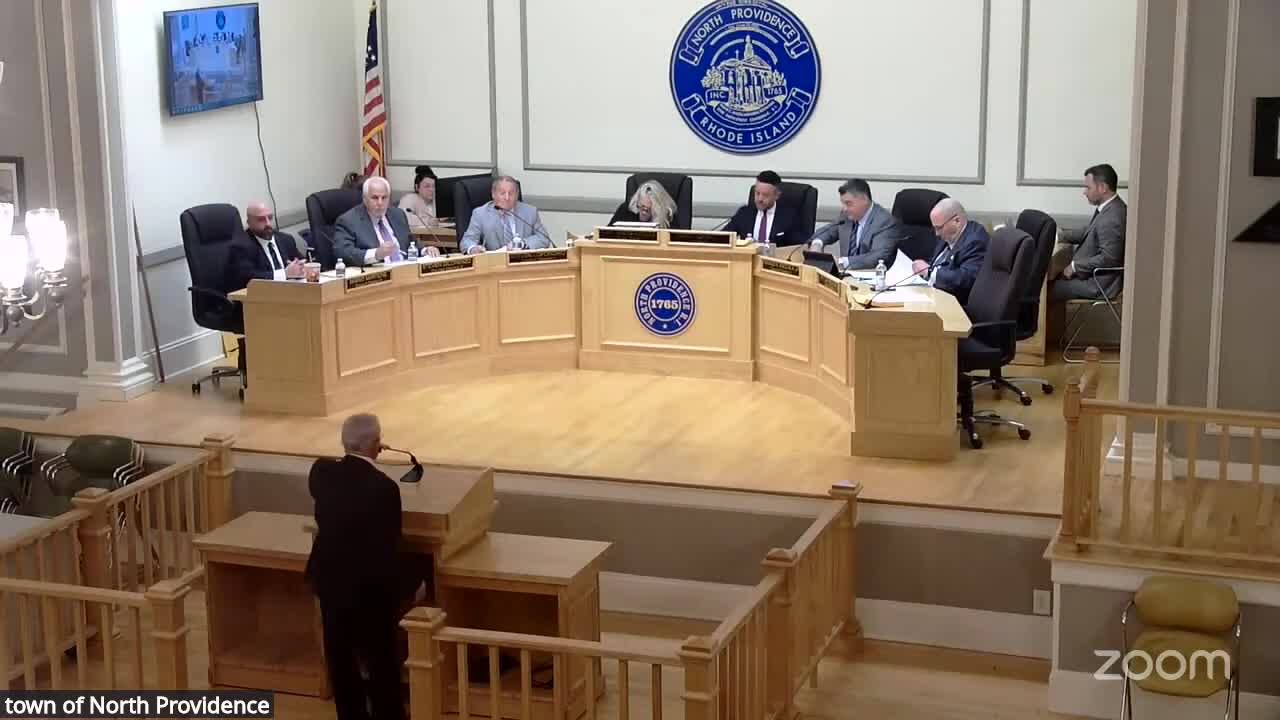
Mayor Lapati on Nov. 5 asked the council to consider contracting annual treatment of the west basin of Wenscott Reservoir after recent testing showed high concentrations of cyanobacteria.
Colin Gosselin, of Water and Wetland, told the council that recent samples from the west basin returned about 250,000 cells per liter of cyanobacteria and that a separate phosphorus test showed roughly 125,000 cells per liter (both figures reported by Gosselin during the meeting). He said those results are well above commonly used guidance — he cited a 70,000‑cells‑per‑liter threshold that, in his account, would preclude swimming or direct contact.
Gosselin described a two-tier approach. He said the contractors applied copper sulfate in late September as a short-term “Band‑Aid” to kill algae but that copper does not address the phosphorus that fuels regrowth. He said the company recommends a lanthanum‑based product (identified in the meeting as UtreSorb) that binds phosphorus into sediments and reduces the nutrient available for algal blooms. Gosselin estimated the initial application at about $46,000, with subsequent years “reduced about $30,000.” He said follow‑up frequency could vary and that, depending on watershed inputs, the treatment might last a “few years.”
Council members asked about circulation and potential sources of phosphorus. Gosselin said increased development and runoff can contribute, and he recommended a watershed assessment (soil and runoff sampling across seasons) if the town wants to locate sources such as lawn runoff or failing septic systems. He also said increasing circulation could help but would not remove phosphorus already available in sediments.
Councilman Bacallus moved to approve contracting the company to perform the algae remediation; Councilman Pollock seconded. The council approved the motion by voice vote; the clerk recorded the result as “the ayes have it.”
The council did not adopt a formal multi‑year commitment during the meeting; the treatment plan discussed includes an initial dose followed by lower‑cost follow‑up treatments. Council members requested monitoring and raised the possibility of later soil and watershed studies to identify phosphorus sources.
Colin Gosselin, of Water and Wetland, told the council that recent samples from the west basin returned about 250,000 cells per liter of cyanobacteria and that a separate phosphorus test showed roughly 125,000 cells per liter (both figures reported by Gosselin during the meeting). He said those results are well above commonly used guidance — he cited a 70,000‑cells‑per‑liter threshold that, in his account, would preclude swimming or direct contact.
Gosselin described a two-tier approach. He said the contractors applied copper sulfate in late September as a short-term “Band‑Aid” to kill algae but that copper does not address the phosphorus that fuels regrowth. He said the company recommends a lanthanum‑based product (identified in the meeting as UtreSorb) that binds phosphorus into sediments and reduces the nutrient available for algal blooms. Gosselin estimated the initial application at about $46,000, with subsequent years “reduced about $30,000.” He said follow‑up frequency could vary and that, depending on watershed inputs, the treatment might last a “few years.”
Council members asked about circulation and potential sources of phosphorus. Gosselin said increased development and runoff can contribute, and he recommended a watershed assessment (soil and runoff sampling across seasons) if the town wants to locate sources such as lawn runoff or failing septic systems. He also said increasing circulation could help but would not remove phosphorus already available in sediments.
Councilman Bacallus moved to approve contracting the company to perform the algae remediation; Councilman Pollock seconded. The council approved the motion by voice vote; the clerk recorded the result as “the ayes have it.”
The council did not adopt a formal multi‑year commitment during the meeting; the treatment plan discussed includes an initial dose followed by lower‑cost follow‑up treatments. Council members requested monitoring and raised the possibility of later soil and watershed studies to identify phosphorus sources.
Don't Miss a Word: See the Full Meeting!
Go beyond summaries. Unlock every video, transcript, and key insight with a Founder Membership.
✓
Get instant access to full meeting videos
✓
Search and clip any phrase from complete transcripts
✓
Receive AI-powered summaries & custom alerts
✓
Enjoy lifetime, unrestricted access to government data
30-day money-back guarantee
