Lake County supervisors hear draft changes to cannabis ordinance; staff proposes larger setbacks, canopy cap and permit rule changes
November 06, 2025 | Lake County, California
This article was created by AI summarizing key points discussed. AI makes mistakes, so for full details and context, please refer to the video of the full meeting. Please report any errors so we can fix them. Report an error »
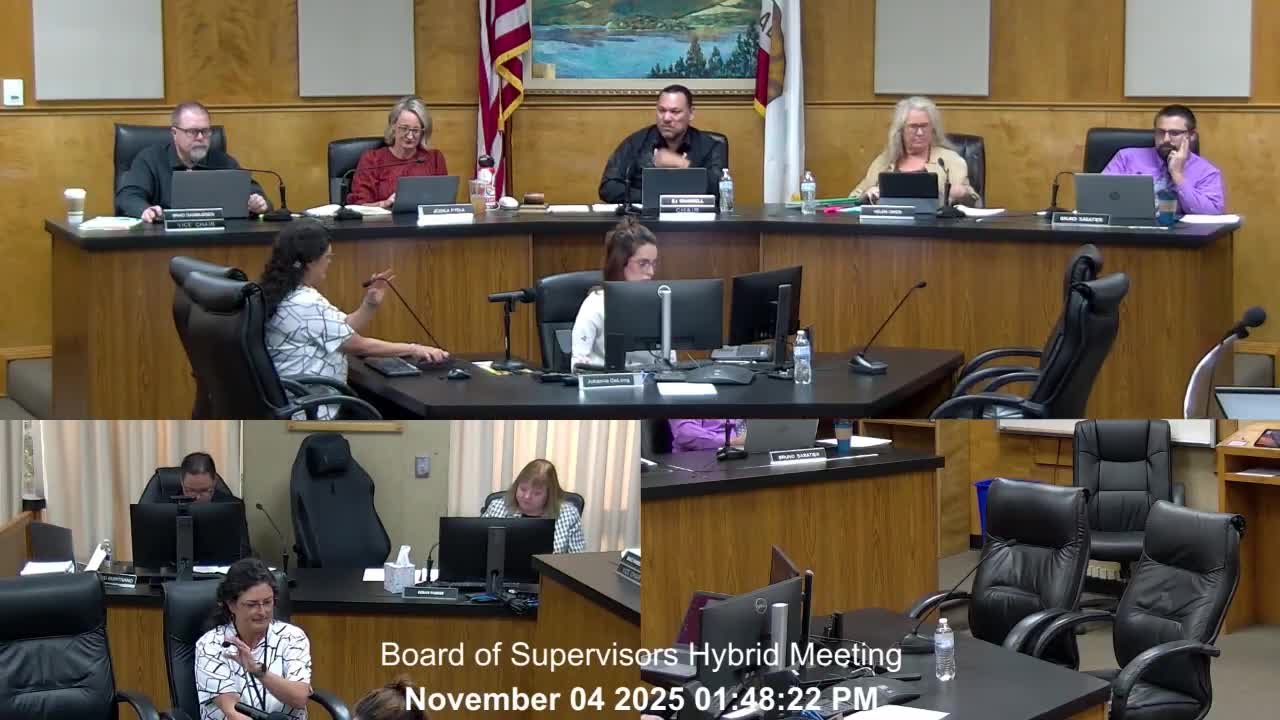
Turner said staff presented an initial update to the Planning Commission on Oct. 9 and plans to provide a draft ordinance to that commission by Nov. 13; the department aims to bring a board item later in the calendar year but said the Nov. 18 date may shift to ensure advisory bodies and counsel can review comments.
What Turner described as the first group of amendments includes a set of changes the department believes can move forward this year: increasing setbacks from off-site residences (staff listed 200 feet to 500 feet as the current working figure); a proposed cap on commercial canopy size (staff flagged 20 acres as a starting point); rules and timelines to clear incomplete or abandoned applications; synchronization with the state on identification of responsible parties and background-clearance language; and clearer methods for calculating canopy to align county permit monitoring with the state's measurement.
Turner said the county will not conduct active-warrant searches at the sheriff's office because state rules limit how those searches may be requested, "but what we do intend to do is add some wording that should we become aware of any active warrants for property owners or applicants or any members of the permit party, it will result in setting aside, tabling the processing of that application until resolution." (Maria Turner, Community Development Director)
Other items in the proposed package include clarifications to distinguish hemp canopy (under the Agricultural Commissioner's jurisdiction) from regulated cannabis canopy, continued discussion of scenic corridor setback language, adding public lands (identified in staff materials as "7.79 Rumsey") to the county's commercial-cultivation exclusion zones and starting the 1,000-foot setback from that boundary, and synchronizing county setbacks from watercourses with the California State Water Resources Control Board. In staff comments during the meeting Turner cited a preliminary table that uses a 150-foot buffer for class 1 and class 2 watercourses and a 50-foot buffer for ephemeral watercourses, subject to final alignment with state standards.
The package also proposes operational and delivery-hour limits recommended by the task force, an opt-out notification deadline of June 1 (to coordinate with the treasurer-tax collector's assessment cycle), a rule that opt-out cannot be used for consecutive years, expiration of a use permit after two years of inactivity, removal of the current 10-year permit limit so a cannabis conditional-use permit more closely "runs with the land," and the addition of a $5,000 restoration bond payable to Lake County.
Turner presented an option for a programmatic environmental impact report (EIR) to develop science-based odor thresholds and mitigation measures and to study water impacts. Staff shared a consultant estimate for a focused programmatic EIR of roughly $250,000 and about eight months of work as an example of a possible next step to establish technical standards the county could rely on during CEQA review and compliance monitoring.
Board members asked that staff pursue a tiered setbacks approach tied to project scale rather than a single static distance, asked that draft ordinance language be routed to the Planning Commission for review consistent with prior practice, and expressed broad interest in addressing water impacts through longer-term technical work while holding the programmatic EIR funding decision for later. No final action or ordinance adoption occurred at this meeting; staff was directed to continue drafting with the board's input and to return with a formal draft for advisory-body review.
Public comments during the hearing raised three recurring concerns: potential fiscal and legal impacts if the county's measure for calculating the tax base departs from Measure C; the cost, scope and legal defensibility of a narrow EIR focused on odor; and enforcement and compliance capacity related to background checks, water use, and illegal grows. Speakers included cannabis operators, attorneys, and community groups urging varying approaches: some urged smaller canopy caps and stricter setbacks; industry representatives urged caution about using CEQA as a regulatory lever and recommended hiring permanent in-house CEQA expertise; community advocates urged strict compliance with voter-approved taxation and stronger water safeguards.
No motions or votes were taken on the ordinance language at this meeting; staff will return with a draft for Planning Commission review and continue to refine the proposal based on board direction.
Don't Miss a Word: See the Full Meeting!
Go beyond summaries. Unlock every video, transcript, and key insight with a Founder Membership.
30-day money-back guarantee
Sponsors
Proudly supported by sponsors who keep California articles free in 2025

