Consultants: Phase 1A study finds capacity limits, recommends studying a single "one water" entity for Washoe County region
November 06, 2025 | Washoe County, Nevada
This article was created by AI summarizing key points discussed. AI makes mistakes, so for full details and context, please refer to the video of the full meeting. Please report any errors so we can fix them. Report an error »
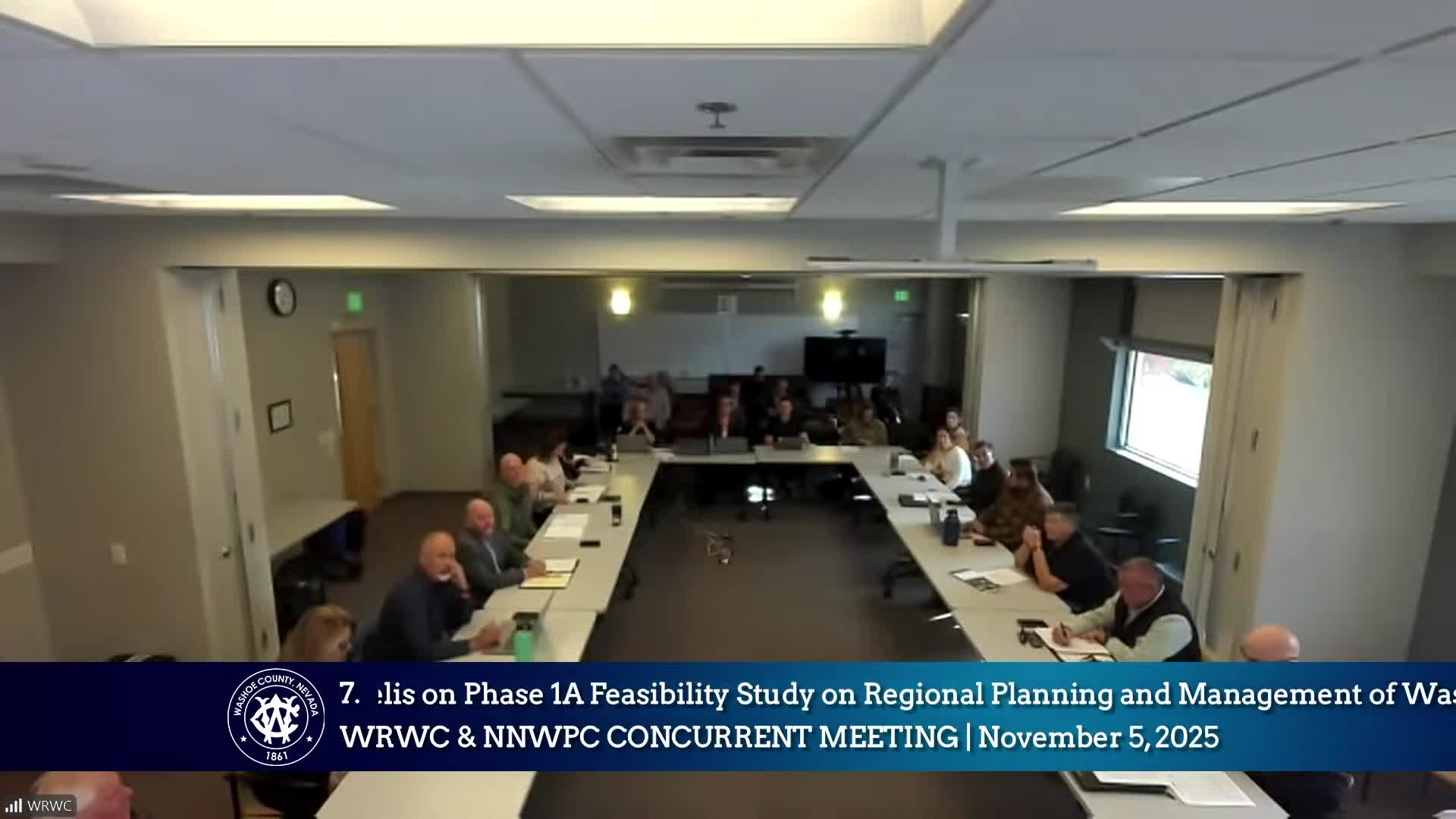
Consultants from Raftelis and partner firms presented findings from a Phase 1A feasibility study on regional wastewater and effluent management at a joint Western Regional Water Commission (WRWC) and Northern Nevada Water Planning Commission (NNWPC) meeting on Nov. 5, 2025, in Washoe County. The study identified interrelated challenges — capacity limitations that vary by location, uncertainty about draft state and federal nutrient regulations, and large long-term capital-investment needs — and said those issues, combined with the close operational link between potable water, wastewater, reuse and stormwater, argue for studying more integrated governance.
"This phase was to identify regional wastewater challenges and objectives by having a lot of discussions with all of you folks," said Zach Green, a consultant with Raftelis, who described Phase 1A as a document review and interview-driven effort that included staff and elected officials. Consultants summarized eight interrelated challenge areas and reported strong participation from finance, engineering, operations and elected leaders.
The team emphasized that "capacity" means different things around the region — hydraulic ability at some plants, nutrient-handling at others, effluent-reservoir space or local reuse demand elsewhere — and that draft nutrient regulations are changing the calculation for effluent quality and disposal. The consultants said those realities, along with a complex patchwork of governance and differing cost-recovery approaches, can slow decisions and create uncertainty for developers and ratepayers.
Consultants described a range of regionalization options from continued collaboration and shared services to partial facility consolidation and full regional consolidation. They reported that, during Phase 1A conversations, many participants expressed a preference to focus study resources on the narrower end of that continuum — advanced alignment or consolidation rather than small incremental coordination — and that there is meaningful interest in a "one water" model that would manage potable water, wastewater and reuse within a single organization. Gwen Moore of Zanjero described the region's water assets as an integrated portfolio and said a single governance model could better reflect that integration.
At the same time, attendees and consultants flagged major concerns that would need resolution before any transition: loss of local control, fair compensation and cost-allocation for existing assets, labor and collective-bargaining impacts, and political will. "There needs to be certainty that folks are represented," the report said, summarizing public-sector concerns; consultants also noted one wastewater agency that expressed a preference for the status quo.
A representative of Sun Valley Public Improvement District told the meeting the district is "not opposed to a regional" approach but would not necessarily surrender its wastewater authority, noting existing collection agreements and capacity arrangements.
The consultants outlined likely next steps if the work continues: more detailed evaluation of governance alternatives, asset valuation and condition assessments, and financial scenarios that would estimate rate impacts and potential upfront compensation under an organizational transition. Kim (program manager) said the Phase 1A final report would be completed in time to be presented to the boards in January 2026, and that subsequent phases (1B and 1C) could include benchmarking case studies, asset valuation and deeper rate and staffing analysis over the following 6–12+ months.
Commission members asked for comparative case studies of western utilities, more granular financial analysis and assurance that local interests and labor issues would be included in any next-phase stakeholder process. Consultants said they can scale benchmarking and case-study work to the commission's interest and that a single consolidated agency — rather than a separate parallel wastewater authority — was the option many participants found most attractive because of reuse, return-flow and water-rights integration.
The presentation closed with a call for further work on asset valuation and compensation mechanisms before making any structural decisions, and with an acknowledgement from consultants that political and implementation risk remains significant and would be a central focus of future phases.
"This phase was to identify regional wastewater challenges and objectives by having a lot of discussions with all of you folks," said Zach Green, a consultant with Raftelis, who described Phase 1A as a document review and interview-driven effort that included staff and elected officials. Consultants summarized eight interrelated challenge areas and reported strong participation from finance, engineering, operations and elected leaders.
The team emphasized that "capacity" means different things around the region — hydraulic ability at some plants, nutrient-handling at others, effluent-reservoir space or local reuse demand elsewhere — and that draft nutrient regulations are changing the calculation for effluent quality and disposal. The consultants said those realities, along with a complex patchwork of governance and differing cost-recovery approaches, can slow decisions and create uncertainty for developers and ratepayers.
Consultants described a range of regionalization options from continued collaboration and shared services to partial facility consolidation and full regional consolidation. They reported that, during Phase 1A conversations, many participants expressed a preference to focus study resources on the narrower end of that continuum — advanced alignment or consolidation rather than small incremental coordination — and that there is meaningful interest in a "one water" model that would manage potable water, wastewater and reuse within a single organization. Gwen Moore of Zanjero described the region's water assets as an integrated portfolio and said a single governance model could better reflect that integration.
At the same time, attendees and consultants flagged major concerns that would need resolution before any transition: loss of local control, fair compensation and cost-allocation for existing assets, labor and collective-bargaining impacts, and political will. "There needs to be certainty that folks are represented," the report said, summarizing public-sector concerns; consultants also noted one wastewater agency that expressed a preference for the status quo.
A representative of Sun Valley Public Improvement District told the meeting the district is "not opposed to a regional" approach but would not necessarily surrender its wastewater authority, noting existing collection agreements and capacity arrangements.
The consultants outlined likely next steps if the work continues: more detailed evaluation of governance alternatives, asset valuation and condition assessments, and financial scenarios that would estimate rate impacts and potential upfront compensation under an organizational transition. Kim (program manager) said the Phase 1A final report would be completed in time to be presented to the boards in January 2026, and that subsequent phases (1B and 1C) could include benchmarking case studies, asset valuation and deeper rate and staffing analysis over the following 6–12+ months.
Commission members asked for comparative case studies of western utilities, more granular financial analysis and assurance that local interests and labor issues would be included in any next-phase stakeholder process. Consultants said they can scale benchmarking and case-study work to the commission's interest and that a single consolidated agency — rather than a separate parallel wastewater authority — was the option many participants found most attractive because of reuse, return-flow and water-rights integration.
The presentation closed with a call for further work on asset valuation and compensation mechanisms before making any structural decisions, and with an acknowledgement from consultants that political and implementation risk remains significant and would be a central focus of future phases.
View the Full Meeting & All Its Details
This article offers just a summary. Unlock complete video, transcripts, and insights as a Founder Member.
✓
Watch full, unedited meeting videos
✓
Search every word spoken in unlimited transcripts
✓
AI summaries & real-time alerts (all government levels)
✓
Permanent access to expanding government content
30-day money-back guarantee
