Maine DOT launches NEPA review for proposed second Skowhegan bridge; downtown option emphasized
November 06, 2025 | Skowhegan, Somerset County, Maine
This article was created by AI summarizing key points discussed. AI makes mistakes, so for full details and context, please refer to the video of the full meeting. Please report any errors so we can fix them. Report an error »
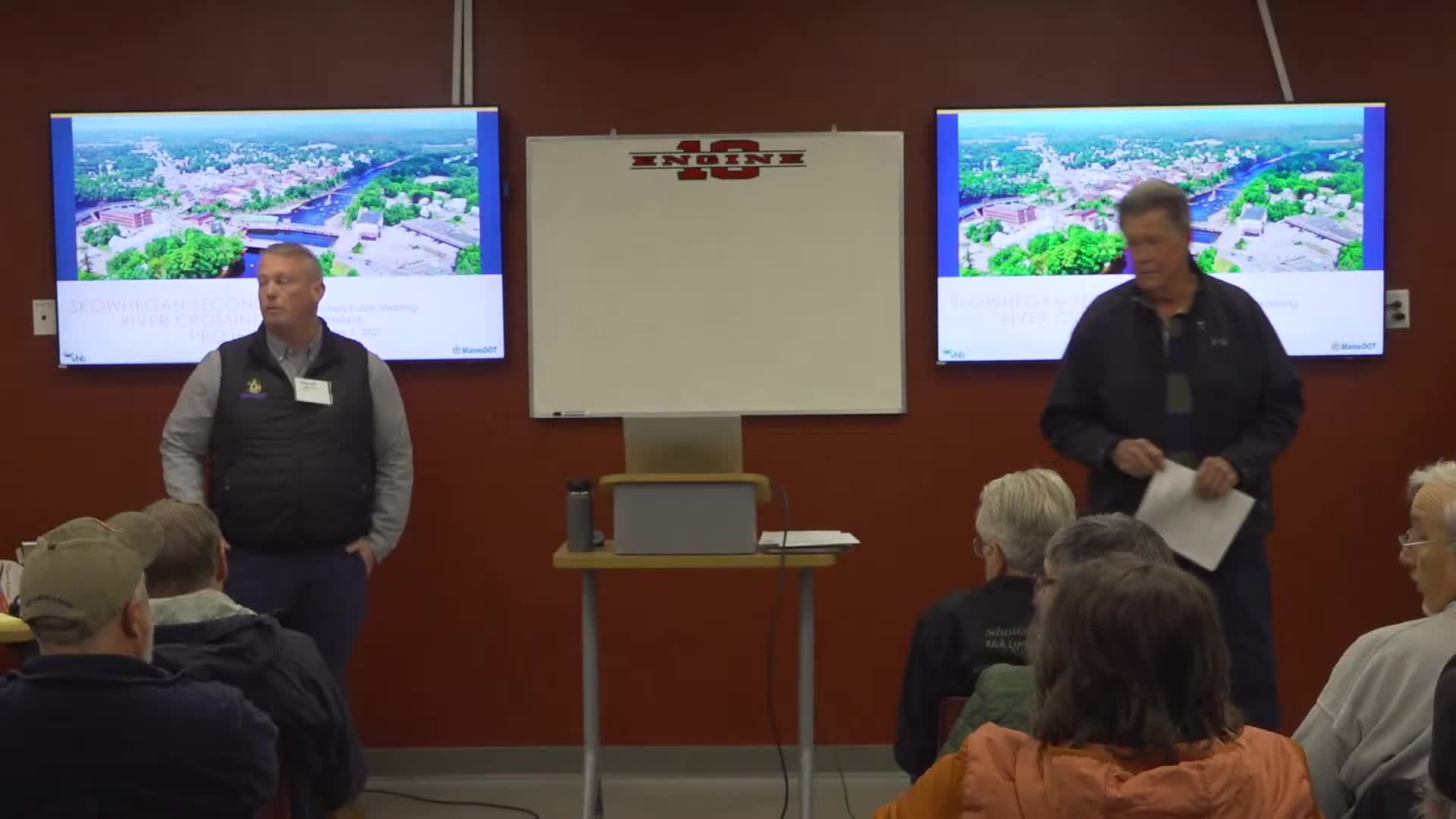
Project staff and consultants reviewed prior studies that narrowed the alternatives. Pete Walker, a project manager working with the consulting team, summarized the 2021 feasibility study and a 2024 transportation master plan, saying those earlier analyses confirmed the need for a second crossing and “pointed very strongly to the benefits of locating that new bridge in the downtown area.” He described the federal National Environmental Policy Act (NEPA) as the governing framework for the next phase and said that NEPA “requires us to look at alternatives to any proposed action.” The team listed other statutes that will be considered during review, including Section 106 of the National Historic Preservation Act, the Uniform Act regarding property acquisition/relocation, and Section 7 of the Endangered Species Act.
Engineers outlined site and design challenges that will be analyzed during the environmental study. Tony Grande, a highway engineer, said the downtown option gained support in part after flooding in 2023 affected a downstream alignment, and noted that the team has assembled base mapping, wetlands, property and crash‑location data to evaluate alternatives. Grande said conceptual design work will examine lane and intersection needs and cautioned that “one lane in each direction is probably not enough,” adding the team will evaluate turn lanes and other intersection improvements. Steve, the project bridge specialist, described steep south‑bank terrain and the need to control bridge grades for safety and accessibility and emphasized minimizing impacts to river hydraulics and whitewater recreation when siting piers or bank supports.
The project team said the current phase will produce conceptual plans adequate for environmental analysis. Walker explained that the environmental document could be a categorical exclusion, an environmental assessment (EA) or an environmental impact statement (EIS), and that staff expect an EA but have not concluded the determination. If a preferred alternative is chosen, the team will advance final engineering and then apply for required state and federal permits; permitting often overlaps the later stages of design.
Speakers described a multi‑year schedule and uncertain funding. Presenters said the environmental study and preliminary design are expected to take about 18–24 months; complete design and permitting could take another two to three years, with construction following that—there is no firm start date. The state is expected to bear the majority of costs but project staff said they anticipate pursuing grant programs and multiple funding sources; specific funding sources and amounts were not specified at the meeting.
Attendees were invited to four interactive stations following the presentation (environmental review, community facilities, mobility and traffic operations, and bridge/network), and staff provided a QR code and contact information for submitting comments. Printed purpose‑and‑need materials were available and staff encouraged written feedback to help define the project’s scope.
The project team repeatedly noted that some impacts to private property and natural resources are likely and that the environmental review will document alternatives and mitigation considerations. No formal decisions or votes were taken at the meeting; this session was framed as an information and feedback opportunity as the project enters the NEPA and preliminary design phase.
View the Full Meeting & All Its Details
This article offers just a summary. Unlock complete video, transcripts, and insights as a Founder Member.
30-day money-back guarantee
Sponsors
Proudly supported by sponsors who keep Maine articles free in 2025

