Planning Commission recommends council approve zoning changes to reduce childcare permitting barriers
November 06, 2025 | Planning Commission , Reno, Washoe County, Nevada
This article was created by AI summarizing key points discussed. AI makes mistakes, so for full details and context, please refer to the video of the full meeting. Please report any errors so we can fix them. Report an error »
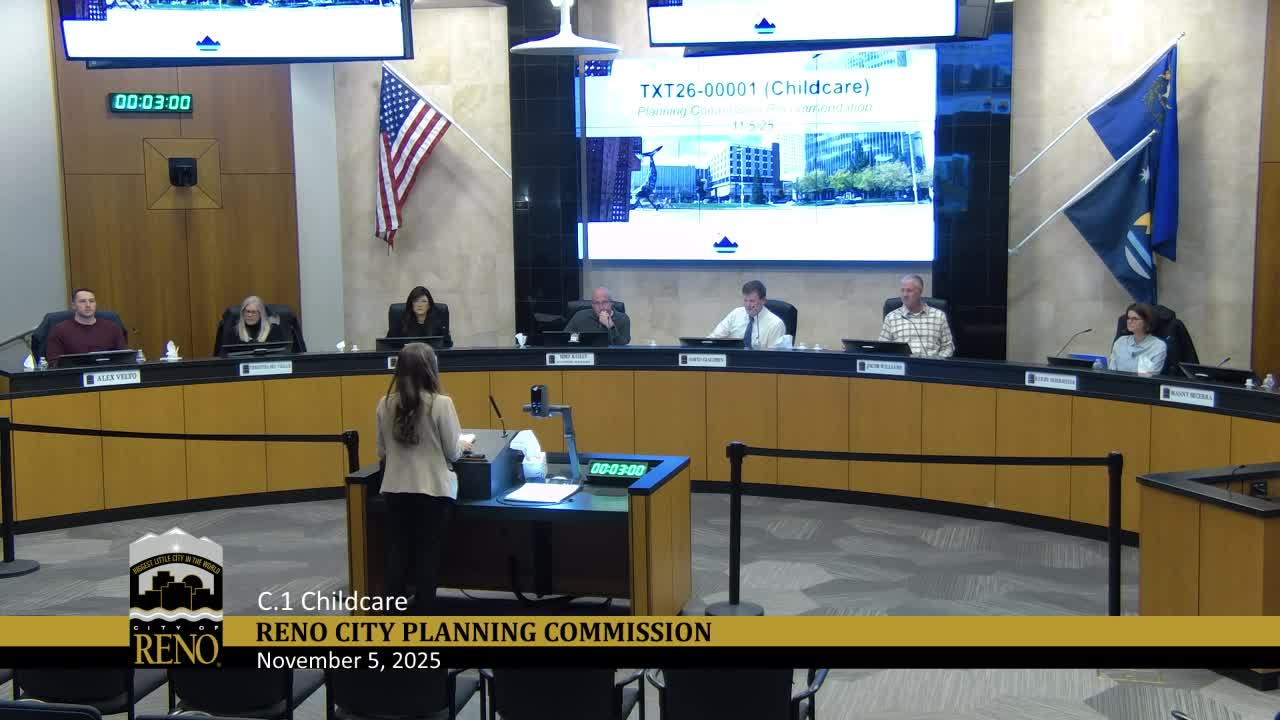
The Reno City Planning Commission on Nov. 5 unanimously recommended that City Council adopt a text amendment to reduce permitting barriers for childcare providers, with staff saying the changes aim to make it easier and less costly to open licensed child care in the city.
Grace MacKinnon, senior management analyst, told commissioners the initiative began when the Children’s Cabinet and Council members asked staff to review the zoning code for obstacles to opening childcare. "Seventy‑two percent of Nevadans live in a childcare desert," MacKinnon said, summarizing state and regional data she used to frame the proposal. She said the amendment would remove the minor conditional use permit (MUP) requirement for in‑home and workplace child care and would reduce the conditional use permit (CUP) requirement to an MUP for childcare centers in residential zones while adding objective standards to reduce neighborhood impacts.
The amendment substitutes objective development standards formerly imposed as conditions of approval in discretionary reviews. They include requiring a pickup/drop‑off plan, limiting outdoor lighting adjacent to residential uses (shielded, downward‑directed fixtures), requiring a six‑foot fence where the facility abuts residential property, and restricting outdoor play hours when adjacent to residences. MacKinnon said the code also would allow applicants who cannot meet the objective standards to pursue a minor conditional use permit review for flexibility.
Commissioners pressed staff on precise wording and potential unintended consequences. Commissioner Velto asked about the change in language from "residential property" to "residential use," and MacKinnon responded: "Residential use is different from residential zoning," explaining the distinction between zoning classifications and the use occurring on a parcel. Commissioners and staff discussed the potential added cost to small, in‑home providers if the commission or council required a solid fence or additional vegetative buffering; staff cautioned that extra requirements could increase time and cost and therefore deter small providers.
Commissioner Williams asked whether the city’s permitting process can check private covenants (CC&Rs) that might bar in‑home childcare; staff said the city does not enforce private restrictions and that requiring staff to verify them would be impractical and inconsistent with other jurisdictions’ practices. Several commissioners noted that many life‑safety and staffing ratios are set by the state and Northern Nevada Public Health, and the amendment focuses on the local land‑use requirements that staff can change.
After deliberation, Commissioner Becerra moved — and Commissioner WR seconded — to recommend City Council approve the text amendment by ordinance. The motion carried unanimously.
The Planning Commission record shows staff conducted outreach (two virtual stakeholder meetings and a presence at local advisory meetings) and considered a public commenter’s request for additional buffering (for example, a solid fence). Staff’s recommendation to the commission preserves discretion: the additional buffer options are documented for Council consideration but were not added as mandatory code requirements at the Planning Commission stage.
What’s next: the commission’s recommendation will go to City Council for first reading in December, with a potential adoption hearing early next year, according to staff.
Votes at a glance
Motion: Recommend City Council approve the text amendment by ordinance.
Mover: Commissioner Becerra.
Second: Commissioner WR.
Outcome: Carried unanimously (voice vote).
Grace MacKinnon, senior management analyst, told commissioners the initiative began when the Children’s Cabinet and Council members asked staff to review the zoning code for obstacles to opening childcare. "Seventy‑two percent of Nevadans live in a childcare desert," MacKinnon said, summarizing state and regional data she used to frame the proposal. She said the amendment would remove the minor conditional use permit (MUP) requirement for in‑home and workplace child care and would reduce the conditional use permit (CUP) requirement to an MUP for childcare centers in residential zones while adding objective standards to reduce neighborhood impacts.
The amendment substitutes objective development standards formerly imposed as conditions of approval in discretionary reviews. They include requiring a pickup/drop‑off plan, limiting outdoor lighting adjacent to residential uses (shielded, downward‑directed fixtures), requiring a six‑foot fence where the facility abuts residential property, and restricting outdoor play hours when adjacent to residences. MacKinnon said the code also would allow applicants who cannot meet the objective standards to pursue a minor conditional use permit review for flexibility.
Commissioners pressed staff on precise wording and potential unintended consequences. Commissioner Velto asked about the change in language from "residential property" to "residential use," and MacKinnon responded: "Residential use is different from residential zoning," explaining the distinction between zoning classifications and the use occurring on a parcel. Commissioners and staff discussed the potential added cost to small, in‑home providers if the commission or council required a solid fence or additional vegetative buffering; staff cautioned that extra requirements could increase time and cost and therefore deter small providers.
Commissioner Williams asked whether the city’s permitting process can check private covenants (CC&Rs) that might bar in‑home childcare; staff said the city does not enforce private restrictions and that requiring staff to verify them would be impractical and inconsistent with other jurisdictions’ practices. Several commissioners noted that many life‑safety and staffing ratios are set by the state and Northern Nevada Public Health, and the amendment focuses on the local land‑use requirements that staff can change.
After deliberation, Commissioner Becerra moved — and Commissioner WR seconded — to recommend City Council approve the text amendment by ordinance. The motion carried unanimously.
The Planning Commission record shows staff conducted outreach (two virtual stakeholder meetings and a presence at local advisory meetings) and considered a public commenter’s request for additional buffering (for example, a solid fence). Staff’s recommendation to the commission preserves discretion: the additional buffer options are documented for Council consideration but were not added as mandatory code requirements at the Planning Commission stage.
What’s next: the commission’s recommendation will go to City Council for first reading in December, with a potential adoption hearing early next year, according to staff.
Votes at a glance
Motion: Recommend City Council approve the text amendment by ordinance.
Mover: Commissioner Becerra.
Second: Commissioner WR.
Outcome: Carried unanimously (voice vote).
Don't Miss a Word: See the Full Meeting!
Go beyond summaries. Unlock every video, transcript, and key insight with a Founder Membership.
✓
Get instant access to full meeting videos
✓
Search and clip any phrase from complete transcripts
✓
Receive AI-powered summaries & custom alerts
✓
Enjoy lifetime, unrestricted access to government data
30-day money-back guarantee
