Central staff update stormwater master plan, demo Early Flows and report FEMA insurance gains
November 06, 2025 | Central, East Baton Rouge Parish, Louisiana
This article was created by AI summarizing key points discussed. AI makes mistakes, so for full details and context, please refer to the video of the full meeting. Please report any errors so we can fix them. Report an error »
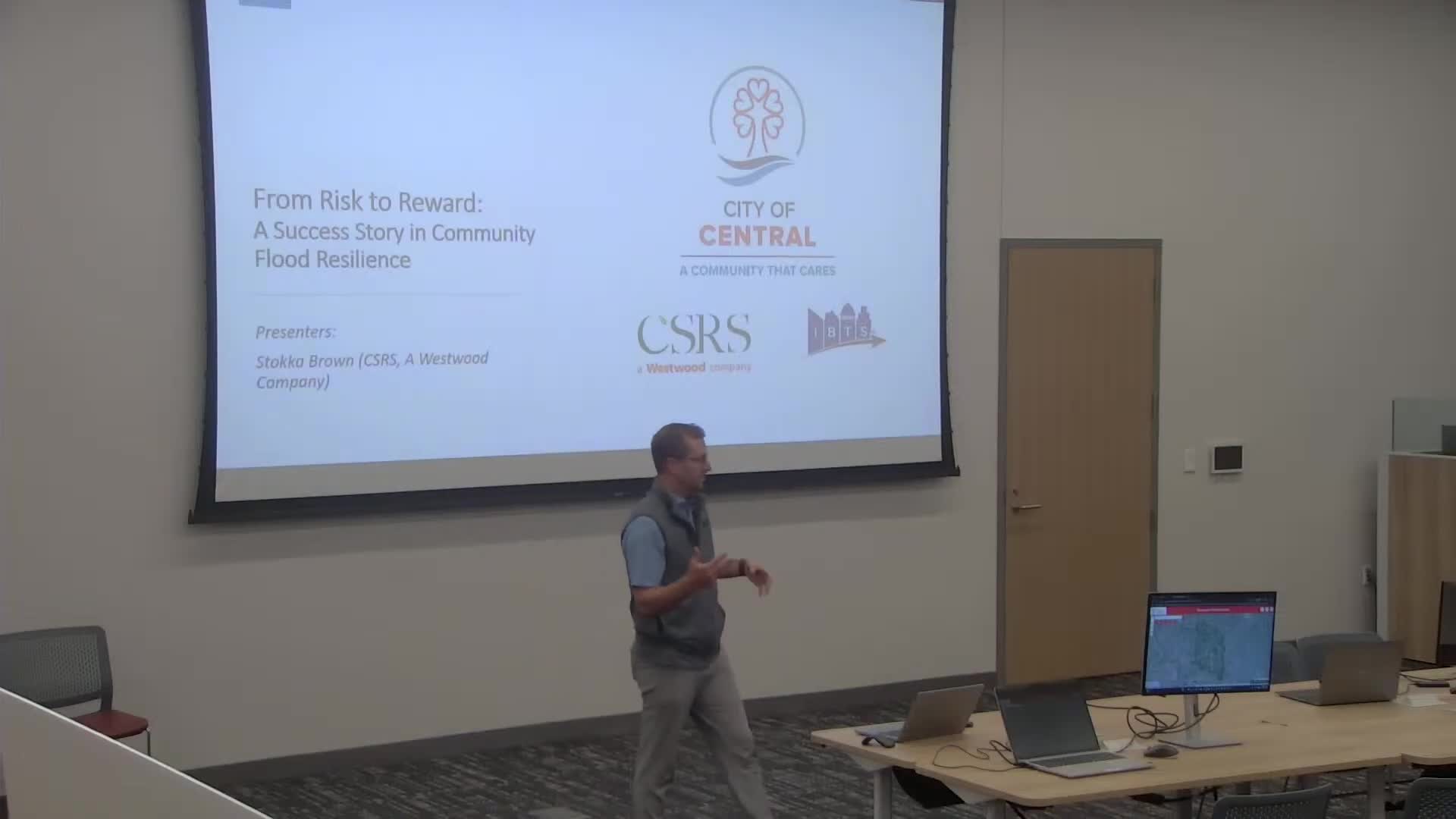
A city staff member said the 2016 flood was "a big catalyst for a lot of this work," and described a program that combines updated surveys, hydraulic modeling, maintenance, regulatory changes and funding strategies. The presentation invited residents to review parcel-level maps and model results at on-site computer stations and to report errors or photos that could improve model accuracy.
Why it matters: Staff told residents that the citys updated hydraulic models identify flood risk beyond areas shown on FEMAs standard flood maps, and that the city is using those models to test whether new development would increase water-surface elevations in local conveyance zones. The models feed an online forecasting tool (Early Flows, www.earlyflows.com) that estimates potential flood depths from incoming rainfall and helps identify roads or properties that could be affected.
Funding and federal grant status: The presenter said Central has secured roughly $60 million to $80 million in funding for stormwater projects to date and described a separate federal award just under $40 million intended for a large retention area at Beaver Bayou. The speaker said some components of that federal funding were canceled by the new administration and that city staff are working with congressional and state delegations to pursue restoration of the award. The city did not specify which grant program issued the award or what the exact timeline is for restoring funds.
Regulatory and project work: Staff described recent regulatory revisions intended to prevent new development from increasing flood risk. The code now requires developments within the conveyance zone to demonstrate "zero increase" in water-surface elevation in the citys hydraulic model before receiving permanent approvals. Staff also emphasized stream setbacks and minimum building-elevation requirements so channels can be widened in future projects without houses occupying the future bank.
Flood insurance and ratings: The presenter said Central improved its FEMA Community Rating System (CRS) classification from a Class 7 to a Class 5. That change corresponds to roughly a 25% flood-insurance discount for eligible policyholders; the presenter noted residents had previously received about a 15% discount under the earlier classification. Staff cautioned that FEMAs Risk Rating 2 reforms are changing individual policy rates over time and that those federal calculations are outside the citys control. Brandon Whitehead, identified during the presentation as the citys floodplain administrator, was listed as the staff contact for detailed questions about the rating and insurance implications.
Community engagement and next steps: Staff encouraged residents to scan QR codes on presentation boards, use the on-site computers to pull up property locations and elevations, and to speak with staff on hand to clarify map details. The presentation emphasized that resident input helps identify mismatches between model outputs and on-the-ground conditions so staff can target inspections and maintenance more efficiently.
What staff did not specify: The city did not provide a schedule of specific projects, precise construction timetables for the Beaver Bayou retention area, or a complete funding breakdown for the $60million to $80million figure. Staff also did not identify all federal grant program names for the canceled awards and said the timing for any restored funding is uncertain.
A staff member closed by asking attendees to visit the boards and computer stations to review model data for their properties and to report discrepancies that would allow staff to pinpoint and inspect problem locations.
Don't Miss a Word: See the Full Meeting!
Go beyond summaries. Unlock every video, transcript, and key insight with a Founder Membership.
30-day money-back guarantee
Sponsors
Proudly supported by sponsors who keep Louisiana articles free in 2025

