Melbourne Beach updates vulnerability assessment to seek state resilience funds as residents report severe street flooding
November 06, 2025 | Melbourne Beach, Brevard County, Florida
This article was created by AI summarizing key points discussed. AI makes mistakes, so for full details and context, please refer to the video of the full meeting. Please report any errors so we can fix them. Report an error »
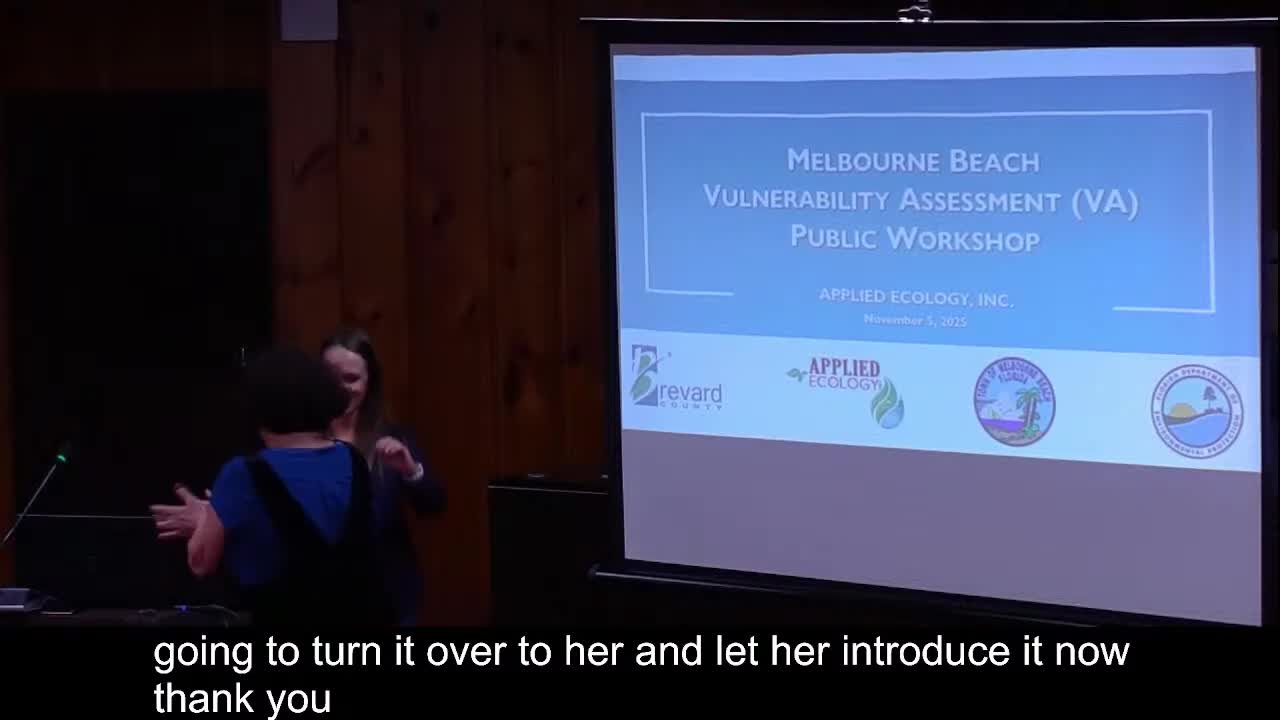
Interim Town Manager Lisa Frazier opened the meeting, saying, "This evening we're talking about our vulnerability assessment," and noted the county-facilitated grant that brought the consultants to the town at no cost. Kelsey Mack, an environmental scientist with the project team who said she is a Melbourne Beach resident, summarized the assessment's purpose: "We are identifying risks and planning for the future when it comes to impacts from climate change, and storm related, storm related impacts."
Why it matters: the assessment is the first step required by state statute and Florida Department of Environmental Protection (FDEP) guidance to apply for Resilient Florida implementation funding, consultants said. The consultant team described modeling scenarios that will be run for current conditions and future projection years (including 2050 and 2080), coastal and tidal flooding, storm surge and rainfall-driven flooding, and engineering-standard 100-year and 500-year, 24-hour storm events.
What presenters told the town: the assessment will pair an inventory of critical assets with exposure and sensitivity modeling. Mack said the team identified about 1,277 critical assets across four state-defined categories: transportation and evacuation routes; critical infrastructure (stormwater and wastewater systems, utility services); community and emergency facilities (fire, police, community centers, schools); and cultural and natural resources (piers, dune crossovers, historic properties). She also noted potable water infrastructure was excluded from this town inventory because some providers declined to share sensitive data.
On sea-level trends and surge, the consultants showed long-term tide data and USGS lagoon station records and cautioned that the Indian River Lagoon and Atlantic coast demonstrate rising water levels that interact differently with storm surge and rainfall. Mack explained that the town's code currently requires modeling or retention of the first 8 inches of runoff from a 10-year, 24-hour storm and that the assessment will test whether those design standards are adequate under projected changes.
Timing and deliverables: consultants said the team will deliver a gap-analysis and asset-inventory memo to the town soon, with a final exposure-and-sensitivity report targeted for delivery by June; the grant period runs through August. Frazier said the town intends to post materials on its website and incorporate findings into capital planning and grant applications.
Residents pressed for immediate fixes during public comment, citing specific, recurring flooding. One resident described a recent storm with "6 inches of rain" that produced "3 feet of standing water outside our front door," adding that manhole covers were insufficient to drain the area and that water drains from county systems overload the town system. The resident identified Cedar Lane (Basin 10) as a repeated problem. Frazier said Basin 10 had become a management priority, that an engineer was scheduled to visit the area and that staff and commissioners were discussing near-term responses.
On grant uses: presenters said FDEP grants typically fund specific capital projects submitted in an application, and awards can support localized projects (for example, stormwater or wastewater upgrades) or regional-scale interventions depending on the application and available funds. The consultants cited recent local awards: Satellite Beach (about $5 million for emergency facilities), Titusville (about $2 million) and a smaller award for Cape Canaveral stormwater improvements.
Public engagement: the county-led scope includes two public meetings for Melbourne Beach. Consultants asked participants to mark locations on maps where theyhave observed flooding so the modeling can be "ground-truthed" with local knowledge.
Next steps: staff and consultants will finalize the asset inventory and modeling, publish deliverables for public review, and use the findings to prioritize adaptation projects and to apply for implementation funding that could support stormwater, wastewater or facility-hardening projects identified in the assessment.
Don't Miss a Word: See the Full Meeting!
Go beyond summaries. Unlock every video, transcript, and key insight with a Founder Membership.
30-day money-back guarantee
Sponsors
Proudly supported by sponsors who keep Florida articles free in 2025

