Grass Valley Council selects downtown oblong roundabout with right‑in/right‑out at South Auburn
November 06, 2025 | Grass Valley, Nevada County, California
This article was created by AI summarizing key points discussed. AI makes mistakes, so for full details and context, please refer to the video of the full meeting. Please report any errors so we can fix them. Report an error »
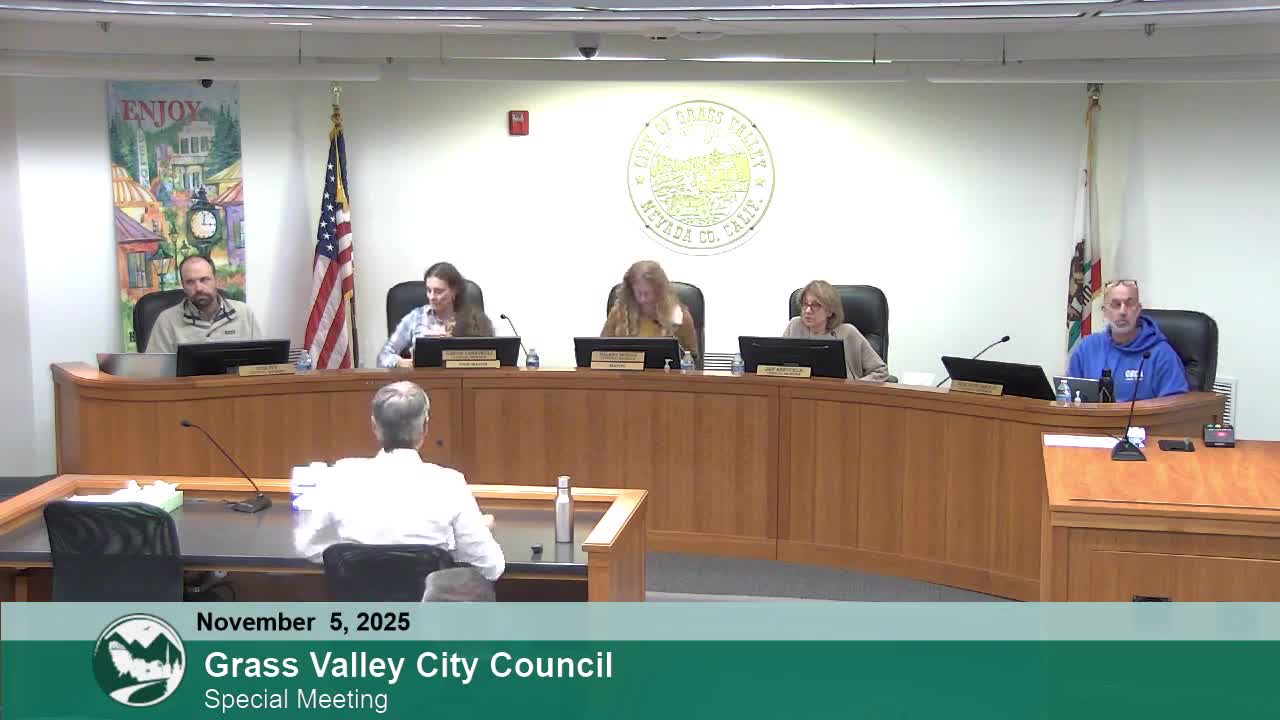
The decision came during a special meeting called to consider refinements to a roundabout design previously included in an intersection analysis adopted in 2020. City Engineer Bjorn Jones told the council the project is fully funded by an Active Transportation Program grant of about $5,300,000 and additional CMAQ funds, and that the funds are earmarked specifically for a roundabout at the triangle intersection. "We were awarded funding over 5,300,000 to fund the complete project," Jones said while summarizing the project history and current PAED (Project Approval and Environmental Documentation) phase. Staff said environmental clearance is expected to be required by September 2026 and that construction is currently forecast for 2028, though schedule risk remains.
Why it mattered: the downtown triangle involves seven closely spaced approaches and has been identified in prior studies as a high‑accident corridor. The council faced a choice between keeping the signalized/grant‑approved layout (Option 1), switching to a stop‑controlled variant (Option 2), or adopting a smaller‑footprint Alternative 5 that would prevent left turns at one approach in exchange for simpler roundabout geometry and potentially lower cost and right‑of‑way impacts.
What staff presented: GHD consultants and city staff reviewed five alternatives and the pros and cons of each. Staff described Option 1 as fully analyzed and Caltrans‑approved but complex and potentially expensive; Option 2 as the least disruptive change that still aligns with the grant concept; and Option 5 as a smaller, simpler footprint that would require public outreach because the right‑in/right‑out would change certain travel patterns, particularly for southbound traffic on South Auburn. Staff recommended council select either Option 2 or Option 5 so the city can continue with environmental review and design.
Council questions and technical details: council members pressed staff about the grant schedule, bicycle and pedestrian accommodations, accessibility for people with visual impairments, and whether the Option 5 sketch had been fully modeled. Staff and GHD said the project intends to provide a 10‑foot shared pedestrian/bicycle trail around the roundabout perimeter and that tactile paving and push‑button crossing aids are being considered for visually impaired pedestrians; audible pedestrian signals are typically reserved for multi‑lane roundabouts. GHD stated Option 5 had been sketched and appears functional but had not been subjected to the same level of traffic simulation as Options 1 and 2. NCTC Executive Director Mike Woodman reminded the council that environmental milestones are programmed by fiscal year and that the city has requested extensions; he also described overlapping State Route 49 projects and urged coordination of contractors.
Public comment: more than a dozen commenters spoke. Business groups and downtown stakeholders asked for strong construction management, night work where feasible, and robust wayfinding to protect merchants. Residents offered mixed views: some favored roundabouts for flow and speed reduction; others warned the design could be confusing, increase use of the Safeway parking lot for turnarounds, or create new pedestrian safety issues. Multiple speakers emphasized accommodating bicycles, people with disabilities, and clear signage for visitors who do not know local streets.
Council deliberation and vote: council members debated tradeoffs between predictability (Option 2) and a simpler single‑roundabout geometry (Option 5). Several members urged stronger outreach and more signage; others emphasized the need to meet grant timelines. A motion to approve Alternative 5 carried 3–2. Minutes and the motion record show the council also directed staff to validate traffic modeling for Option 5, develop a construction management plan (including an expectation of significant nighttime work where feasible), and prepare detailed signage, accessibility and outreach plans during the design phase.
What’s next: staff will proceed with the PAED process for the selected alternative, revalidate traffic studies as needed, develop construction phasing and a traffic management plan, and present design details (signage, pedestrian accommodations, landscaping) during the design phase. NCTC and city staff said they will pursue schedule extensions with the California Transportation Commission as required to keep the grant allocation intact.
Don't Miss a Word: See the Full Meeting!
Go beyond summaries. Unlock every video, transcript, and key insight with a Founder Membership.
30-day money-back guarantee
Sponsors
Proudly supported by sponsors who keep California articles free in 2025

