Public commenters and OPIC push TCEQ to recognize schools, hospitals and churches as "affected persons" in concrete batch-plant permits
November 06, 2025 | Commission on Environmental Quality(TCEQ), Departments and Agencies, Executive, Texas
This article was created by AI summarizing key points discussed. AI makes mistakes, so for full details and context, please refer to the video of the full meeting. Please report any errors so we can fix them. Report an error »
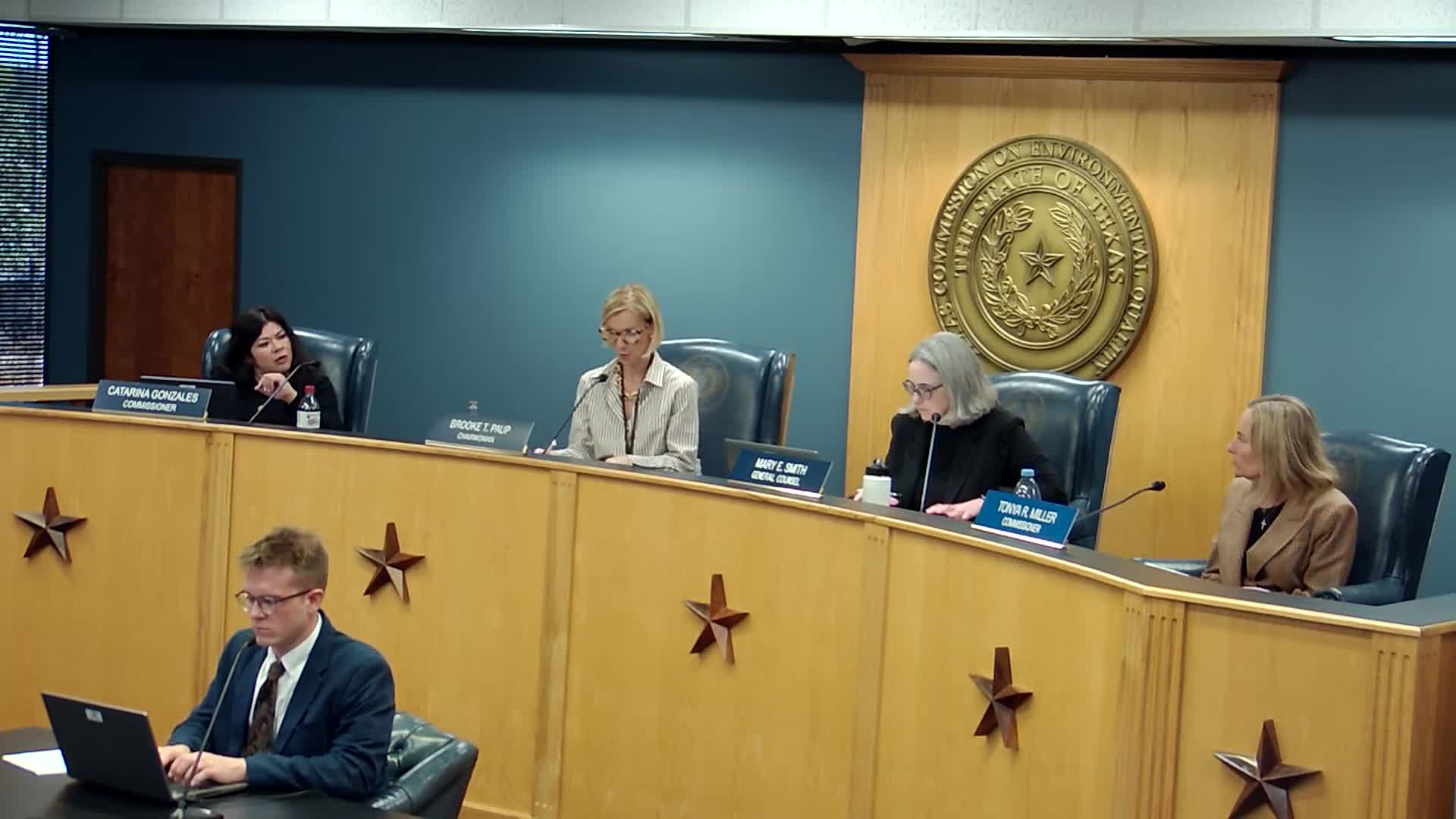
Garrett Arthur of OPIC said the written report, prepared under Texas Water Code section 5.2725, evaluates the office's performance and budget needs and offers legislative or regulatory recommendations. "The written report before you is intended to satisfy this statutory requirement for fiscal year 2025," Arthur said.
A steady stream of commenters told commissioners that current rules leave vulnerable institutions with limited ability to seek contested-case hearings when potential sources of airborne emissions open near schools, daycares, hospitals and churches. Laura Colangelo, executive director of the Texas Private Schools Association, urged recognition of schools as affected persons when a concrete batch plant applies for a permit, noting the current radius-based test often excludes schools whose student populations travel from broader areas.
"For schools, the initial permitting process is the first and best opportunity to protect student health and safety," Colangelo said. She and others pointed to regulatory gaps that allow certain temporary batch plants to operate without new public notice, and argued those gaps can leave students and other sensitive populations without recourse.
The Texas Catholic Conference of Bishops, represented by Jenny Andrews, urged the same change for churches, childcare facilities and hospitals. "A hospital located within 440 yards of a proposed plant may reasonably fear that particulate matter would harm patients," Andrews said.
Parents, physicians and local leaders gave personal accounts. Mary Andrew, a parent whose kindergartner attends school adjacent to a batch plant, described tracking "sight, smells, and sounds" during drop-off and pickup and urged parity between protections for homes and schools. Gabrielle Hatton, a physician, described seeing severe pulmonary distress in patients and said she fears similar impacts for children attending schools near batch plants.
Public Citizen's Texas office and commercial-real-estate representatives also backed OPIC's recommendation. Catherine Guerra of Public Citizen urged the commission to consider OPIC reports as early warnings; Michael Renna and Austin Baker described community anxiety and operational burdens introduced when such facilities open near schools.
Commissioners thanked staff and members for the comments. One commissioner noted OPIC's performance measures have not been updated since 2012 and directed the general counsel to work with OPIC and the executive director to revisit OPIC's performance measures and to initiate a rulemaking to better define the office's role.
The report itself required no commission action at the meeting. Several commenters acknowledged that changes would require legislative action; the commission recorded public support and directed staff to pursue internal rulemaking on OPIC's role and performance measures.
No formal changes to the concrete batch-plant permitting rules were adopted at the meeting; commenters and OPIC recommended legislative or rule changes to expand affected-person status and close notice gaps.
View the Full Meeting & All Its Details
This article offers just a summary. Unlock complete video, transcripts, and insights as a Founder Member.
30-day money-back guarantee
Sponsors
Proudly supported by sponsors who keep Texas articles free in 2025

