Baltimore council committee presses for clearer police accountability data and stronger civilian oversight
November 05, 2025 | Baltimore City, Baltimore County, Maryland
This article was created by AI summarizing key points discussed. AI makes mistakes, so for full details and context, please refer to the video of the full meeting. Please report any errors so we can fix them. Report an error »
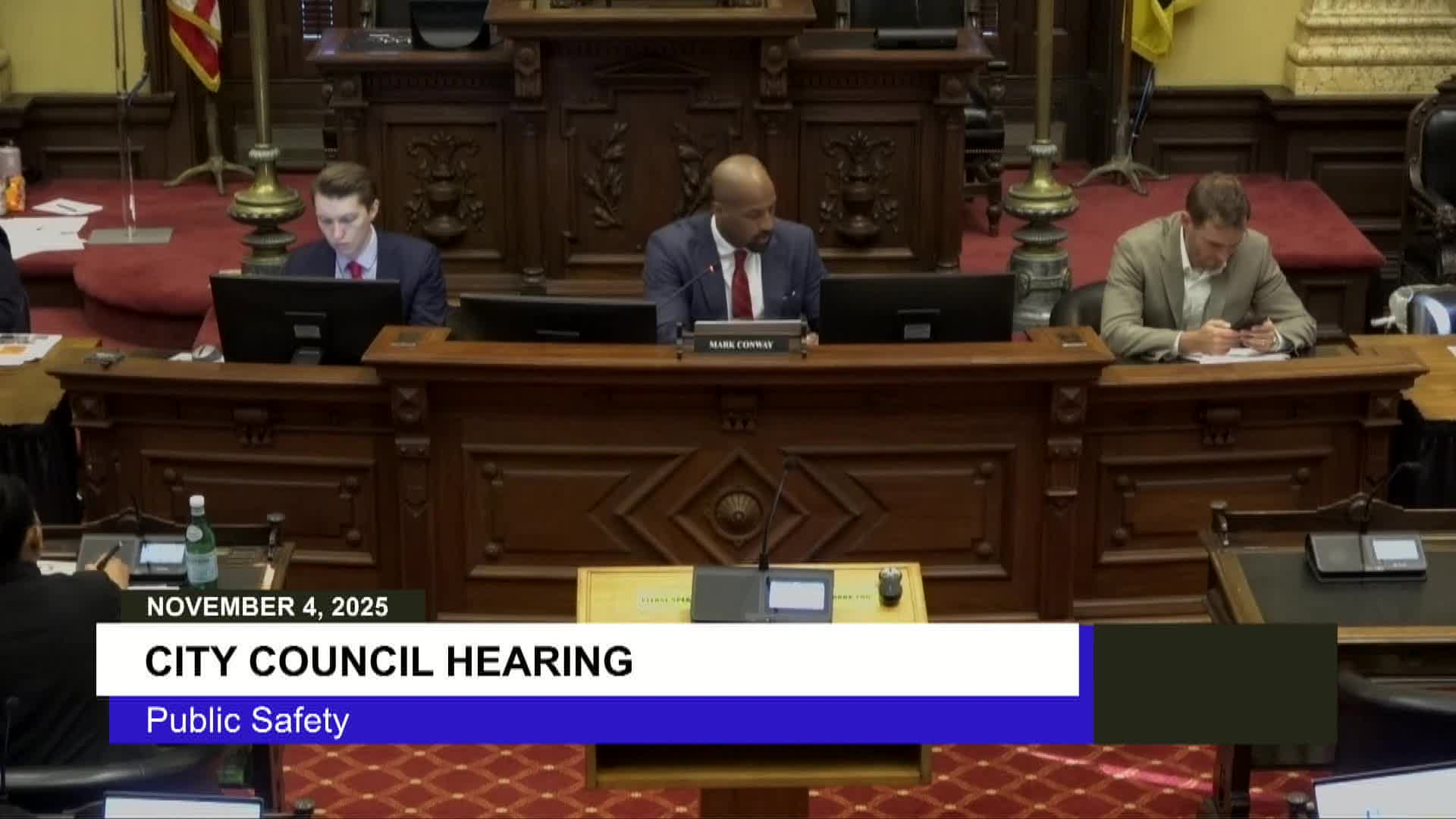
Committee Chair Mark Conway said the hearing was intended to review L.O.25-0036 and "identify options to strengthen police accountability and increase transparency regarding accountability procedures." He warned that "when trust is exhausted, when the bank runs empty, our beloved city is liable to erupt," and said citizen oversight is "the cornerstone of Baltimore's police reforms."
Why it matters: Council members pressed officials for a single, traceable dataset and clearer timelines so the public and council can see whether recommended discipline is carried through. Without unified data linking complaints, ACC charging decisions, trial-board outcomes and department-imposed discipline, council members said they cannot tell how many officers were disciplined, how many appeals were filed, or whether discipline produced changes in behavior.
What officials said: Jasmine Riggins, a member of both the PAB and ACC, said oversight must have "legal independence from the law department to the extent possible, and operational independence from the office of equity and civil rights." Riggins warned that oversight bodies can be "structurally undermined" when a single mayoral administration controls appointing authority and administrative functions.
OECR Director Amber Green disputed several of the committee's assertions about withheld data and delayed work, saying OECR provided memos and follow-up meetings and that the office "does work in partnership" with the PAB and ACC. BPD Deputy Commissioner Brian Neto described the intake and adjudication flow: PID classification, investigation, supervisory and legal review, then either the Disciplinary Review Committee (for non-public cases) or the ACC (for cases involving members of the public), and, where requested, a subsequent trial board.
Key numbers presented (as discussed in the hearing): committee members and agency officials repeatedly referenced year-to-date 2025 figures. BPD said there were 959 ACC-eligible complaints reported calendar year-to-date, 675 officers with complaints and 286 officers with two or more complaints. BPD reported the ACC heard about 974 cases year-to-date; OECR said for FY25 the ACC heard 1,190 cases and administratively charged 758, and that 320 members accepted ACC-recommended discipline while 321 elected trial boards. Committee members also referenced reporting that about 488 trial boards remain pending across the system.
Timelines and process friction: Officials said statutory timelines were recently adjusted. OECR described a 334-day investigatory period for law enforcement agencies to complete an investigation and transfer a case to the ACC, with the ACC allowed additional time (up to an allotment described in statute) to request follow-up and reach a charging decision. BPD said the average time for an investigation to completion across types of cases is roughly 235 days; OECR cited its own 30-day prep clock for case files to the ACC and an average OECR turnaround of about 21 days for processing cases.
Evidence and body-worn cameras: Committee members raised the consequences of missing video evidence. BPD officials said most body-worn camera issues are "late activations" rather than deliberate deactivations and that the department audits recordings; BPD and OECR staff said the number of complete non-activations is very small. ACC and OECR staff said late activation or missing footage can materially affect the ability to charge or prove misconduct in some cases.
Legal authority and subpoenas: Members asked whether the ACC can compel additional investigation or issue subpoenas when it deems evidence missing. OECR, ACC and BPD representatives explained that the ACC has statutory authority to request further investigation and subpoenas, but council members requested a formal written opinion from the Law Department clarifying how that authority is executed in practice and whether and how the city solicitor's dual roles create conflicts.
Requests and next steps: The committee made formal data requests, including a unified dataset linking complaints and outcomes across agencies; a breakdown of average processing time by allegation category; a list of officers with multiple complaints and their hiring jurisdictions; examples where OECR requests to BPD were not fully satisfied; and a written legal clarification from the Law Department on subpoena authority and counsel roles. No formal council action or vote was taken at the hearing.
Broader context and outlook: ACC Chair Tiara Hawkes told the committee the system is relatively new and will produce uneven results during implementation, but said ACC members meet weekly and work with OECR and BPD to resolve issues. Several council members said they support stronger civilian oversight but want statutory, procedural and technical fixes so the PAB, OECR and ACC can operate with timely data and the practical independence needed to sustain public trust.
Ending: The committee recessed after one public speaker and directed staff to follow up on the data and legal clarifications the hearing requested, including the unified dataset and Law Department opinion on subpoena authority.
View the Full Meeting & All Its Details
This article offers just a summary. Unlock complete video, transcripts, and insights as a Founder Member.
30-day money-back guarantee
Sponsors
Proudly supported by sponsors who keep Maryland articles free in 2025

