West Warwick council authorizes study of residential lot-size rules, asks staff to probe setbacks and subdivision risks
November 05, 2025 | West Warwick , Kent County, Rhode Island
This article was created by AI summarizing key points discussed. AI makes mistakes, so for full details and context, please refer to the video of the full meeting. Please report any errors so we can fix them. Report an error »
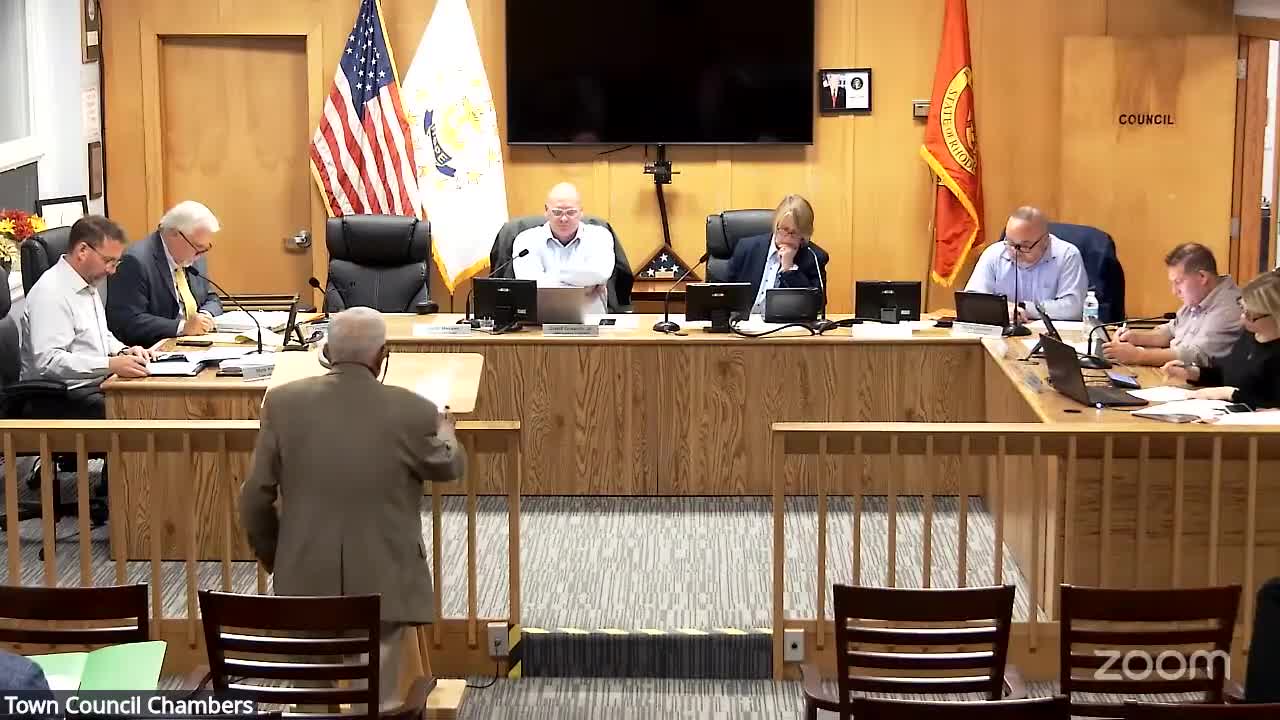
Council member Al asked the council Nov. 4 to let staff examine changes to how the town classifies residential lots and to report back with options, including possible setbacks for accessory structures and protections against over‑subdivision.
Al said the current scheme "is something we've come up with and we're the only community to have it" and noted the town's zoning text dated to 1965 and revised in 1993. He proposed reclassifying lots by actual lot size (for example, 0–7,500 square feet as the smallest band, 7,500–10,000 as a second band and >10,000 as a third) so that rules would follow the parcel rather than the zone in which it lies.
The request prompted sustained pushback from council members concerned the change could let owners of large lots subdivide and "cram" multiple 5,000‑square‑foot houses into neighborhoods now characterized by larger lots. Council member David Gosselin warned that a 40,000‑square‑foot parcel could be split into many 5,000‑square‑foot buildable lots under the proposed banding and said, "I can throw 7 houses around me now. I'm leaving the town. I don't care. I left 7 houses and left my neighborhood in shambles." (Remark attributed to David Gosselin in the transcript.)
Speakers pressed for more detail on the interplay between town rules and state law. Staff and other council members discussed narrower approaches such as adjusting setbacks for sheds and accessory buildings, placing targeted moratoria, or distinguishing rules for new construction versus existing houses. Tax assessor/town staff noted existing processes (variances, certificates of occupancy) and the need to consider state statutory changes in subdivision law.
Council members did not adopt an ordinance. Instead they authorized staff to research the proposal further, investigate how other municipalities handle similar changes, and return with a report and possible draft language that would include safeguards (for example, subdivision controls, setback adjustments, or moratoria) if needed. Multiple members said they support looking at setbacks for accessory structures but are not in favor of measures that would make it "a lot easier for a lot to be built on."
Al said the current scheme "is something we've come up with and we're the only community to have it" and noted the town's zoning text dated to 1965 and revised in 1993. He proposed reclassifying lots by actual lot size (for example, 0–7,500 square feet as the smallest band, 7,500–10,000 as a second band and >10,000 as a third) so that rules would follow the parcel rather than the zone in which it lies.
The request prompted sustained pushback from council members concerned the change could let owners of large lots subdivide and "cram" multiple 5,000‑square‑foot houses into neighborhoods now characterized by larger lots. Council member David Gosselin warned that a 40,000‑square‑foot parcel could be split into many 5,000‑square‑foot buildable lots under the proposed banding and said, "I can throw 7 houses around me now. I'm leaving the town. I don't care. I left 7 houses and left my neighborhood in shambles." (Remark attributed to David Gosselin in the transcript.)
Speakers pressed for more detail on the interplay between town rules and state law. Staff and other council members discussed narrower approaches such as adjusting setbacks for sheds and accessory buildings, placing targeted moratoria, or distinguishing rules for new construction versus existing houses. Tax assessor/town staff noted existing processes (variances, certificates of occupancy) and the need to consider state statutory changes in subdivision law.
Council members did not adopt an ordinance. Instead they authorized staff to research the proposal further, investigate how other municipalities handle similar changes, and return with a report and possible draft language that would include safeguards (for example, subdivision controls, setback adjustments, or moratoria) if needed. Multiple members said they support looking at setbacks for accessory structures but are not in favor of measures that would make it "a lot easier for a lot to be built on."
View the Full Meeting & All Its Details
This article offers just a summary. Unlock complete video, transcripts, and insights as a Founder Member.
✓
Watch full, unedited meeting videos
✓
Search every word spoken in unlimited transcripts
✓
AI summaries & real-time alerts (all government levels)
✓
Permanent access to expanding government content
30-day money-back guarantee
