Livingston council approves expansion of automated license-plate readers after debate on privacy and oversight
November 05, 2025 | Livingston City, Merced County, California
This article was created by AI summarizing key points discussed. AI makes mistakes, so for full details and context, please refer to the video of the full meeting. Please report any errors so we can fix them. Report an error »
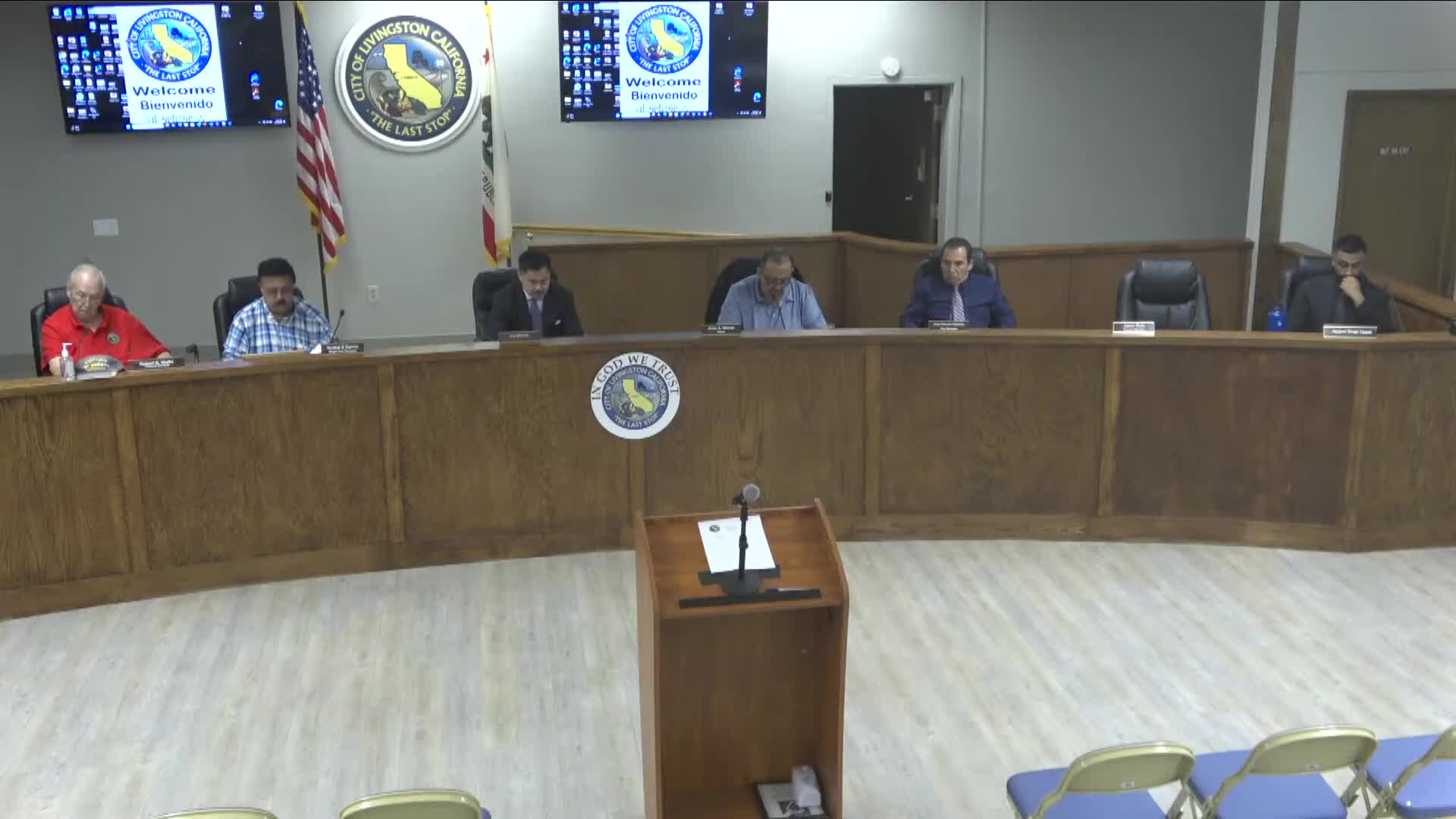
The vote authorizes the city manager to enter a 36-month agreement with Flock Safety for additional fixed ALPR cameras and associated services, with an initial fiscal-year appropriation of $30,000 and an overall three-year not-to-exceed amount of $90,000 as presented by staff and the vendor.
The council heard a detailed presentation from Lily Ho, public affairs manager at Flock Safety, and Chief John Ramirez of the Livingston Police Department. Ho described the system's operation (solar-powered cameras mounted on poles that capture license-plate images), privacy features (no facial recognition, optional retention period, end-to-end encryption) and integrations with law-enforcement databases. Chief Ramirez said the system provides objective, actionable evidence and supports investigations; he described current configuration limits, administrator controls and sharing restrictions.
Opponents in council and the public raised civil-liberties concerns. Council member Uphol (City Council member) questioned normalization of surveillance and the potential for misuse, citing national examples where plate-reader data was used against individuals who were later cleared. Uphol said, "We don't have to use the number 100... but I do have an ideological stance against surveillance." (first reference: Council member Uphol, City Council member). Patricia Zamora of Seventh Gen Art House and other residents urged attention to community supports and not to rely on technology alone.
Supporters said the system has helped solve crimes and is integrated with the department's evidence systems. Council member Wallace (City Council member) said the cameras have produced positive results locally and voiced support for continuing the program. Chief Ramirez and Flock representatives explained administrative safeguards, a public transparency portal that logs searches and sharing, and a default 30-day camera-image retention that the city can change.
Council members negotiated oversight measures during debate. Council required ongoing auditing and reporting: the system's audit trail (who searched what and why) must be published to the transparency portal and staff agreed to regular reports on contracts and usage. The council also placed a 50-mile default sharing radius for local agency access and said that sharing beyond that radius would require administrative approval.
The motion to approve the contract passed 3-1. Council member Uphol cast the sole dissenting vote.
The city manager and police department will implement the contract provisions, set the retention period and configure sharing and audit settings; the council asked for periodic reports on usage and audits.
Provenance: The discussion and vote are recorded in the Nov. 4 council transcript beginning when item 8.1 was introduced and during extended public and council comment that led to the roll call vote (see transcript blocks at 02:40:17 and 03:34:45).
View the Full Meeting & All Its Details
This article offers just a summary. Unlock complete video, transcripts, and insights as a Founder Member.
30-day money-back guarantee
Sponsors
Proudly supported by sponsors who keep California articles free in 2025

