Council approves streamlined outreach contracts as city shifts more homelessness engagement in‑house
November 05, 2025 | San Jose , Santa Clara County, California
This article was created by AI summarizing key points discussed. AI makes mistakes, so for full details and context, please refer to the video of the full meeting. Please report any errors so we can fix them. Report an error »
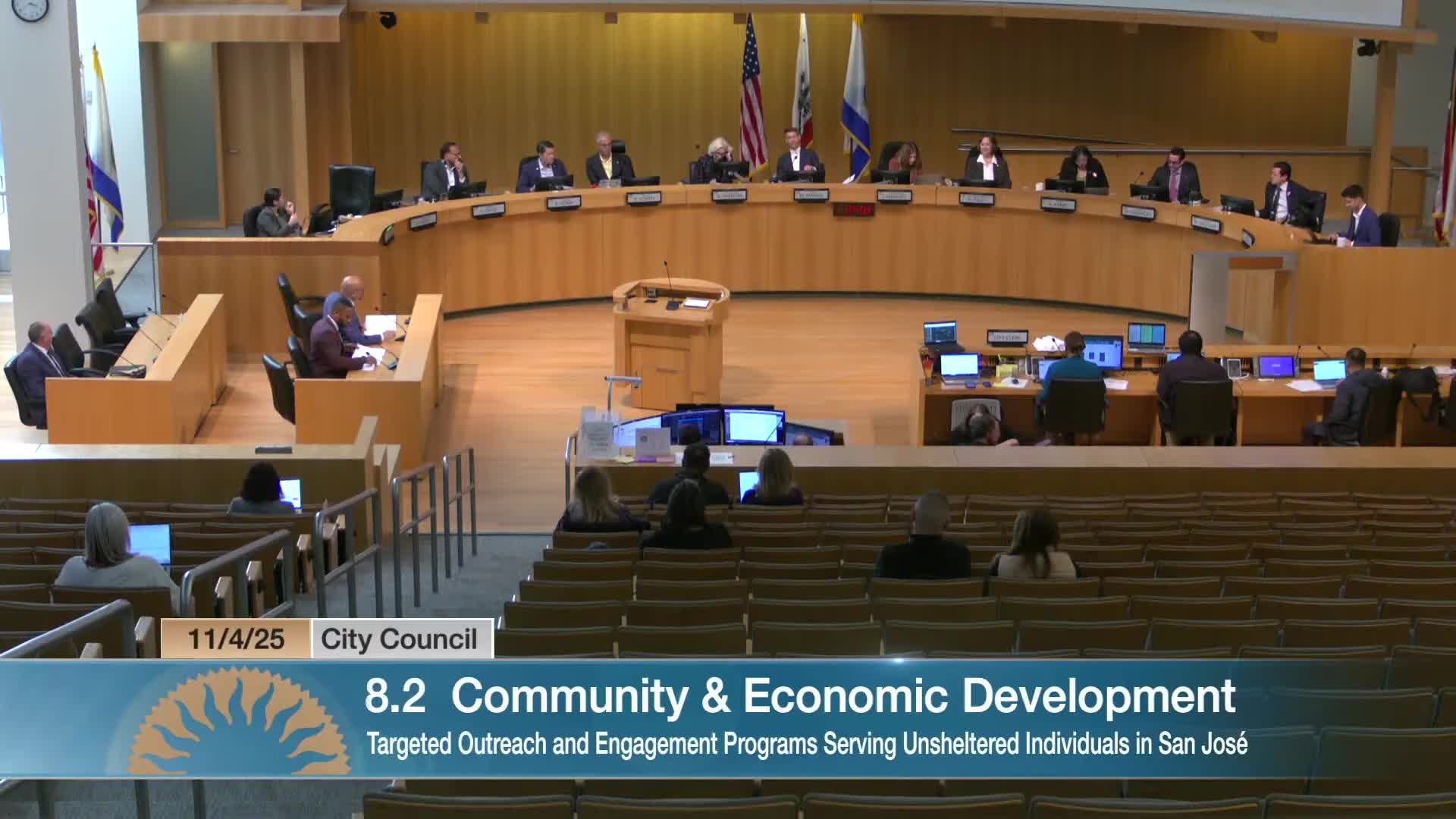
Housing Department staff described a strategic shift from heavier reliance on contracted outreach toward a blended model that keeps some functions with outside partners while expanding internal outreach capacity. "As we shift from building out additional shelter capacity towards maintaining an effective, efficient, and outcome driven system," Director of Housing Eric Solihuan said, the city will prioritize data, deployment and decision making to maintain high occupancy and match outreach to available shelter beds.
Deputy Director of Housing Cupid Alexander outlined results from the prior contract period: the outreach program reached 2,225 individuals, completed more than 28,000 outreach sessions, and recorded 866 transitions from street engagement into shelter, housing or reunification. Staff also reported a sustained occupancy rate of roughly 96% across 20 emergency interim housing sites.
Because the city does not operate the county HMIS database, staff said they are building supplementary tracking to meet council data requests and improve analysis of migration flows, program resistance, and service needs. City staff emphasized that more in‑house capacity will let the city standardize data entry and provide closer coordination with police, public works and county partners for deploying teams to high‑need areas such as downtown.
Council discussion touched on humane enforcement, reasonable accommodations, and avoiding displacement into other districts. Councilmember Campos called for clear protocols and training on reasonable accommodations and handling of personal belongings consistent with the recent audit of the city's coordinated homeless response. Staff said ADA accommodation decisions are primarily handled by internal teams but that contractors are trained to support the process when needed.
Councilmember Campos moved to accept staff recommendations and the motion passed unanimously.
What the city approved
- Grant agreements to continue targeted outreach and engagement services with a smaller contracted footprint while expanding internal outreach teams; the overall contracted amount before this action was reduced from roughly $8.6 million (April 2024 period) to about $3.0 million in the current phase, reflecting a shift in strategy and staffing. (Motion: Councilmember Campos; Vote: adopted unanimously.)
Key implementation notes and metrics cited by staff
- Outreach engagements: 2,225 people reached; 28,000+ outreach sessions completed.
- Outcomes: 866 people moved from street engagement to shelter, housing or reunification; 1,050–1,450 participants are targeted through the coming site openings and deployment plan.
- System utilization: ~96% occupancy across 20 emergency interim housing sites; over 1,500 active interim beds in the system.
- Data and systems: City will supplement HMIS reporting with additional, council‑directed tracking because HMIS is administered by the county and has constraints on what fields can be added.
Provenance: topic introduced at 02:19:20 (transcript block starting 8360.2295) and concluded with the unanimous council vote at 02:52:15 (transcript block starting 10335.205).
View the Full Meeting & All Its Details
This article offers just a summary. Unlock complete video, transcripts, and insights as a Founder Member.
30-day money-back guarantee
Sponsors
Proudly supported by sponsors who keep California articles free in 2025

