Alabama SBI describes drones’ role in crime scene mapping, search and rescue
November 05, 2025 | Joint Interim Committees, Alabama Legislative Sessions, Alabama
This article was created by AI summarizing key points discussed. AI makes mistakes, so for full details and context, please refer to the video of the full meeting. Please report any errors so we can fix them. Report an error »
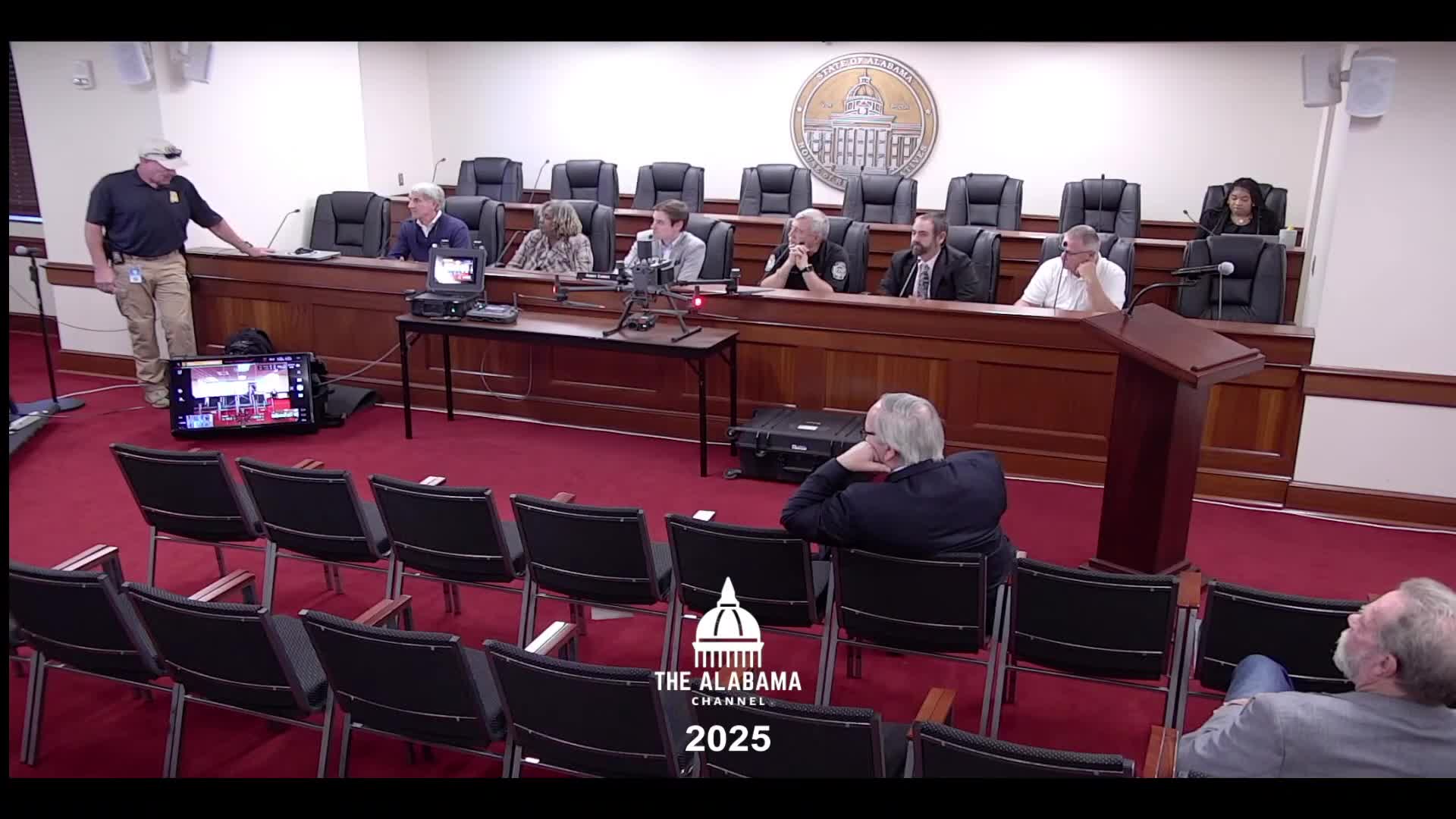
"We run about 2,100 to 2,200 law enforcement missions a year," Hamilton said, identifying DJI platforms as the program’s primary hardware and noting the unit has 23 sworn operators and 46 drones covering all 67 counties.
Hamilton described a range of missions: traffic‑homicide investigations that previously took four to six hours but now can be processed in 20–30 minutes, SWAT overwatch, search and rescue, narcotics investigations and large‑event traffic management. He said drones reduce officer exposure on highways and preserve transient evidence such as skid marks and other surface impressions that wash away over time.
Hamilton outlined technical workflows used in prosecutions and reconstruction: combining exterior drone mapping with interior FARO scanner captures, storing flight metadata in the bureau’s GIS (pilot, lat/long, duration), and producing scaled maps that are "within centimeters of accuracy." He described sensor payloads in current use, including thermal/FLIR cameras, long‑range zooms and laser range finders, and said some enterprise platforms have flight endurance of roughly 40 minutes.
Hamilton showed detection statistics for Montgomery: he reported 352 launches in a month inside a five‑mile radius, 13,000 in a year, and 26,000 over five years within a 35‑mile radius — figures he used to underscore the density of local drone activity and the need for mitigation options. He described a detection system that reports transmitter location and the drone’s home point, and he described a "geo parking lot" mitigation concept that would guide errant aircraft to land so operators can be educated and have equipment returned.
Hamilton also walked the committee through courtroom and operational examples — interstates cleared faster after drone mapping, night‑time searches using thermal imaging, and storm damage assessments streamed to emergency management — and stressed training and human factors: "A lot of departments buy a drone and it sits in a closet because they were never trained to begin with."
The committee asked how long the current fleet could operate if foreign‑made platforms were restricted; Hamilton said the answer depends on parts and battery availability and that obsolescence could render some aircraft inoperable when batteries or spares are no longer available. The committee directed staff to assemble findings for the January legislative session.
Ending: The committee did not take policy action at the hearing; it asked staff to deliver a report to the legislature when it convenes in January.
Don't Miss a Word: See the Full Meeting!
Go beyond summaries. Unlock every video, transcript, and key insight with a Founder Membership.
30-day money-back guarantee
Sponsors
Proudly supported by sponsors who keep Alabama articles free in 2025

