Committee advances ‘growth corridor boulevard’ designation and emphasizes pedestrian safety on University Boulevard
November 04, 2025 | Montgomery County, Maryland
This article was created by AI summarizing key points discussed. AI makes mistakes, so for full details and context, please refer to the video of the full meeting. Please report any errors so we can fix them. Report an error »
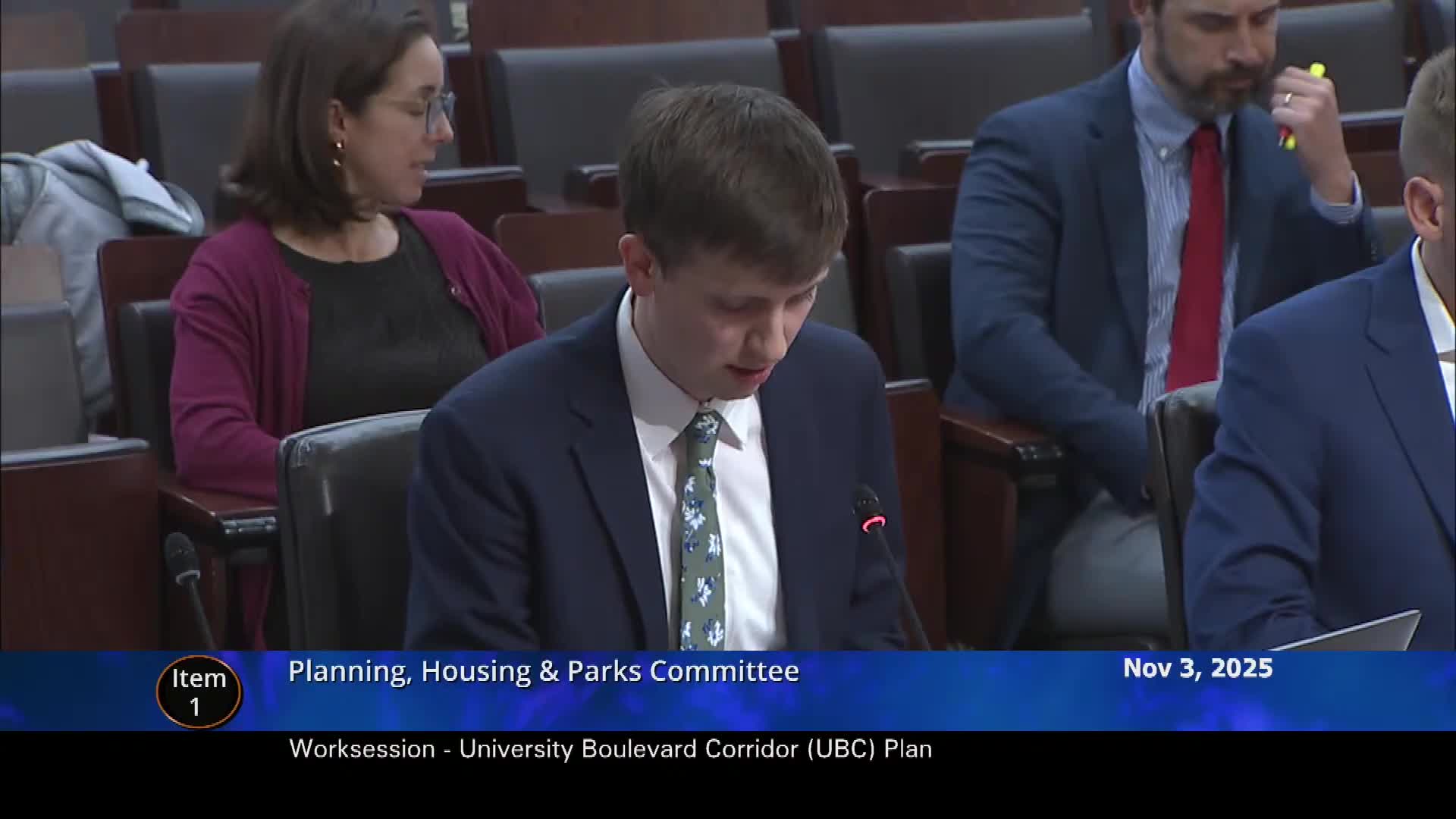
Committee members and staff framed the change as a design‑led approach focused on pedestrian safety. Mr. Kenny, transportation staff, told the committee the designation carries several characteristics—‘‘high to moderate residential mixed‑use or retail, high to moderate pedestrian activity, premium transit service, infrequent driveways and frequent street trees’’—and that the designation sets a lower target speed (30 mph versus the current 35 mph) and shorter distances between protected crossings.
Councilmember Fanning Gonzales welcomed the recommendation and emphasized its safety purpose, saying, ‘‘they're having way too many people who have not just getting hurt by crossing University Boulevard, but die by crossing University Boulevard.’’ Councilmember Mink also endorsed reducing speeds and adding protected crossings.
Staff and members discussed the relationship between the proposed street classification and zoning. Planning staff said the causal relationship is primarily one‑way: zoning changes (a ‘‘vast majority’’ of segments zoned moderate and high density) would justify the growth corridor boulevard designation, but the designation itself does not automatically change zoning. Alex Rixey, Transportation Planning Division, explained that the designation informs design and implementation choices and that many of the features draw on the Complete Streets design guide.
The committee asked MCDOT to clarify operational implications, noting that the designation is a design and policy cue that directs future capital projects and redevelopment review. Staff told members the recommendation would move forward and that MCDOT would be asked to comment on implementation details and on timing and funding in subsequent packets.
What happens next: committee members asked staff to return with more implementation details, including funding paths and MCDOT comments on how the safety elements would be operationalized in this corridor. The item remains a staff recommendation and has not been voted into law at this meeting.
Don't Miss a Word: See the Full Meeting!
Go beyond summaries. Unlock every video, transcript, and key insight with a Founder Membership.
30-day money-back guarantee
Sponsors
Proudly supported by sponsors who keep Maryland articles free in 2025

