Committee narrows approach to new street connections; favors pedestrian‑only paved trails for several links
November 04, 2025 | Montgomery County, Maryland
This article was created by AI summarizing key points discussed. AI makes mistakes, so for full details and context, please refer to the video of the full meeting. Please report any errors so we can fix them. Report an error »
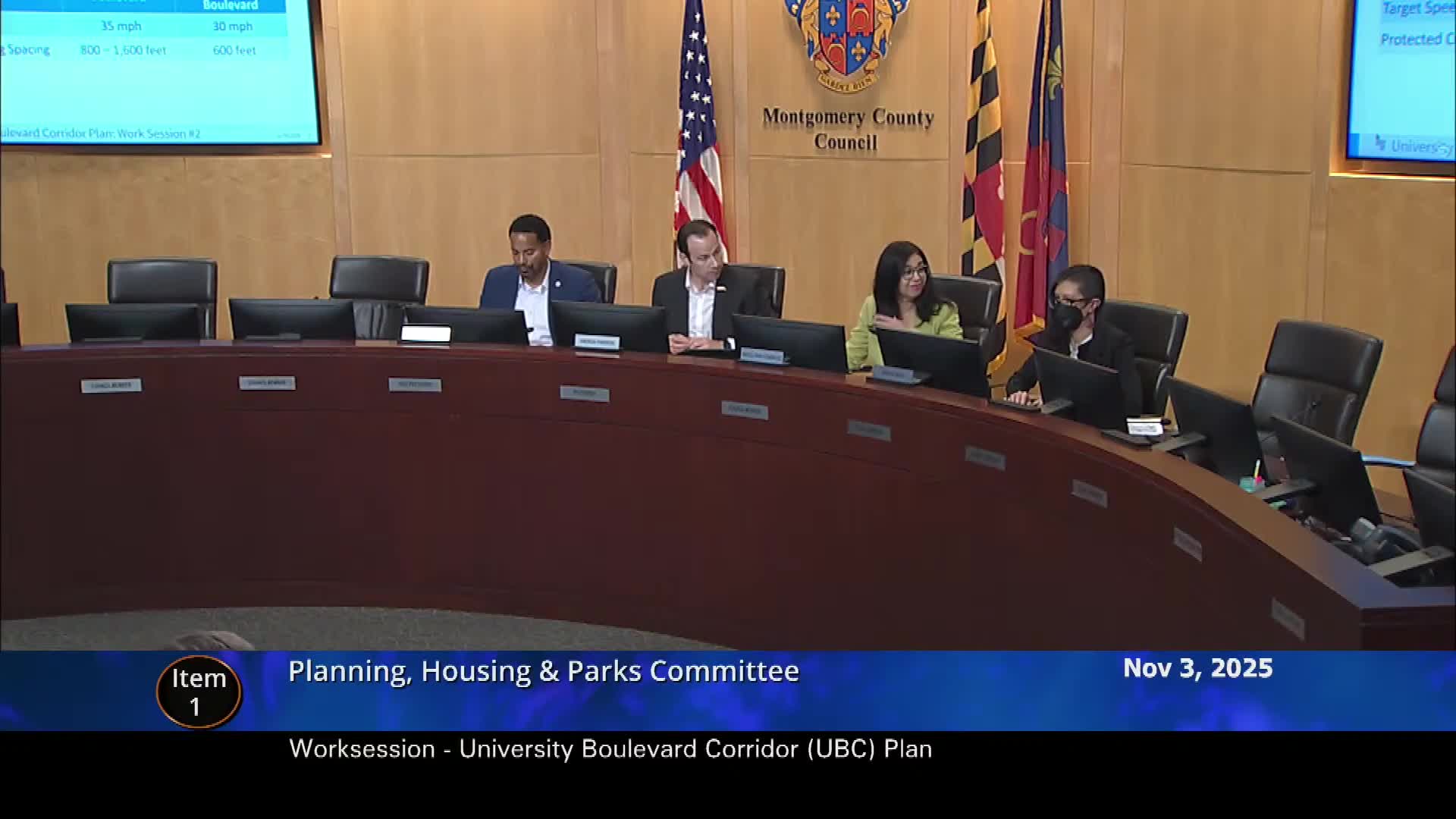
Staff said these connections would be built at the time of redevelopment and that where vehicle access raised safety concerns, the committee could recommend pedestrian‑and‑bicycle‑only connections instead. Alex Rixey (Transportation Planning Division) stated, “all of these recommendations in this section... would happen with redevelopment.” Corey Pitts (MCDOT) said his division had done a high‑level review of cut‑through potential and agreed with staff where connections are expected to be stubs rather than full through routes.
The committee reviewed specific sites: Markwood/Dayton; Nicholas/Palmander/Glen Park; Tenbrook/Access Road; Orange Drive; Greenock Road and Royalton Road; Gilmore Drive segments; and Breewood/Whitehall/Whitehall‑Gilmore links. On Tenbrook and one of the Tenbrook stub connections staff and MCDOT concluded a cut‑through was unlikely because the proposed link would dead‑end and tie into a trail. For several other locations—most notably Greenock/Royalton and the proposed Gilmore extensions—committee members worried that creating vehicular through‑connections would invite cut‑through traffic by routing non‑local drivers onto narrow neighborhood streets.
After debate the committee gave directions: confirm intersection realignments that are clearly redevelopment‑driven (Markwood, Nicholas, Eisner), confirm Tenbrook/Access Road and Orange Drive as redevelopment stubs, and for Greenock/Royalton and the parallel Gilmore/Dennis/Dallas/Burnett connections convert the recommendation to paved pedestrian/cyclist‑only connections pending staff follow‑up. Jessica McVerry (East County Plan Division) noted these connections can be paired with driveway consolidation during redevelopment to shift access off University Boulevard onto a parallel street where appropriate.
What happens next: staff will prepare revised plan language for the Nov. 10 work session that (a) clarifies the redevelopment trigger language, (b) spells out where paved pedestrian connections are preferred in place of vehicular through‑streets, and (c) provides evidence from MCDOT on cut‑through analysis for Gilmore and other contested links.
View the Full Meeting & All Its Details
This article offers just a summary. Unlock complete video, transcripts, and insights as a Founder Member.
30-day money-back guarantee
Sponsors
Proudly supported by sponsors who keep Maryland articles free in 2025

