4 Corners debate: committee rejects automatic bus‑lane presumption, asks for pedestrian‑first redesign and clearer language on Arcola right‑turns
November 04, 2025 | Montgomery County, Maryland
This article was created by AI summarizing key points discussed. AI makes mistakes, so for full details and context, please refer to the video of the full meeting. Please report any errors so we can fix them. Report an error »
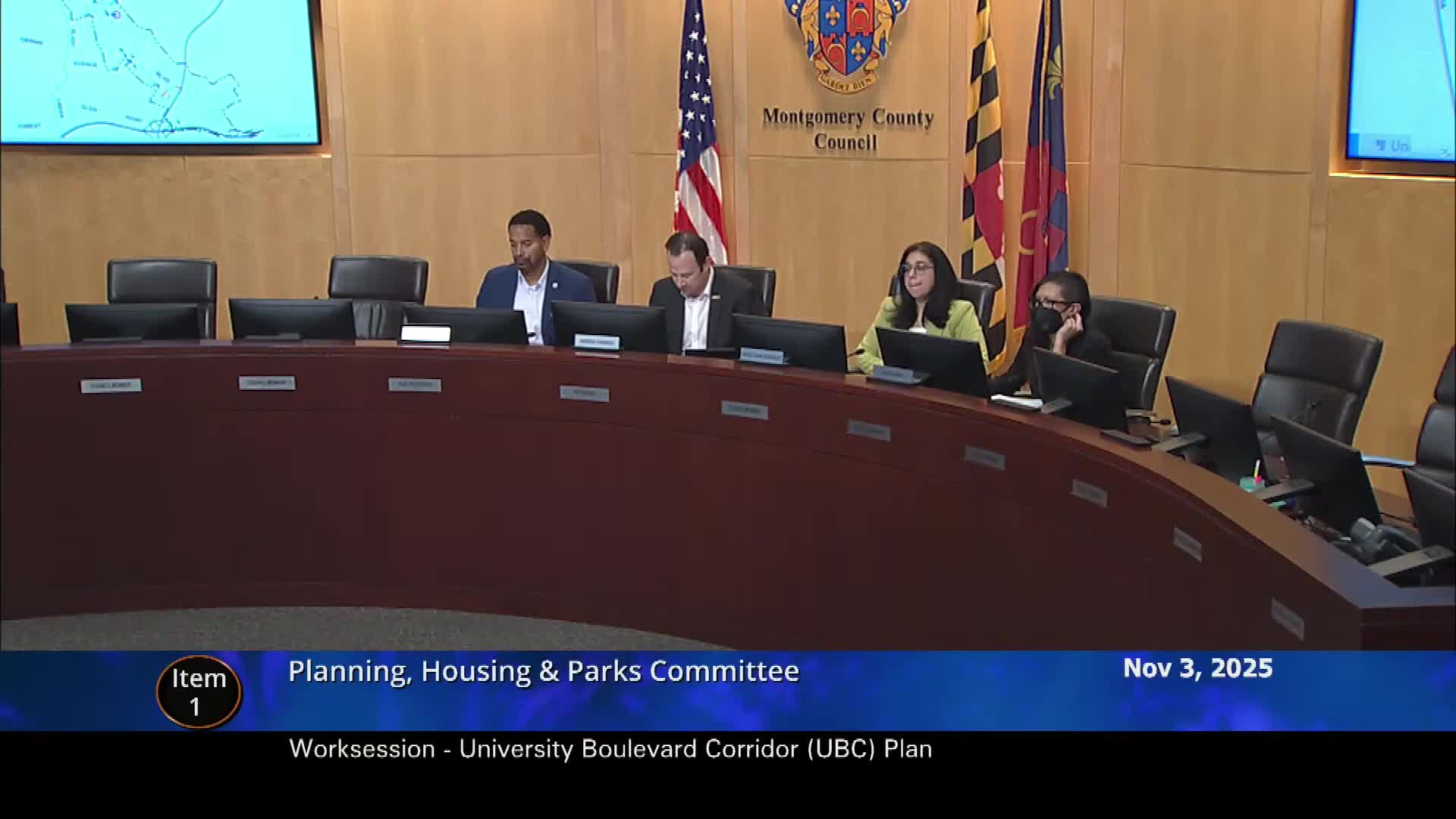
The planning board draft recommends preserving or adding dedicated bus lanes through 4 Corners (consistent with an earlier 2013 transit corridors approach) and building phase 1/2 incremental improvements. The public hearing draft instead proposed repurposing an existing travel lane in each direction to provide a wider pedestrian breezeway (sidepath) and street tree buffer without acquiring additional right‑of‑way.
MCDOT noted both options would increase travel times slightly but that the ‘‘limited change’’ lane‑repurposing approach was estimated in past analysis to add roughly 8–11 seconds on average through the 4 Corners area during peak hours. Planning staff and environmental staff underscored the need for wider street buffers (6–8 feet) to establish a viable tree canopy and to create a safer walking environment: "we need the soil volume... if you have smaller areas, the trees... don't tend to survive," said Steve Findlay (environment and climate division).
After extended discussion the committee accepted revised staff language directing planning and transportation staff to "evaluate options to improve transit performance through 4 Corners." The language now enumerates potential tools—"transit signal priority or relocating bus stops"—but removes an instruction to repurpose general travel lanes to bus‑only lanes at this stage. The committee also asked staff to return with comparative images of 4‑ to 8‑foot buffers, examples elsewhere in the county, and a lane‑diet analysis showing practical tradeoffs for sidewalks, buffers and tree planting.
Channelized right turns: the committee also took up recommendations to remove or reconfigure channelized right‑turn lanes countywide where they reduce pedestrian safety. Staff recommended clarifying the plan language so it prioritizes reconfiguration that improves safety (squaring off channelized returns to a right angle) while allowing DOT to retain a turning lane where removing it would ‘‘significantly impair public safety.’’ Planning staff and MCDOT said they prefer language that puts safety first and leaves operational judgments to DOT during project design.
What happens next: staff will provide the committee with side‑by‑side images of different sidewalk and buffer widths, a lane‑diet analysis showing expected changes in travel time and right‑of‑way impacts, and edited plan language that replaces ambiguous footnotes with clear text on how channelized rights at Arcola will be handled.
View the Full Meeting & All Its Details
This article offers just a summary. Unlock complete video, transcripts, and insights as a Founder Member.
30-day money-back guarantee
Sponsors
Proudly supported by sponsors who keep Maryland articles free in 2025

