Lafayette council approves fee for nonemergency lift assists at residential care facilities after debate
November 04, 2025 | Lafayette City, Tippecanoe County, Indiana
This article was created by AI summarizing key points discussed. AI makes mistakes, so for full details and context, please refer to the video of the full meeting. Please report any errors so we can fix them. Report an error »
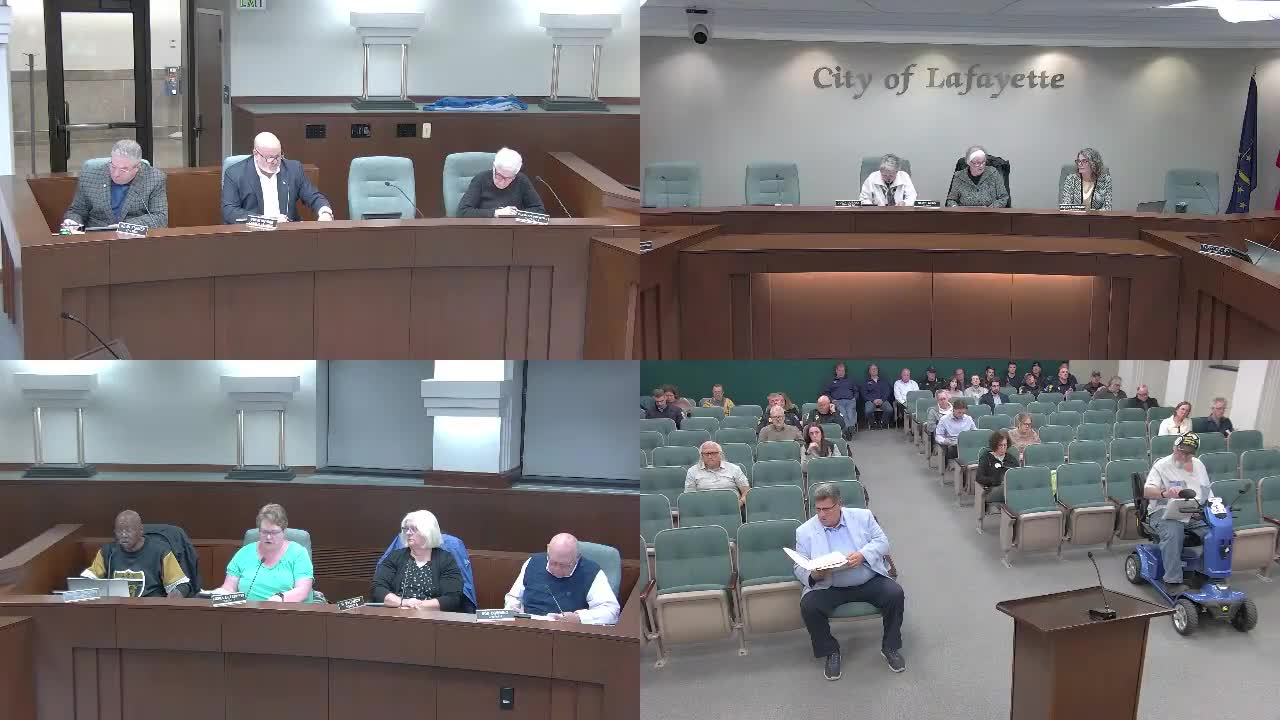
Chief Michael Alcar, Lafayette Fire Department, told the council the ordinance responds to repeated calls to nursing homes and assisted-living facilities for lift assists — incidents in which staff ask firefighters to help lift or move a resident when the facility has existing equipment and trained staff. "This ordinance was brought to me by several firefighters," Chief Alcar said, describing the measure as a way to support firefighters and discourage facilities from relying on first responders for nonmedical lifting tasks.
Captain Tim Francovich, Lafayette Fire Department, said from his experience most residential care facilities have Hoyer lifts and staff trained to use them and that the frequency of lift-assist calls rose during the COVID period. "I've not had one that I felt the staff could not have handled this on their own," Francovich said. He described situations where crews were dispatched to calls that, in his view, the facility staff could have managed.
At the meeting a council member voiced concern that a $500 fee would be an unfair burden on residents of these facilities, noting many residents are low- or fixed-income. That council member said, "$500 is too much money to charge." Another council member framed the ordinance as a deterrent to prevent facilities from abusing emergency responder resources and protect firefighters from avoidable risks.
The ordinance text presented to council applies the fee to nonemergency lift assists at residential care facilities and specifically excludes in-home residential lift assists for private residences, according to staff remarks at the meeting.
Clerk-conducted roll call showed the ordinance passed with the following votes: Plinker — yes; Snyder — yes; Weese — yes; Brown — yes; Ehlersmeyer — yes; Williamson — no; Downey — yes. The council did not record a motion or second in the transcript excerpt; the clerk proceeded to a roll call vote after public comment and council discussion.
The council did not adopt a waiver or reduced-fee provision during the vote; implementation details, including final fee schedule, training or enforcement procedures, and whether facilities could appeal or request exemptions, were not specified in the meeting record.
Don't Miss a Word: See the Full Meeting!
Go beyond summaries. Unlock every video, transcript, and key insight with a Founder Membership.
30-day money-back guarantee
Sponsors
Proudly supported by sponsors who keep Indiana articles free in 2025

