Roselle trustees review 2026 ‘maintenance’ budget; agree to pursue streaming tax, higher video‑gaming fee and use reserves instead of extra property tax
November 04, 2025 | Roselle, DuPage County, Illinois
This article was created by AI summarizing key points discussed. AI makes mistakes, so for full details and context, please refer to the video of the full meeting. Please report any errors so we can fix them. Report an error »
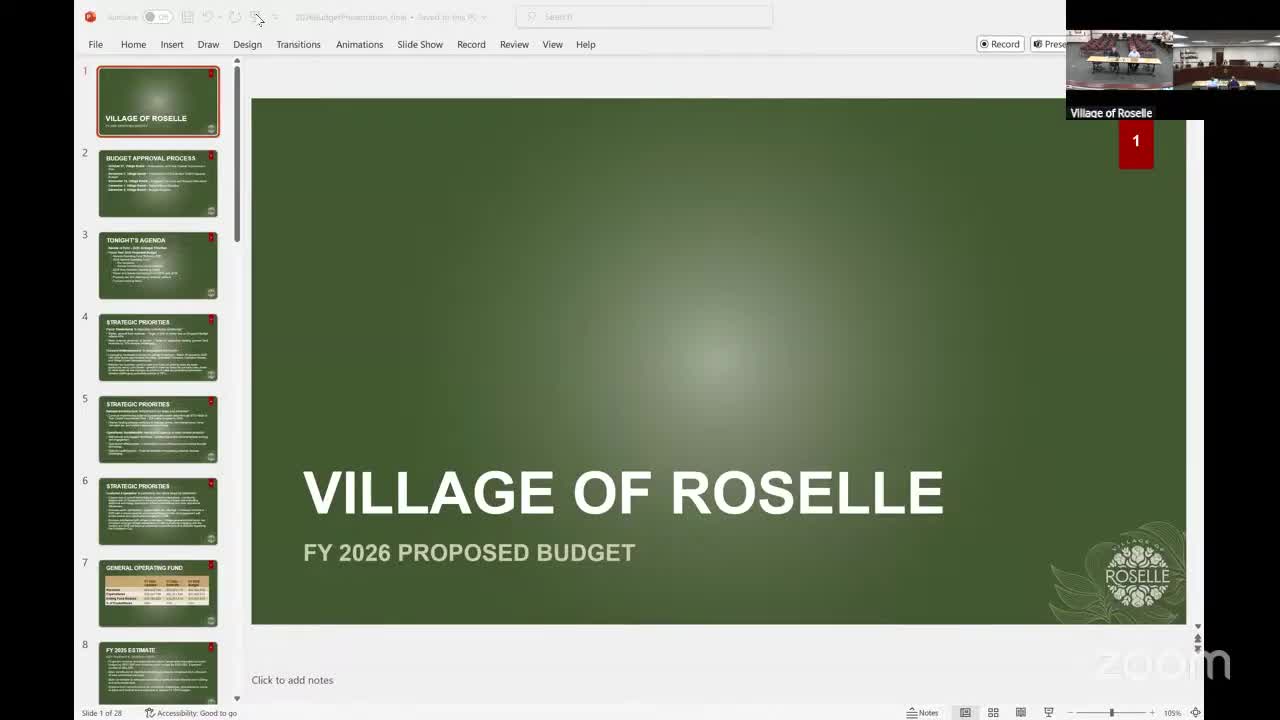
"The budget does kinda require some difficult decisions by the board to maintain services and meet your strategic goals," said Jason Bialowski, the village administrator, as he opened the presentation. Bialowski said staff used a strategic approach focused on organizational efficiency and noted the proposed plan includes no new programs or additional headcount.
Why it matters: trustees heard that personnel costs — wages, health insurance and pension obligations — drive most of the year‑over‑year increase. Staff said the proposed budget would rely in part on expanded local revenue streams rather than deep cuts to services and that those choices will affect core operations such as police, fire and public works.
Key numbers and assumptions
- Staff reported about a $980,000 (roughly 4%) increase in total expenditures from the 2025 adopted budget to the 2026 proposal, with about 80% of that increase attributable to nondiscretionary personnel‑related costs. The village general‑fund balance is projected to fall from about 45% to 43% under the current proposal.
- The 2025 year‑end estimate shows a small surplus (~$52,000) driven by vacancies and reduced contract spending; staff cautioned some revenue lines are lower than prior expectations (state shared sales tax, building and ambulance fees).
- The packet includes a departmental scorecard and an adopted $110 million five‑year capital improvement program; water and wastewater five‑year projects total about $26 million in the CIP presentation.
Revenue options staff proposed
- Expand the amusement tax to explicitly cover streaming and similar online amusements and raise the rate from 3% to 5%. Staff estimated the change would yield about $120,000.
- Increase the video‑gaming terminal fee from the prior benchmark to $750 per terminal; staff estimated roughly $50,000 in additional revenue.
- Increase building and permit revenues based on expected development activity (staff modeled an $80,000 increase in permit revenue). Other options discussed included a dedicated stormwater utility fee, use of additional home‑rule sales tax and dipping into general‑fund reserves.
"Doing those two — increasing the rate and expanding the definition — is resulting and showing an additional $120,000 in revenue," Bialowski said of the amusement tax modification.
Trustee reaction and board direction
Trustees expressed differing views on tax increases. Several trustees said they were reluctant to raise permanent property tax levels beyond PTELL (the Property Tax Extension Limitation Law) and favored using reserves or other temporary measures while staff provides additional analysis.
Trustee Cheryl (last name not specified in the record) said, "I would like to utilize reserve," referring to the board’s preference to use reserves rather than immediately levy an additional $250,000 in property tax. Trustee discussion also emphasized the tradeoffs of hiring freezes: vacancies produce short‑term savings but can increase overtime and burnout.
Consensus items and follow‑up
- The board expressed support to move forward with drafting an ordinance to expand the amusement tax to include streaming and to increase the rate to 5% (trustees polled generally in favor).
- Trustees also signaled support for raising the video‑gaming terminal fee (staff will model $750 per terminal for comparison with neighboring communities).
- On the $250,000 in additional property tax beyond PTELL, the board favored using general‑fund reserves for 2026 while asking staff to return a plan that includes alternatives and targeted expense reviews for 2027.
Staff requests and next steps
Trustees asked staff for several follow‑ups before final budget adoption: a variance/driver analysis that explains large compound annual growth rates in certain departments since 2021; a breakdown of recurring IT costs (finance director Tom Dahl noted annual Microsoft licensing is about $40,000); examples from other municipalities on implementing a streaming/amusement tax; and a line‑item list of current vacant positions to inform any hiring‑freeze discussion. The board tentatively scheduled an additional meeting on Dec. 1 if needed and set Dec. 8 as the budget adoption hearing.
What the budget does not do
The proposed budget, as presented, does not add new full‑time positions and does not make sweeping program cuts; staff described it as aimed at sustaining existing service levels while addressing structural imbalances.
Looking ahead
Bialowski told trustees that larger, longer‑term projects — including ERP (enterprise resource planning) upgrades, potential radio replacement obligations for public safety and water/sewer capital needs tied to the CIS cap — could require future funding beyond what the 2026 maintenance budget covers. The board asked staff to prepare options and a time line for more detailed operational review in early 2026.
"We can kind of realign on what are our service delivery expectations and what would that impact the budget for then," Bialowski said, summarizing the staff expectation to return with more detailed analyses.
The village will publish the revised budget scorecard and follow‑up materials ahead of the Dec. 8 adoption meeting.
Don't Miss a Word: See the Full Meeting!
Go beyond summaries. Unlock every video, transcript, and key insight with a Founder Membership.
30-day money-back guarantee
Sponsors
Proudly supported by sponsors who keep Illinois articles free in 2025

