Water Quality Advisory Board urges regional coordination, funding plan and septic‑system inspections
November 03, 2025 | Teton County, Wyoming
This article was created by AI summarizing key points discussed. AI makes mistakes, so for full details and context, please refer to the video of the full meeting. Please report any errors so we can fix them. Report an error »
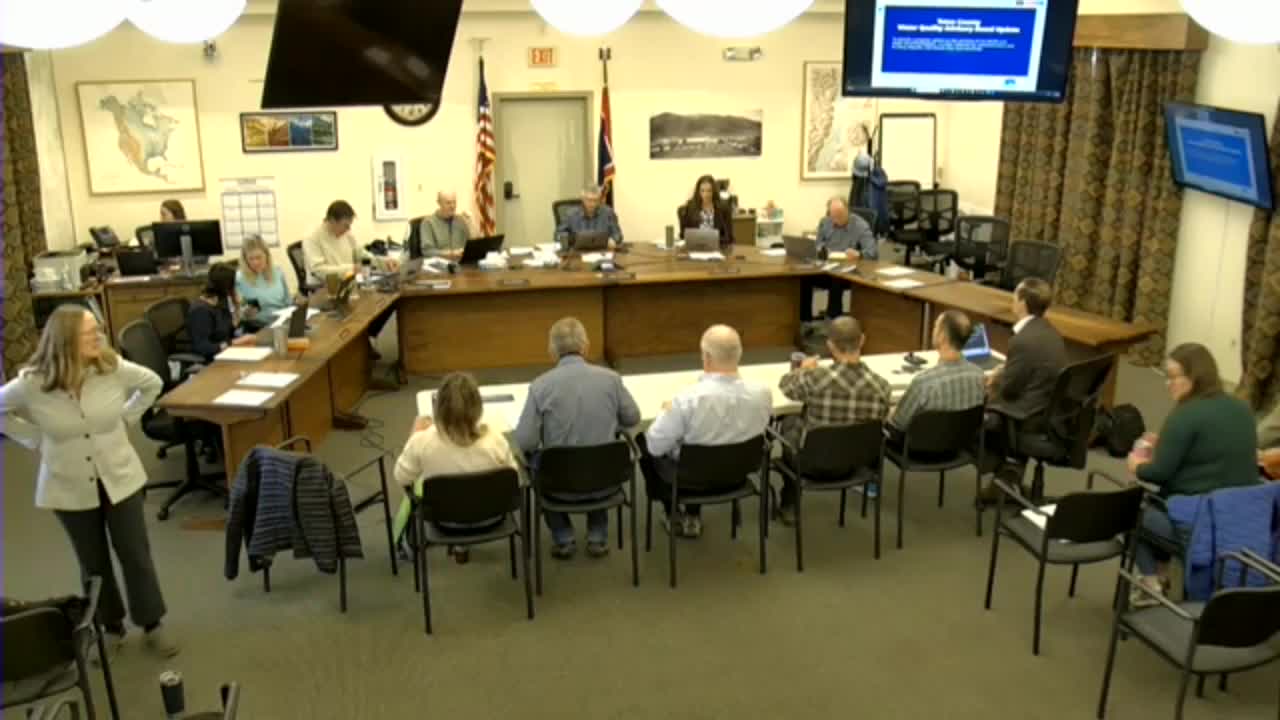
The Teton County Water Quality Advisory Board (WQAB) presented a progress update to the county commissioners and urged that the county pursue longer‑term regional coordination of wastewater infrastructure while moving forward with near‑term actions on specific projects, funding and septic‑system oversight.
Chris Peltz (county staff) and John Martin (vice chair, Water Quality Advisory Board) summarized the board’s role: to assist staff with strategic priorities, review and strengthen project proposals, recommend funding approaches and provide a public venue for technical discussion. The board described a five‑element scoring matrix—environmental benefit, community impact, financial considerations, regulatory alignment and operational feasibility—used to evaluate proposals and to guide applicants toward additional funding sources rather than act as a simple yes/no filter.
John Martin told the commissioners, “We have two iconic streams that are impaired here in Teton County. Flat Creek and Fish Creek should not be impaired, not in an area like Teton County.” He and other board members described thousands of septic systems countywide (the board identified several thousand and noted about 300 likely “ghost” systems not in current databases) and recommended stronger oversight. The board reported that, in April, it passed a motion to “strongly support requiring an operating permit and inspection of all existing and future septic systems in Teton County.” Staff said Title 9 (small wastewater facility rules) is under revision and that implementing a countywide inspection and permitting program will require additional personnel and funding.
The board discussed regionalization: members said the county’s roughly 17 separate water and sewer districts create fractured, ad‑hoc decision making and recommended a long‑term move toward a regional authority or other coordination mechanism. The board and staff emphasized that a regional approach should not delay near‑term projects; projects already proposed should proceed even as the county studies governance options.
Funding and priorities
Board members and commissioners discussed scale: the WQAB estimated a minimum funding need in the order of hundreds of millions of dollars to implement all recommendations, with board members suggesting $100 million to $200 million as a plausible scale. The panel flagged state financing tools such as the State Revolving Fund (SRF), which board members said could be paired with county contributions to leverage limited local funds. The board also highlighted one near‑term proposal: support for Hoback Water and Sewer District’s funding application (the board recorded unanimous support and cited private and conservation district contributions that leveraged county funds).
Impaired streams and restoration planning
County staff described ongoing work on impaired water bodies: Flat Creek and Fish Creek are listed for water‑quality impairments. Teton Conservation District, working with the Wyoming Department of Environmental Quality, is drafting an advanced restoration plan under the Clean Water Act Section 303(d) process; the plan will identify best management practices and will be evaluated over time before any required TMDL (total maximum daily load) is imposed.
Next steps and staff resource needs
Board members asked for clearer direction from commissioners about priorities and trade‑offs. County staff and the board requested a follow‑up memo identifying where commissioners see priorities (for example, whether to emphasize Title 9 changes, regional governance work, or financing analysis). Staff cautioned that implementing inspections, permitting and monitoring will require dedicated staff or contracted technical services and budget allocations. The board recommended further work on public finance education and discussions with state funding partners to lay a foundation for longer‑term capital and operational financing.
Chris Peltz (county staff) and John Martin (vice chair, Water Quality Advisory Board) summarized the board’s role: to assist staff with strategic priorities, review and strengthen project proposals, recommend funding approaches and provide a public venue for technical discussion. The board described a five‑element scoring matrix—environmental benefit, community impact, financial considerations, regulatory alignment and operational feasibility—used to evaluate proposals and to guide applicants toward additional funding sources rather than act as a simple yes/no filter.
John Martin told the commissioners, “We have two iconic streams that are impaired here in Teton County. Flat Creek and Fish Creek should not be impaired, not in an area like Teton County.” He and other board members described thousands of septic systems countywide (the board identified several thousand and noted about 300 likely “ghost” systems not in current databases) and recommended stronger oversight. The board reported that, in April, it passed a motion to “strongly support requiring an operating permit and inspection of all existing and future septic systems in Teton County.” Staff said Title 9 (small wastewater facility rules) is under revision and that implementing a countywide inspection and permitting program will require additional personnel and funding.
The board discussed regionalization: members said the county’s roughly 17 separate water and sewer districts create fractured, ad‑hoc decision making and recommended a long‑term move toward a regional authority or other coordination mechanism. The board and staff emphasized that a regional approach should not delay near‑term projects; projects already proposed should proceed even as the county studies governance options.
Funding and priorities
Board members and commissioners discussed scale: the WQAB estimated a minimum funding need in the order of hundreds of millions of dollars to implement all recommendations, with board members suggesting $100 million to $200 million as a plausible scale. The panel flagged state financing tools such as the State Revolving Fund (SRF), which board members said could be paired with county contributions to leverage limited local funds. The board also highlighted one near‑term proposal: support for Hoback Water and Sewer District’s funding application (the board recorded unanimous support and cited private and conservation district contributions that leveraged county funds).
Impaired streams and restoration planning
County staff described ongoing work on impaired water bodies: Flat Creek and Fish Creek are listed for water‑quality impairments. Teton Conservation District, working with the Wyoming Department of Environmental Quality, is drafting an advanced restoration plan under the Clean Water Act Section 303(d) process; the plan will identify best management practices and will be evaluated over time before any required TMDL (total maximum daily load) is imposed.
Next steps and staff resource needs
Board members asked for clearer direction from commissioners about priorities and trade‑offs. County staff and the board requested a follow‑up memo identifying where commissioners see priorities (for example, whether to emphasize Title 9 changes, regional governance work, or financing analysis). Staff cautioned that implementing inspections, permitting and monitoring will require dedicated staff or contracted technical services and budget allocations. The board recommended further work on public finance education and discussions with state funding partners to lay a foundation for longer‑term capital and operational financing.
View the Full Meeting & All Its Details
This article offers just a summary. Unlock complete video, transcripts, and insights as a Founder Member.
✓
Watch full, unedited meeting videos
✓
Search every word spoken in unlimited transcripts
✓
AI summaries & real-time alerts (all government levels)
✓
Permanent access to expanding government content
30-day money-back guarantee
