Houston Police outline mental‑health response: co‑responder teams, outreach and training credited with fewer visible encampments
November 03, 2025 | Houston, Harris County, Texas
This article was created by AI summarizing key points discussed. AI makes mistakes, so for full details and context, please refer to the video of the full meeting. Please report any errors so we can fix them. Report an error »
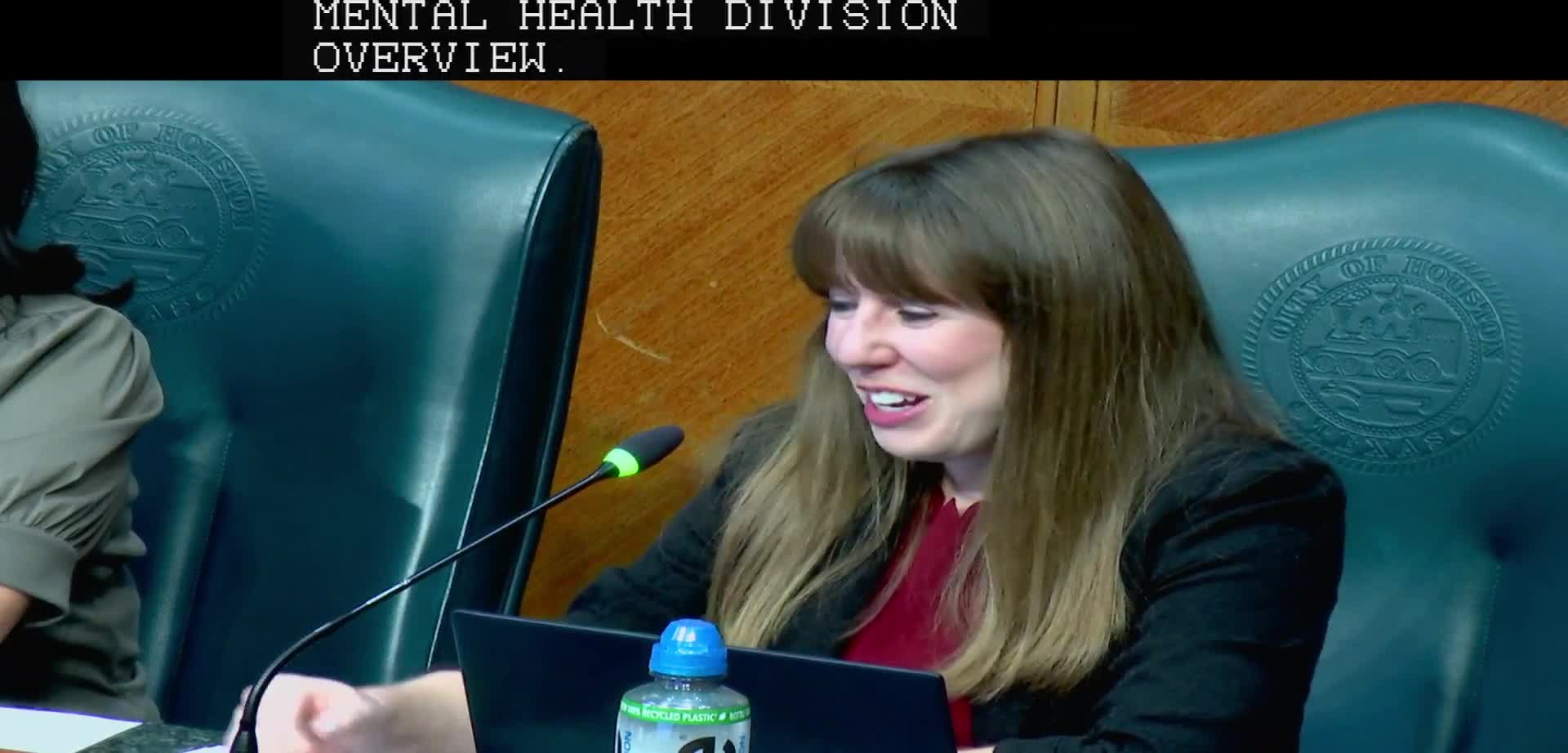
"Neither mental illness nor homelessness are crimes," said Jessica Anderson, executive assistant chief over strategic operations. Anderson introduced Captain Isaac Duplishane, who described the division’s history, operations and partnerships with the Harris Center for Mental Health and IDD.
The division traces its partnership with the Harris Center to 1991 and said it began broad training of officers in the early 1990s. Captain Duplishane said more than 80% of HPD officers are crisis‑intervention‑trained and that the department requires annual recertification for those classes.
The division’s highest‑level response is a Crisis Intervention Response Team, a co‑responder model that pairs an HPD officer with a Harris Center clinician. "Sometimes our mental‑health consumers deal better with clinicians. Sometimes they deal better with the officers," Duplishane said. He described the co‑responder team as able to address scenes where a clinician alone could not safely respond and credited the model with improving outcomes.
Duplishane outlined several programs that operate under the division’s umbrella:
- Homeless Outreach Team: daily outreach to build trust, facilitate identification (HPD provides affidavits of identity), and connect people to housing and services. The team coordinates with patrol and Differential Response Teams (DRTs) and partners in the Coalition for the Homeless.
- Boarding Home Enforcement Detail: enforces a local boarding‑home ordinance via education and inspections, issuing citations only after repeated noncompliance.
- Chronic Consumer Stabilization Initiative (CCSI): a voluntary, co‑case‑management program with the Harris Center that the division said reduces both calls to police and psychiatric hospital days by roughly 70% for participants.
- Senior Justice Assessment Center: a case‑examination unit that coordinates with Adult Protective Services and other agencies to protect elders and vulnerable adults.
- Training Unit: an in‑house crisis‑intervention training program that produces scenario‑based exercises and annual recertification; last year HPD trained five full cadet classes, officials said.
Duplishane said the division is co‑located with the Harris Center, which he described as providing immediate clinician access and facilitating referrals. He noted the division has also trained other agencies and serves as a national learning site for crisis‑intervention programs.
Committee members asked specific questions about program outcomes. Duplishane said outreach teams offer services to roughly 700 people per month, and that about 250–300 accept services in a typical month. On visible homelessness trends, he said the city’s point‑in‑time estimate fell from just under 8,000 in 2011 to roughly 3,300 in the most recent January estimate, which he said represents more than a 65% reduction in visible homelessness since 2011.
Council members also inquired about funding. Duplishane confirmed that the division expanded several programs in 2021 using American Rescue Plan Act (ARPA) funds and that the Harris Center has absorbed some ongoing costs for the crisis call diversion center after ARPA funding ended. He said the diversion center typically handles about 500 calls per month and estimated a total cost per diverted call of roughly $125 when ARPA funding was included; he contrasted that with an approximately $2,000 per‑call figure cited for a separate rapid‑response program.
Committee members asked for more detail and charts, and Duplishane said HPD would provide additional statistics on point‑in‑time counts and ARPA impacts.
Duplishane illustrated training effectiveness with a de‑escalation example involving Sergeant Michael Pulido: Pulido arrived at a scene in which an individual threatened a child with a knife and used de‑escalation tactics to secure a peaceful resolution in under a minute. Duplishane said HPD shows that video in cadet classes as an example of crisis‑intervention training in practice.
The presentation closed after members of the committee praised the division’s work and as members requested supplemental materials and data charts for follow up.
Don't Miss a Word: See the Full Meeting!
Go beyond summaries. Unlock every video, transcript, and key insight with a Founder Membership.
30-day money-back guarantee
Sponsors
Proudly supported by sponsors who keep Texas articles free in 2025

