Austin Emergency Management outlines overhaul of city's emergency plans; committee approves prior minutes
November 03, 2025 | Austin, Travis County, Texas
This article was created by AI summarizing key points discussed. AI makes mistakes, so for full details and context, please refer to the video of the full meeting. Please report any errors so we can fix them. Report an error »
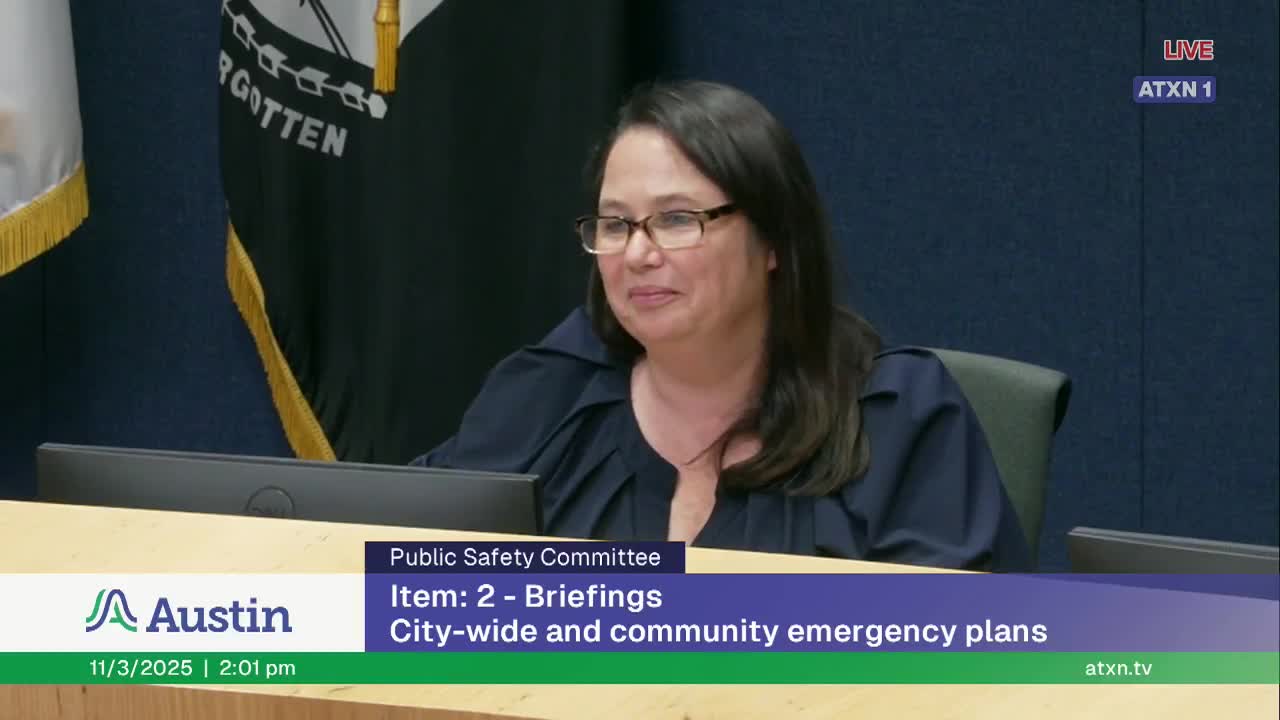
An Austin Emergency Management staff member told the committee the work includes a new City of Austin Emergency Operations Basic Plan as the foundational document, 21 emergency support functions aligned to the National Response Framework, hazard-specific annexes for threats such as wildfire, winter storm, flooding and active threats, and functional annexes that cover actions such as alerts, evacuations and shelter operations. "We're the ones that are committed to doing the legwork, the research, the homework to bring different organizations together...and make sure that we have a one team, one fight approach," the staff member said.
Why it matters: Staff said the changes are intended to make plans actionable during incidents rather than merely procedural. The city will set measurable "capability targets" for functions such as public information and warning and mass care; those targets will be used to identify gaps and guide grant requests, contracts or mutual-aid arrangements so Austin can meet performance objectives during a disaster.
What staff described: The briefing laid out several linked elements:
- The basic emergency operations plan will describe authorities, coordination with county and state partners, and the transition to long-term recovery.
- Hazard-specific annexes will attach to the basic plan and cover specialized needs and protective actions for wildfires, winter storms, floods and active-threat incidents.
- Functional annexes will document cross-cutting responses (for example, the all-hazards protective action plan for evacuation or shelter-in-place operations, and mass-care procedures for food, water and emergency shelter).
- A supporting annex will provide operational details for external partners (for example, how to log into state systems and execute prescribed roles) so outside assisting entities can operate consistently with city expectations.
- Alerting tools and accessibility: staff described WarnCentralTexas (subscription-based) and federal systems — the Integrated Public Alert and Warning System (IPAWS) and the Wireless Emergency Alert system (WEA). Staff noted IPAWS/WEA are subject to FCC constraints on message content and that WarnCentralTexas allows the city to include more detailed incident information. An accessible hazard alert system is planned for Deaf and hard-of-hearing residents.
- Community involvement and living documents: the plans will be posted online as living documents and will incorporate community input and social vulnerability data to help prioritize where to preposition resources after a disaster.
Timeline and next steps: Staff said the draft basic plan provided to the committee in September is nearly finished and that the city plans to finalize and roll it out early next year. Additional annexes (including the wildfire and protective action plans) will be built and released across the following year. Staff expects early-next-year communications on identified capability gaps after department-level assessments, training, exercises and regional validation.
Regional coordination and funding: The staff member said the gap analysis will be used to support requests for Urban Area Security Initiative (UASI) homeland security funding and to align regional planning through CAPCOG and other partners. The staff member said the city will seek to document pinch points and then decide whether to procure equipment, establish contracts or pursue mutual-aid solutions.
Committee questions and follow-up: Councilmember Duchin asked whether Austin's capability targets would be comparable to other cities; staff said historical target capability lists and the Emergency Management Accreditation Program provide baseline guidance but that Austin will set locally appropriate success metrics. Duchin asked whether staff would publish the detailed metrics; staff said the city will share overarching plans widely but may not publish all internal target-setting materials. The committee also asked when gap-analysis results would be shared; staff estimated early next year after department data collection, training exercises and regional coordination.
Other business: Councilmember Deacon proposed a pilot for traffic-enforcement zones and said he would follow up with Austin Police Department staff; the committee agreed to pass the suggestion to the chair for possible placement on a future agenda.
Action recorded: The committee approved the Sept. 22, 2025 Public Safety Committee meeting minutes (motion moved by Councilmember Duchin; seconded by the acting chair). No other formal actions or votes were recorded on the emergency-planning briefing.
Quotes (selected):
"One team, one fight approach" — Austin Emergency Management staff member describing the department's goal for coordinated response.
"We're the ones that are committed to doing the legwork, the research, the homework to bring different organizations together to break down silos of excellence and make sure that we have a unity of effort" — Austin Emergency Management staff member.
Details to watch for: staff said the basic plan is the highest priority for publication and that the city will continue to plan, train and exercise with community groups, NGOs and the private sector to refine capability targets and gap closures. Staff noted the planned addition of an assistant director and a senior planner to complete staffing for the department.
Sources: Presentation and Q&A by Austin Emergency Management staff to the Public Safety Committee of the Austin City Council, Nov. 3, 2025.
Don't Miss a Word: See the Full Meeting!
Go beyond summaries. Unlock every video, transcript, and key insight with a Founder Membership.
30-day money-back guarantee
Sponsors
Proudly supported by sponsors who keep Texas articles free in 2025

