Small seven-unit warehouse proposal flagged for fire, water and drainage requirements
November 04, 2025 | Nassau County, Florida
This article was created by AI summarizing key points discussed. AI makes mistakes, so for full details and context, please refer to the video of the full meeting. Please report any errors so we can fix them. Report an error »
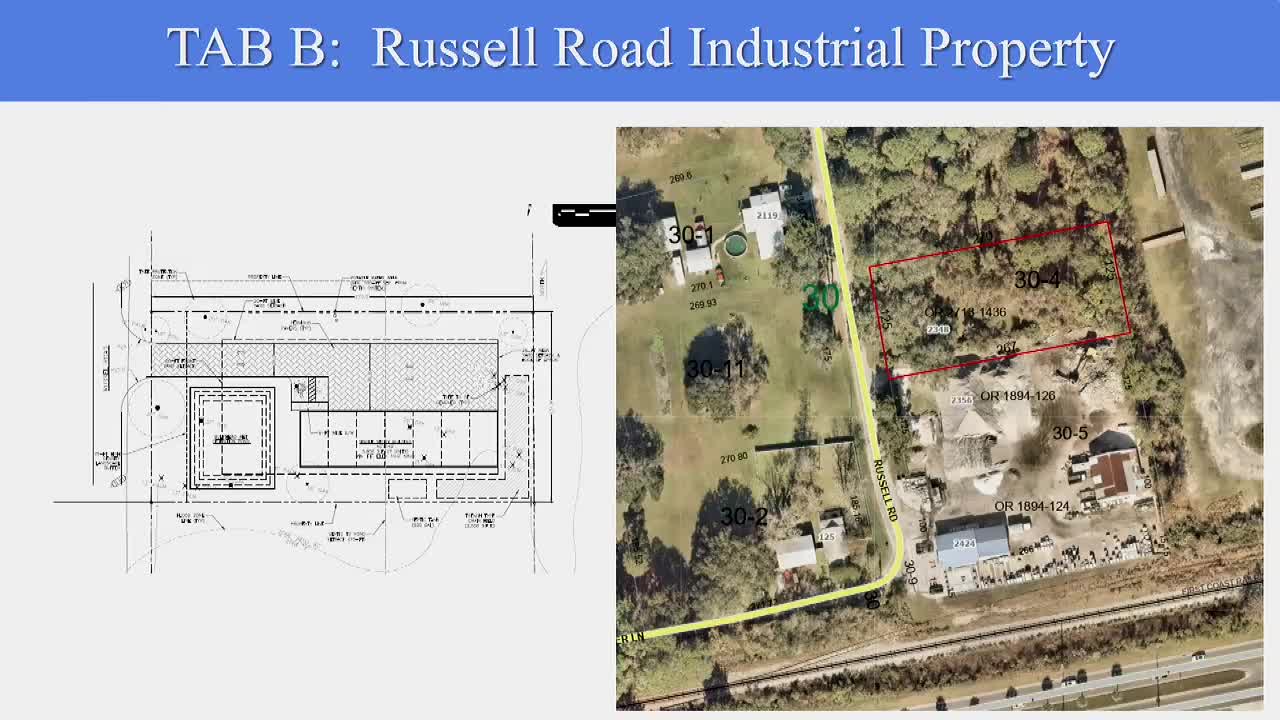
County reviewers focused on infrastructure and safety requirements. Caleb Perris of Development Services cited multiple roadway and drainage standards — including commercial driveway spacing, parking curbing or wheel stops, a required stormwater infrastructure maintenance plan, fencing for bulk-headed wet ponds, a six-foot sidewalk along the frontage, and the need to coordinate a traffic-impact analysis per BOCC Resolution 2019-174 (staff to call transportation engineer Andrew Avant).
Ronnie from the Health Department said the applicant must apply for state health permitting, pay required fees, and complete water testing under the limited-use public-well standards; septic capacity must be reviewed and an operating permit could be required depending on on-site materials. Bob Bradley from the Fire Marshal’s Office said mini-storage facilities must be sprinklered, asked what would be stored in the units, and said the site’s driveway exceeding the 150-foot dead-end maximum requires a cul-de-sac, T, or Y turnaround unless an AutoTURN demonstration proves emergency apparatus can turn on site. Bradley added that if municipal water is available within a quarter mile the developer must extend a hydrant to the site and that connecting to public water could obviate limited-use well testing.
“Per section 9.3, our driver design, commercial driveways do require 25 foot spacing from the property line,” Perris said, and he reminded the applicant to include standard general notes and paving/stormwater notes with the engineering submittal. Health staff summarized well and septic testing and permitting requirements and the Fire Marshal asked for an AutoTURN to demonstrate fire-apparatus access and for a hydrant installation if water is within the 1/4-mile threshold.
Next steps: The applicant must provide additional technical submittals — a coordinated call with transportation staff for trip generation, a stormwater maintenance plan and engineering details, Health Department permit applications and water testing results, septic capacity documentation, and AutoTURN or turnaround designs for fire apparatus review. No approvals were granted at the pre-application meeting.
Don't Miss a Word: See the Full Meeting!
Go beyond summaries. Unlock every video, transcript, and key insight with a Founder Membership.
30-day money-back guarantee
Sponsors
Proudly supported by sponsors who keep Florida articles free in 2025

