Eagle planning panel remands Watermark subdivision to staff after residents raise floodway, density and amenity concerns
November 03, 2025 | Eagle, Ada County, Idaho
This article was created by AI summarizing key points discussed. AI makes mistakes, so for full details and context, please refer to the video of the full meeting. Please report any errors so we can fix them. Report an error »
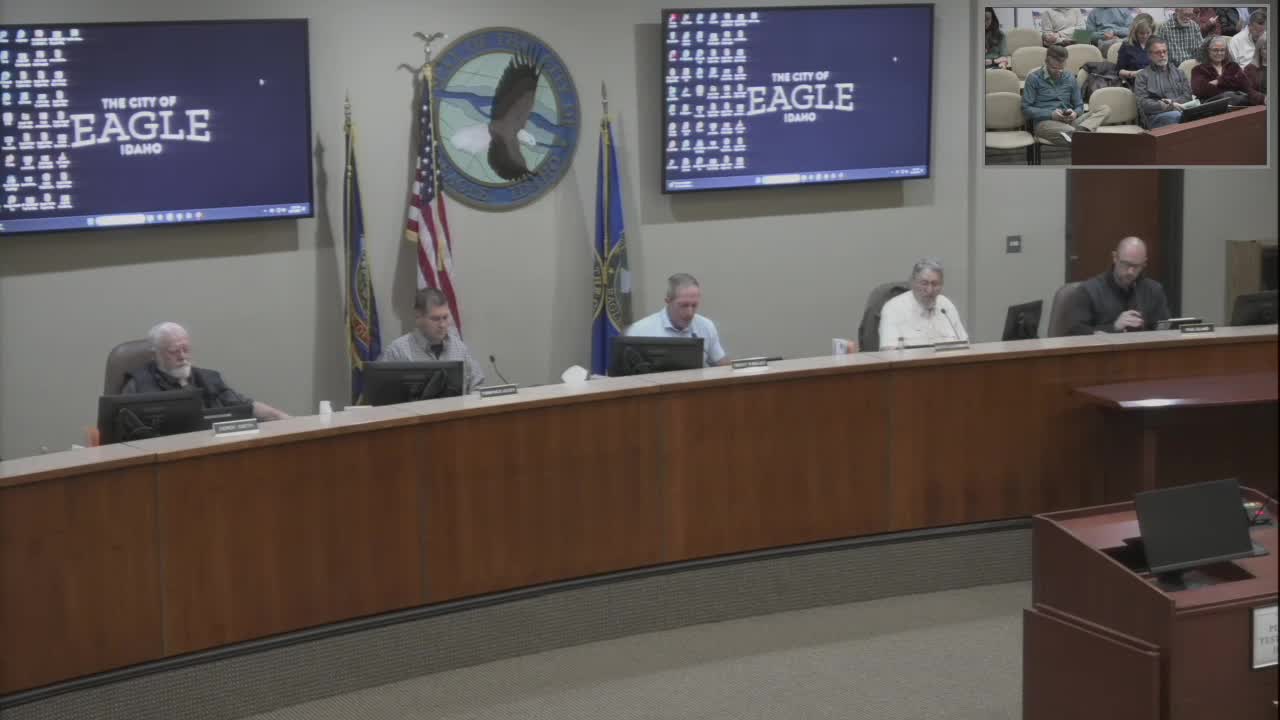
The City of Eagle Planning and Zoning Commission on Nov. 4 recommended remanding the Watermark Subdivision application back to staff for revision after a lengthy public hearing and resident testimony.
Boise Hunter Homes proposes the Watermark project on a mixed‑use parcel south of Riverside Drive along the Boise River: a preliminary plat, preliminary development plan, conditional use permit and development agreement modification for roughly 151 lots — 147 attached single‑family lots and four common lots — at a density staff summarized as 15.82 dwelling units per acre (density was calculated excluding the floodway). Planning staff’s packet shows the applicant is requesting multiple waivers from MUDA standards, including minimum lot size, lot width and frontage, setbacks, public utility/irrigation/drainage easements, detached sidewalks and an increase in allowable lot coverage.
Haley Durham, planning and zoning staff, told commissioners the application proposes a mix of attached units and common open space and that the property’s southern portion sits in the FEMA floodway and therefore ‘‘will require an engineered no‑rise certification and … a conditional letter of map revision’’ for certain improvements. ‘‘A 147 of those are single family attached with 4 common lots. Overall density of 15.82 dwelling units per acre,’’ Durham said during her presentation.
Applicant representatives said the product is a for‑sale, attached single‑family community designed to deliver homeownership at lower maintenance and with substantial shared amenities. ‘‘For the last 10 years, we've let the public use our property for free with no recorded easements at the request of the city of Eagle on an interim basis,’’ said Travis Hunter of Boise Hunter Homes, describing prior informal public access to a greenbelt stub on the site. Todd Tucker, the applicant’s project representative, summarized project amenity plans and said the developer is seeking waivers so the product can be sold as owner‑occupied townhomes instead of built as multifamily rental buildings.
Tucker and staff both described the proposed open‑space arrangement and listed requested waivers. Tucker said the applicant would provide roughly 53% open space and asked that several staff conditions be modified to use the final plat recordation as the trigger for certain obligations. He also offered some concessions in response to public testimony: he said the developer would consider CC&Rs that define and limit short‑term rentals (the applicant indicated a 30‑day threshold would be acceptable) and would add CC&R language restricting parking on driveways shorter than 20 feet.
Neighbors and the River District Homeowners Association — represented by Elam & Burke attorney Abby Germaine — urged the commission to require additional changes before the project advances. They asked the commission to (at minimum) keep active recreation out of the floodway, require detached sidewalks and planting strips, reconsider the number and placement of vehicle access points to limit cut‑through traffic, and seek a lower overall density and larger lot sizes than the applicant proposed. Germaine urged a continuance so the applicant and staff could ‘‘instruct the applicant to make some necessary revisions to the applications and the plat.’’
Public commenters cited wildlife and habitat impacts, increased traffic through adjacent River District streets, concerns about on‑street parking and generator noise from active recreation (pickleball courts were a focal point). Multiple residents said the Greenbelt path in that stretch is a valued, largely natural corridor used daily by neighbors.
Staff noted Parks, Pathways and Recreation Commission support for constructing the proposed amenities as shown but also flagged that any physical improvements in the floodway require federal mapping/engineering approvals and coordination with river maintenance entities. Bill Vaughn, the city’s zoning administrator, confirmed that where pressurized irrigation is not available developments often use potable water for landscaping.
After extended commission discussion about waivers, access and floodway uses, Commissioner Roland moved to remand the Watermark applications to staff so the applicant and staff could redraft certain items. The motion, as recorded by the commission, required a number of revisions including a CC&R prohibition on short‑term rentals less than 30 days, a CC&R restriction on driveway parking for drives shorter than 20 feet, shared access and maintenance easements for rear access alleys (rather than treating the alleys as a common lot), striking one of the staff’s DA conditions regarding sidewalks as proposed, striking the offsetting open‑space condition in part, and deleting the proposed pickleball courts from the floodway. Commissioner Owen seconded the motion.
The commission recommended remand by a recorded vote (five in favor, one opposed). Chairman Wright and a majority of commissioners voted to remand; Commissioner McCauley asked to be recorded as voting no. The action was a recommendation from the Planning and Zoning Commission to city staff and, ultimately, to City Council for final decisions where required.
What comes next: the commission’s motion sends the application back to staff and directs the applicant to address the named items for a revised submittal. The applicant and staff will work through the requested edits, and the project will return to the commission or proceed to City Council according to the city’s process. Several elements remain unresolved in the record, including final language for CC&Rs, the exact footprint and mitigation for proposed active recreation, and the engineering approvals needed for any work within the floodway.
Boise Hunter Homes proposes the Watermark project on a mixed‑use parcel south of Riverside Drive along the Boise River: a preliminary plat, preliminary development plan, conditional use permit and development agreement modification for roughly 151 lots — 147 attached single‑family lots and four common lots — at a density staff summarized as 15.82 dwelling units per acre (density was calculated excluding the floodway). Planning staff’s packet shows the applicant is requesting multiple waivers from MUDA standards, including minimum lot size, lot width and frontage, setbacks, public utility/irrigation/drainage easements, detached sidewalks and an increase in allowable lot coverage.
Haley Durham, planning and zoning staff, told commissioners the application proposes a mix of attached units and common open space and that the property’s southern portion sits in the FEMA floodway and therefore ‘‘will require an engineered no‑rise certification and … a conditional letter of map revision’’ for certain improvements. ‘‘A 147 of those are single family attached with 4 common lots. Overall density of 15.82 dwelling units per acre,’’ Durham said during her presentation.
Applicant representatives said the product is a for‑sale, attached single‑family community designed to deliver homeownership at lower maintenance and with substantial shared amenities. ‘‘For the last 10 years, we've let the public use our property for free with no recorded easements at the request of the city of Eagle on an interim basis,’’ said Travis Hunter of Boise Hunter Homes, describing prior informal public access to a greenbelt stub on the site. Todd Tucker, the applicant’s project representative, summarized project amenity plans and said the developer is seeking waivers so the product can be sold as owner‑occupied townhomes instead of built as multifamily rental buildings.
Tucker and staff both described the proposed open‑space arrangement and listed requested waivers. Tucker said the applicant would provide roughly 53% open space and asked that several staff conditions be modified to use the final plat recordation as the trigger for certain obligations. He also offered some concessions in response to public testimony: he said the developer would consider CC&Rs that define and limit short‑term rentals (the applicant indicated a 30‑day threshold would be acceptable) and would add CC&R language restricting parking on driveways shorter than 20 feet.
Neighbors and the River District Homeowners Association — represented by Elam & Burke attorney Abby Germaine — urged the commission to require additional changes before the project advances. They asked the commission to (at minimum) keep active recreation out of the floodway, require detached sidewalks and planting strips, reconsider the number and placement of vehicle access points to limit cut‑through traffic, and seek a lower overall density and larger lot sizes than the applicant proposed. Germaine urged a continuance so the applicant and staff could ‘‘instruct the applicant to make some necessary revisions to the applications and the plat.’’
Public commenters cited wildlife and habitat impacts, increased traffic through adjacent River District streets, concerns about on‑street parking and generator noise from active recreation (pickleball courts were a focal point). Multiple residents said the Greenbelt path in that stretch is a valued, largely natural corridor used daily by neighbors.
Staff noted Parks, Pathways and Recreation Commission support for constructing the proposed amenities as shown but also flagged that any physical improvements in the floodway require federal mapping/engineering approvals and coordination with river maintenance entities. Bill Vaughn, the city’s zoning administrator, confirmed that where pressurized irrigation is not available developments often use potable water for landscaping.
After extended commission discussion about waivers, access and floodway uses, Commissioner Roland moved to remand the Watermark applications to staff so the applicant and staff could redraft certain items. The motion, as recorded by the commission, required a number of revisions including a CC&R prohibition on short‑term rentals less than 30 days, a CC&R restriction on driveway parking for drives shorter than 20 feet, shared access and maintenance easements for rear access alleys (rather than treating the alleys as a common lot), striking one of the staff’s DA conditions regarding sidewalks as proposed, striking the offsetting open‑space condition in part, and deleting the proposed pickleball courts from the floodway. Commissioner Owen seconded the motion.
The commission recommended remand by a recorded vote (five in favor, one opposed). Chairman Wright and a majority of commissioners voted to remand; Commissioner McCauley asked to be recorded as voting no. The action was a recommendation from the Planning and Zoning Commission to city staff and, ultimately, to City Council for final decisions where required.
What comes next: the commission’s motion sends the application back to staff and directs the applicant to address the named items for a revised submittal. The applicant and staff will work through the requested edits, and the project will return to the commission or proceed to City Council according to the city’s process. Several elements remain unresolved in the record, including final language for CC&Rs, the exact footprint and mitigation for proposed active recreation, and the engineering approvals needed for any work within the floodway.
Don't Miss a Word: See the Full Meeting!
Go beyond summaries. Unlock every video, transcript, and key insight with a Founder Membership.
✓
Get instant access to full meeting videos
✓
Search and clip any phrase from complete transcripts
✓
Receive AI-powered summaries & custom alerts
✓
Enjoy lifetime, unrestricted access to government data
30-day money-back guarantee
