Committee seeks fiscal-sustainability tool to test long-term city costs of development
November 03, 2025 | San Marcos City, Hays County, Texas
This article was created by AI summarizing key points discussed. AI makes mistakes, so for full details and context, please refer to the video of the full meeting. Please report any errors so we can fix them. Report an error »
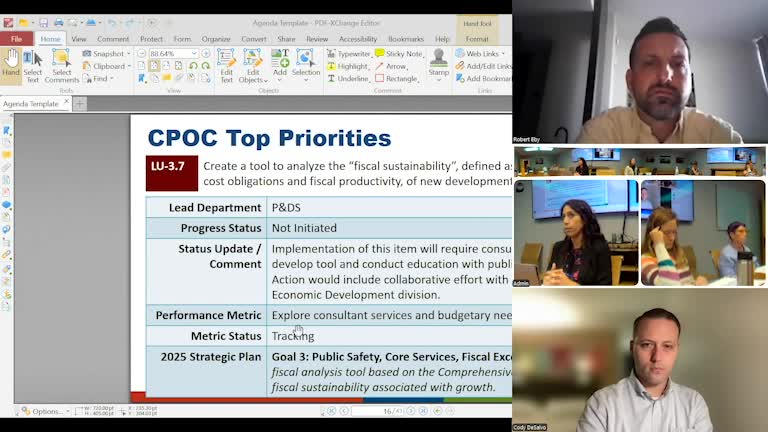
Committee members asked whether the model would project costs and revenues over multiple decades and requested that the tool include utility capacity and utility-rate implications (water, wastewater, electricity), infrastructure replacement costs, and environmental costs where they can be monetized (for example, long-term water or energy impacts). Planning staff identified the City of Fate, Texas, and a consulting firm that provides similar tools as references members could review.
Members suggested the tool should be flexible enough to compare development types (for example, single-family suburbs versus higher-density centers or data centers) and to produce an estimated payback or net fiscal position over a long-term horizon. Several members emphasized that results of such a model should inform city decisions and approvals as an additional input rather than serve as an absolute directive.
The committee amended the recommendation resolution language to add utility capacity and utility rates to the fiscal-sustainability evaluation and to ask staff to consider environmental costs and longer-term budgetary outcomes as part of the analysis.
View the Full Meeting & All Its Details
This article offers just a summary. Unlock complete video, transcripts, and insights as a Founder Member.
30-day money-back guarantee
Sponsors
Proudly supported by sponsors who keep Texas articles free in 2025

