Shoreline council opens hearings on 2026 property tax levy and mid‑biennial budget; staff flags rising police costs
November 03, 2025 | Shoreline, King County, Washington
This article was created by AI summarizing key points discussed. AI makes mistakes, so for full details and context, please refer to the video of the full meeting. Please report any errors so we can fix them. Report an error »
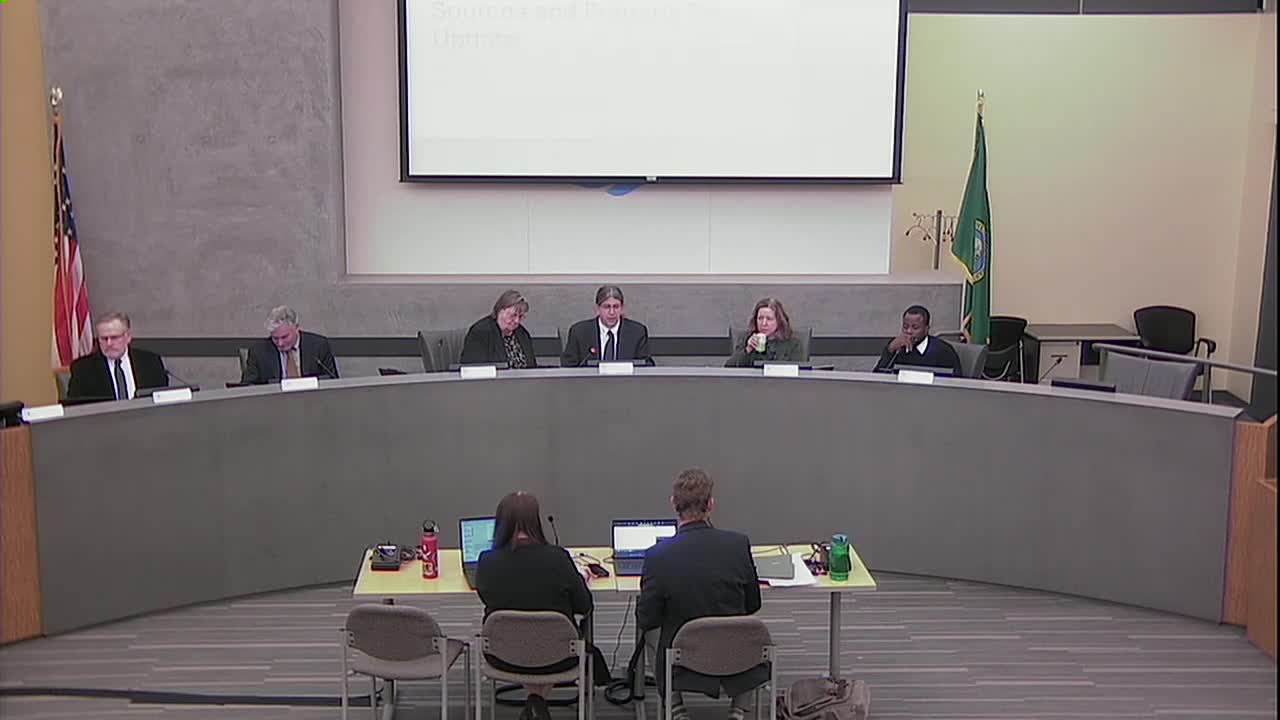
Administrative Services Director Joe Brandstetter introduced Budget and Tax Manager Christie Hopkins, who told the council the third‑quarter snapshot shows general‑fund revenues at about 64% of budget and expenditures at about 60% through September. Hopkins said property‑tax collections run at roughly 54% of the allowable levy at this point in the year and that sales tax receipts are down about 5.3% from last year, driven largely by a roughly 19% decline in construction sales tax.
Hopkins said the proposed 2026 levy uses the voter‑approved levy lift and the June‑to‑June CPI of 2.683%, plus revenue from new construction and refunds. Staff estimated 2026 property‑tax receipts at about $25.8 million and an estimated city levy rate of $1.49; she also noted a voter‑approved parks excess levy estimated at about $2.95 million for 2026. "Majority of collections happen in April and October," Hopkins said during her presentation.
On the mid‑biennial package, staff highlighted two fee‑related changes: the addition of "co‑living houses" as a new land‑use category for impact fees, and a 4% technology fee on permitting to support online permitting systems and vendor costs. Hopkins said the 4% technology fee aligns with practices in comparable cities and is intended to cover ongoing portal and software expenses.
Brandstetter and Hopkins also presented a 10‑year financial forecast showing the city balanced through 2029 and an anticipated deficit beginning in 2030 (the forecast does not assume any further levy lifts after 2029). They identified roughly $2.6 million in potential mid‑biennial one‑time requests and noted staff set aside $500,000 for potential cost overruns on a capital project (the N 145th Street project). "We expect police cost to continue to rise faster than CPI," Brandstetter said, and staff showed public safety (largely the King County Sheriff’s Office contract) accounted for about 32% of operating budget for the 2025–26 biennium.
Councilmembers pressed staff for clear examples of taxpayer impact. A resident who testified asked how tax increases translate for renters in large apartment complexes; Hopkins said calculations are easier for owner‑occupied single‑family homes and that whether landlords pass costs to tenants depends on private contracts and market conditions. Councilmembers asked staff to provide sample dollar impacts (for example, a $500,000 home) and to clarify how much capacity remains for one‑time council amendments while preserving the city’s target reserves.
Public comment during both hearings included support for activating land near the North City light‑rail station and Rotary Park for small businesses and community events; online commenters described markets, food‑truck gatherings and night‑market concepts as ways to draw foot traffic. Several councilmembers noted interest in proposals on the table and asked colleagues to submit written amendment requests in time for the Nov. 17 staff report.
No final vote was taken on the property levy or the mid‑biennial amendment at Monday’s meeting. Council indicated it would likely place the property‑tax ordinance on a future consent calendar for action after additional materials are provided.
Details to watch: staff said development permit revenue is running about 11.5% above the budgeted projection, while real‑estate‑excise tax receipts are close to budget after one large sale; staff flagged the dispatch workload and cost‑allocation formula with other contract cities as a near‑term cause of added public‑safety costs (staff estimated the workload allocation added roughly $250,000 of the recent cost increase). Council asked for clearer homeowner impact examples and for staff to quantify how proposed council amendments would affect one‑time capacity and reserves going into 2026.
View the Full Meeting & All Its Details
This article offers just a summary. Unlock complete video, transcripts, and insights as a Founder Member.
30-day money-back guarantee
Sponsors
Proudly supported by sponsors who keep Washington articles free in 2025

