Laredo council reaffirms opposition to border barriers in city limits and votes to invite president through governor's office
November 03, 2025 | Laredo, Webb County, Texas
This article was created by AI summarizing key points discussed. AI makes mistakes, so for full details and context, please refer to the video of the full meeting. Please report any errors so we can fix them. Report an error »
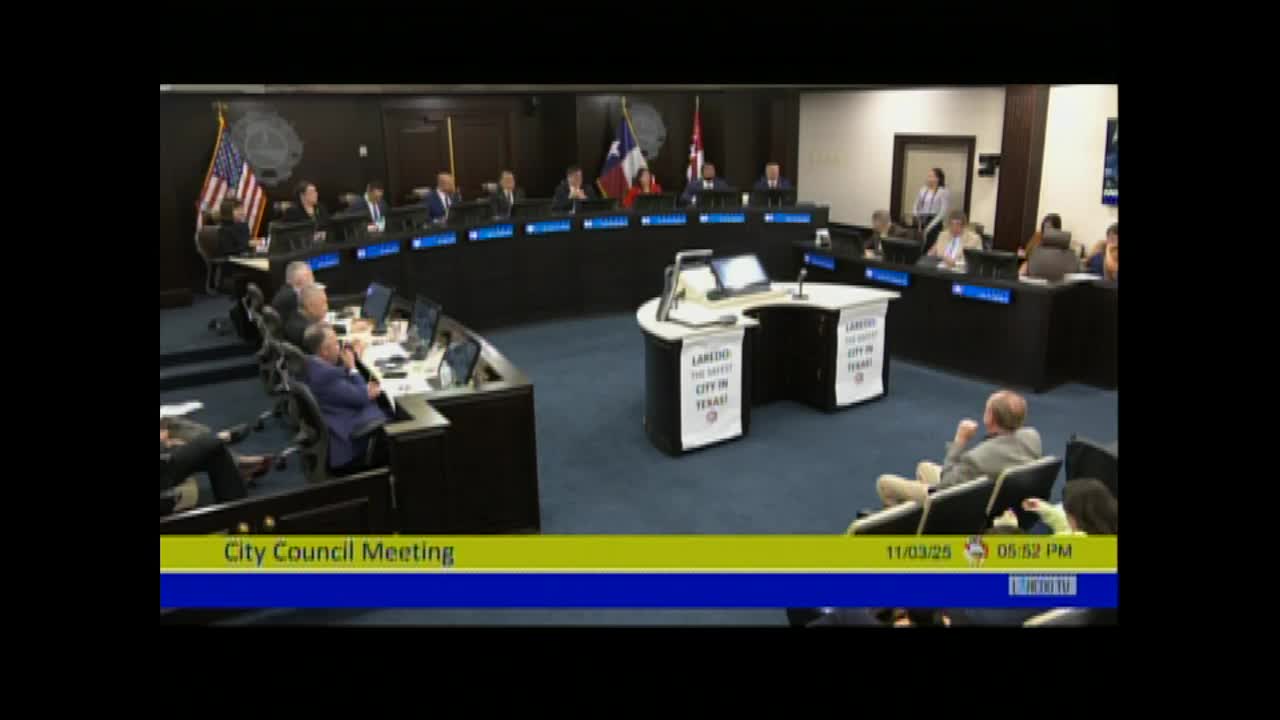
The council held an extended public-comment period focused on the proposed barrier. Multiple residents and community leaders urged the council to oppose a border wall within city limits, arguing it would harm the river environment, damage cross-border commerce and divide communities. "We need that money to fund our future on projects that bring billions of dollars in revenue to our border city," said Valentin Ruiz, a local resident who spoke during public comment.
After executive session, the council voted to send a resolution to the record that affirmed support for border security generally but opposed construction of a border barrier inside residential areas or within city limits. The motion to adopt the council's position passed without division.
Council then debated a related item proposing a formal invitation to President Donald J. Trump to visit Laredo. Councilmember Dr. Tyler King, who made the motion, described the invitation as a way to show the president the local context and the Max Mandel municipal golf course that stands in the proposed barrier's path. "For me, it's just, we cannot order him to come. We can request that he come," King said.
Council amended the motion to have any invitation coordinated through the mayor's office and transmitted via the governor's office and the city's congressional delegation. The motion passed; the mayor instructed staff to work with state and federal offices on the invitation. A small number of council members asked to be recorded as opposed to the invitation.
Why it matters: Council members and dozens of public speakers said the barrier proposal could require eminent-domain acquisitions, alter river hydraulics and affect commerce that is central to Laredo's economy. The council's actions establish a record for the city's stance and create a platform for further engagement with state and federal officials.
What happens next: The mayor directed staff to involve the governor's and congressional offices to pursue the invitation and to bring back recommended next steps to the council. Council earlier also approved a motion to explore a delegation and possibly host an international summit to discuss waterfront and border impacts.
View the Full Meeting & All Its Details
This article offers just a summary. Unlock complete video, transcripts, and insights as a Founder Member.
30-day money-back guarantee
Sponsors
Proudly supported by sponsors who keep Texas articles free in 2025

