Lynnwood prosecutors say second courtroom and state changes stretch staff; cover sheet lists $111,100 budget amendment
November 03, 2025 | Lynnwood, Snohomish County, Washington
This article was created by AI summarizing key points discussed. AI makes mistakes, so for full details and context, please refer to the video of the full meeting. Please report any errors so we can fix them. Report an error »
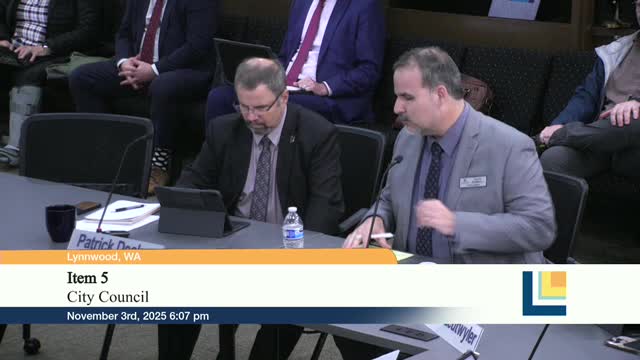
"We're gonna be needing an additional body, I think, to fully staff Lynnwood's needs," said Jim Zacker, one of the prosecuting attorneys who briefed the council. Zacker cited the city's 2022 rollout of body‑worn cameras, the January 2024 charging memorandum from the elected prosecutor, and a Supreme Court decision that will reduce public‑defender case counts beginning in January 2026 as contributors to increased workload.
The prosecutors described several operational pressures: the city now fields two simultaneous courtrooms, which places attorneys in court while case preparation and victim‑witness work still require office time; evidence from body‑worn cameras and evolving charging standards raise case complexity; and a national drawdown on public‑defender caseloads may shift processing demands. Zacker said the office has tried to reduce attorney time on administrative tasks by creating a non‑attorney case‑coordinator role to handle witness contact, restitution and other preparatory work.
Council members asked whether the presentation was a policy conversation about how cases should be prosecuted or a request for immediate dollars. Zacker replied that he had not brought specific dollar amounts to the meeting and described the presentation as largely informational. "I didn't want to get bogged down in the numbers today," he said.
At least one item on the meeting packet, however, did include a dollar figure. Council President Nick Coelho noted the agenda cover sheet lists a requested budget amendment for $111,100 to increase appropriations for prosecutorial services in 2026. Council members asked the prosecuting office to return with more detailed options, including cost estimates and comparisons of how cases could be handled in a therapeutic or "community court" track versus the regular trial track.
Council members also explored shorter‑term and longer‑term options. Some suggested changing charging standards for low‑value thefts — an approach used by neighboring jurisdictions — while others warned that narrowing prosecution could require staff to handle a different mix of cases and would not necessarily reduce workload. Prosecutors cautioned that community‑court handling and regular trial‑track cases demand different levels of attorney time and that any conversion to a therapeutic model would require program design and coordination with the court.
What happens next: Prosecutors said they will return to the council with more detailed scenarios and financial figures to support the policy choices the council wants to make about caseload management and staffing. The agenda packet for the meeting already lists a $111,100 budget amendment request for 2026; no vote or final appropriation took place at the Nov. 3 work session.
Don't Miss a Word: See the Full Meeting!
Go beyond summaries. Unlock every video, transcript, and key insight with a Founder Membership.
30-day money-back guarantee
Sponsors
Proudly supported by sponsors who keep Washington articles free in 2025

