Dallas committee reviews DRIVE procurement framework to boost small business access while aligning with federal rules
November 03, 2025 | Dallas, Dallas County, Texas
This article was created by AI summarizing key points discussed. AI makes mistakes, so for full details and context, please refer to the video of the full meeting. Please report any errors so we can fix them. Report an error »
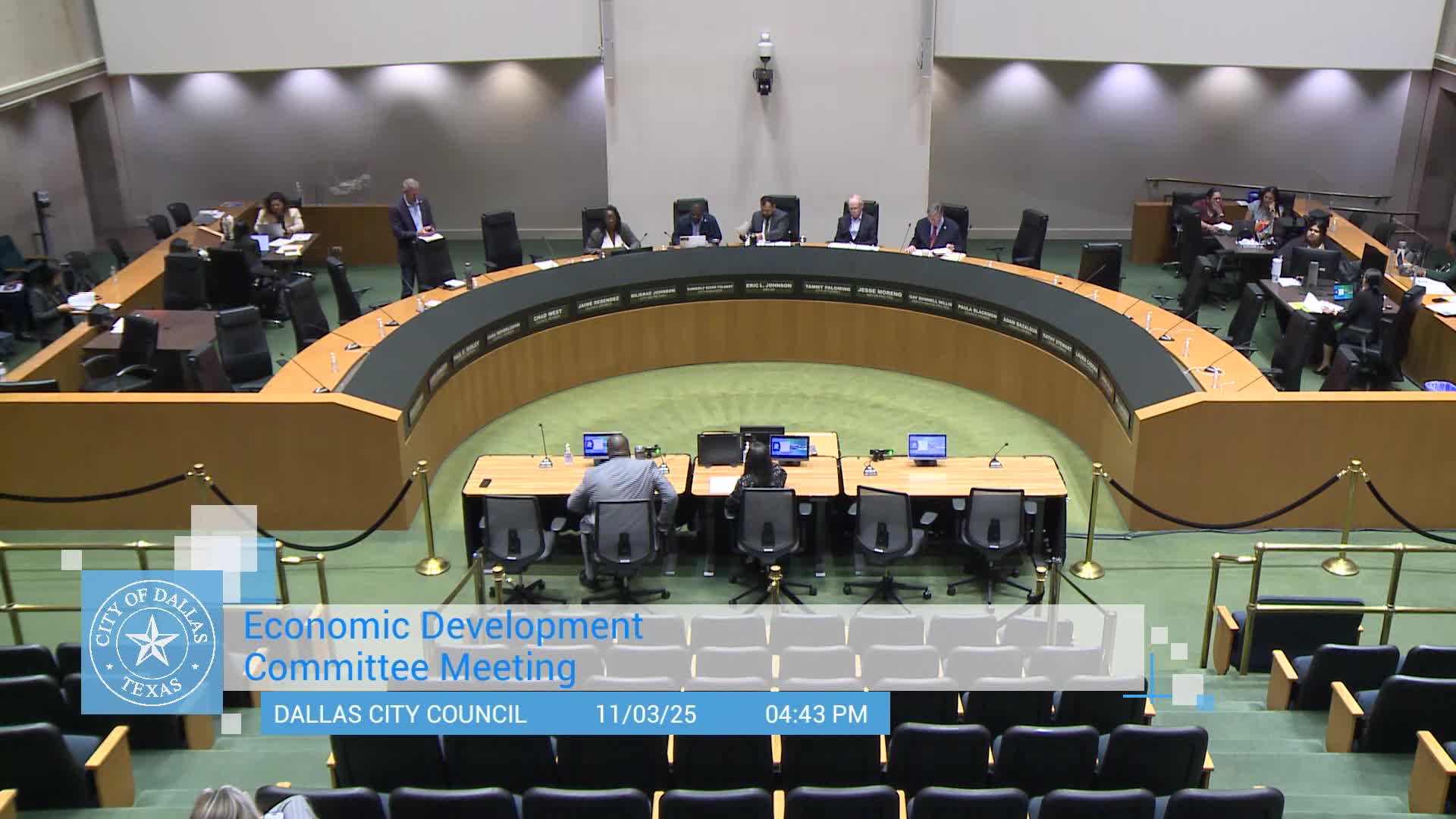
"Today, I'm pleased to present the drive policy framework, developing regional and inclusive vendor enterprises," Ortiz said, outlining a shift from the city’s 2008 BID policy toward a data‑driven, race‑neutral small business enterprise (SBE) approach. Ortiz said federal guidance issued in January 2025 requires public agencies to eliminate race‑ or religion‑based criteria in awarding contracts while continuing to support small‑business access through legally compliant, race‑neutral strategies.
The DRIVE framework centers on eight components staff developed after consulting more than 200 stakeholders. Key elements include a "first look" priority for informal procurements under $100,000, unbundling large contracts where appropriate, using best‑value evaluation criteria that balance cost, quality and inclusion, recognizing self‑performing SBEs, and tracking participation through an engagement score and monthly subcontractor reporting. Ortiz said emergency procurements, cooperative agreements and federally funded procurements would remain excluded from DRIVE.
Ortiz described proposed eligibility and goal‑setting processes: the city would initially use Small Business Administration size standards as a baseline but will validate whether local thresholds should be lower through a market utilization (availability) study. "So this is really to help us identify what the threshold should be if we want something different than what the SBA standard," a committee member summarized during questions, and Ortiz confirmed the study is expected to be completed in November.
Staff said DRIVE would continue to recognize regional and federal certifications (for example, SBA 8(a), HUBZone and service‑disabled veteran certifications) and include a phase‑graduation mechanism to allow firms that grow beyond SBE thresholds to continue participating while opening space for new small businesses. Ortiz also described a proposed evaluation rubric that awards points for SBE utilization (including credit for self‑performance), local economic impact (with greater points for firms headquartered in the city of Dallas versus the broader MSA) and an engagement score that rewards contractors who bring in first‑time small subcontractors and support mentor‑protégé arrangements.
Committee members pressed staff on specifics they said matter in practice. Council member Gracie asked whether the DOT/DBE recertification process and a higher personal net worth threshold would make qualifications more burdensome; Ortiz said DBE recertification will require a personal narrative of economic disadvantage under new federal parameters and staff are monitoring federal and state regulatory changes. Ortiz also told the committee that the Texas comptroller has paused HUB certification issuance and renewal while legal reviews proceed and that staff are preparing operational guidance for affected vendors.
Members also discussed metrics for unbundling and contractor performance. Gracie urged inclusion of past performance and change‑order history in the engagement score so that recurring low‑quality contractors do not crowd out new entrants. Staff said they will measure unbundling success by new contractors brought into the city, the number of awards, and department annual reports that forecast upcoming solicitations and opportunities for smaller scopes.
On procurement method, staff said the city will consider best‑value procurements where appropriate to evaluate factors beyond price (such as past performance and DRIVE criteria), though pricing negotiation would not be permitted under standard procedures. Council member Blair asked whether the city could track whether low bids that later generate many change orders are actually cost‑effective; Ortiz said past performance could be a criteria under best value and that staff can review change‑order trends.
Committee members also asked about assistance for vendors seeking certification and registration. Ortiz said registration to be a Dallas bidder remains free, three regional certification agencies work with the city and vendors, and staff can refer vendors to those agencies; if processing times become excessive, staff could fund resources to assist with city registration. Ortiz said roughly 2,000 current vendors already have an SBE certification and staff expect to register additional firms as the program transitions.
On schedule, Ortiz told the committee the market utilization study results are expected in November, staff will return to council with an updated briefing on Dec. 3, and a council vote is scheduled for Dec. 10; if adopted, implementation would begin in January 2026. Committee members asked for feedback to be submitted early (staff suggested Nov. 17 as a target) so comments can be incorporated prior to the December council actions.
The committee did not take formal votes on the DRIVE framework during the briefing. The only formal action recorded during the meeting was approval of the prior meeting minutes at the start of the session. The meeting was adjourned at 05:18.
Don't Miss a Word: See the Full Meeting!
Go beyond summaries. Unlock every video, transcript, and key insight with a Founder Membership.
30-day money-back guarantee
Sponsors
Proudly supported by sponsors who keep Texas articles free in 2025

