McFarland Youth Center warns of ‘existential’ funding risk as village pauses community center plan
November 04, 2025 | McFarland School District, School Districts, Wisconsin
This article was created by AI summarizing key points discussed. AI makes mistakes, so for full details and context, please refer to the video of the full meeting. Please report any errors so we can fix them. Report an error »
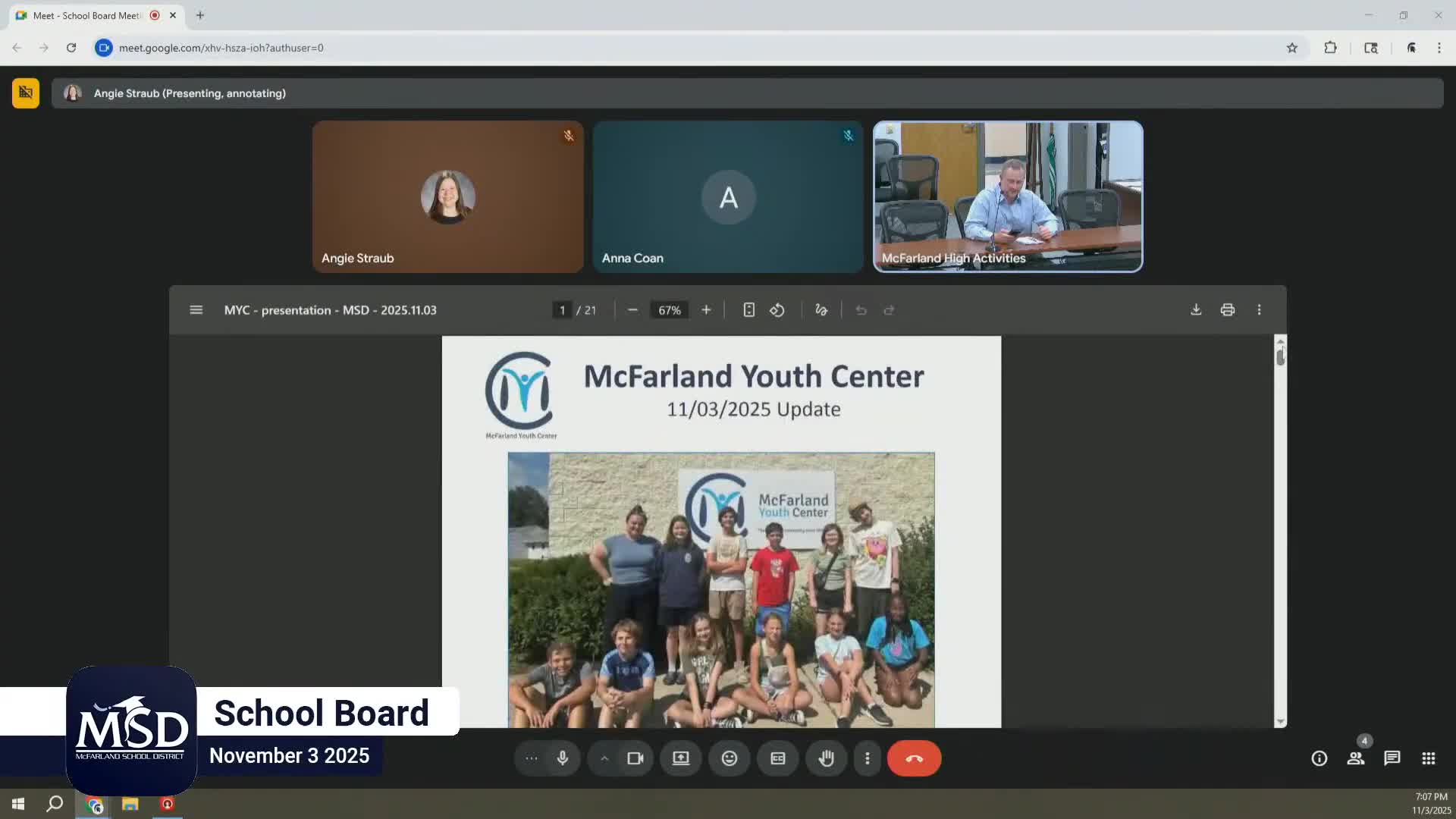
“McFarland Youth Center has existed, in essence, since 1998,” Miller told the board, summarizing the nonprofit’s origins, its weekday hours and typical attendance. He described a mix of unstructured recreation and increasingly intentional, structured programming — leadership and service activities, “Fresh Food Fridays” cooking sessions and field trips — that the center tracks as “asset‑building hours.” Miller said typical attendance during the school year is about 20–25 students a day and that the center has logged roughly 25,000 open hours and an order‑of‑magnitude estimate of 70,000 asset‑building hours over its lifetime.
Miller credited long‑standing support from the school district, Dane County and many individual donors for sustaining programming and staffing. He also described an operational transition plan he and the youth center board developed with Village of McFarland staff that envisioned moving day‑to‑day administration to the village when a planned McFarland community center would provide a permanent space. That project was paused in 2024, and later the village staff informed Miller the village “no longer saw this as a good fit for them at this time,” he said.
The youth center board proposed a transition date of July 1, 2026, and told the village that timeline in writing. Miller said the village later suggested a partial alternative — setting aside funds in next year’s municipal budget to help the center continue while stakeholders work out a longer plan. He said the village budget amendment that would reserve such funds was scheduled for an up‑or‑down vote “this Thursday” at 7 p.m., and warned that the amendment’s failure would place the youth center in “existential jeopardy” for 2026 operations.
“We are in serious jeopardy of not continuing the youth center in the current format with the current resources we have,” Miller said, describing the board’s difficulty sustaining the time‑consuming administrative workload and the volunteer board. He asked the district and other municipal partners to help explore alternate governance or funding options if the village does not adopt the proposed budget change.
The presentation covered staffing and programming details: the center’s paid director, volunteers and a mix of funding sources; the decision to move from largely unstructured activities to more structured, asset‑based programming starting roughly in 2006–07; and examples of service work including a toiletry‑kit project and a plastic‑bag‑recycling bench program in partnership with local service groups. Miller said the center typically opens 3–6 p.m. on school days and 1–5 p.m. in the summer, and that some younger high‑school volunteers help in a limited, structured role.
Board members asked about demographics, revenue and municipal support. Miller said the village of McFarland and the town of Dunn do provide some support; he said other municipalities in the school district had been approached in the past but “there was not anyone receptive” to providing funding at that time. He told the board the Dane County contract funding looked roughly level in preliminary numbers but cautioned the center remains sensitive to cuts.
After discussion, the board voted to approve a 2025–26 memorandum of understanding that formalizes the district’s relationship with the youth center for the upcoming year. The MOU approval was a separate, board action during the meeting and passed 4–0.
Miller asked the board to note that if the village budget amendment is not approved the center will need support from broader stakeholders — the district, other municipalities, foundations or private donors — to complete feasibility work and identify sustainable operational arrangements. He said the youth center board is willing to explore other paths but lacks the bandwidth and professional capacity to run a full feasibility study without external help.
Why this matters: The youth center provides after‑school supervision, structured youth development and service opportunities for middle‑school students in McFarland. Any disruption or closure would reduce supervised after‑school options for middle‑grade children, a cohort that typically has fewer extracurricular choices than high‑school students and for whom the center says it reaches roughly 25–30% of the middle‑school population in a typical year.
What’s next: Miller said the village budget amendment will be voted at an upcoming village meeting (the center announced the item “this Thursday” at 7 p.m.), and the youth center board is preparing contingency planning if the amendment does not pass. The district’s approval of the MOU secures a year of partnership, but longer‑term governance and funding remain unresolved.
View the Full Meeting & All Its Details
This article offers just a summary. Unlock complete video, transcripts, and insights as a Founder Member.
30-day money-back guarantee
Sponsors
Proudly supported by sponsors who keep Wisconsin articles free in 2025

