Palo Alto Council adopts updated emergency plan, approves wildfire protection plan and accepts audit
November 04, 2025 | Palo Alto, Santa Clara County, California
This article was created by AI summarizing key points discussed. AI makes mistakes, so for full details and context, please refer to the video of the full meeting. Please report any errors so we can fix them. Report an error »
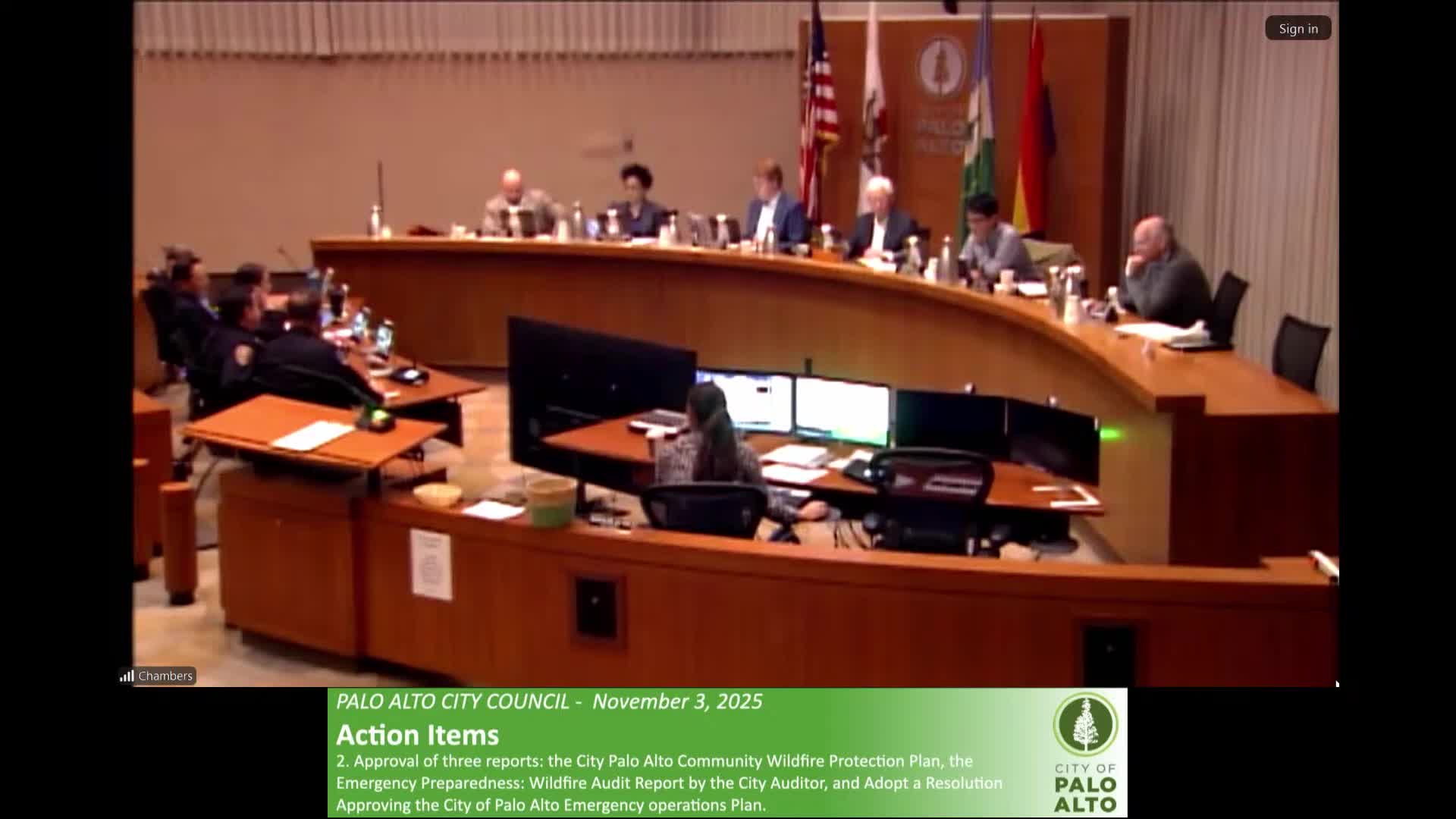
The documents aim to better prepare the city for wildland‑urban interface fires in the Foothills by emphasizing roadside fuel reduction, neighborhood defensible‑space programs and regional coordination with neighboring agencies. The council vote followed a multi‑department presentation and a city auditor's review that identified strengths and areas for improvement.
"The Emergency Operations Plan ... is our foundational emergency planning document," Assistant City Manager Kylene Uzay told the council as staff introduced the package. Fire Chief Duker and newly appointed Fire Chief Steven Lindsey described efforts to expand on preexisting hazard‑reduction programs, deploy sensors and cameras, and coordinate shared staffing at Foothills Station 8 during high‑risk periods.
Chief Lindsey said the CWPP's goal is to prevent catastrophic wildfires and, when fires occur, to contain them to smaller footprints: "One of the main focuses ... is on preventing catastrophic wildfire, with the goal of containing fires to less than 10 acres." He outlined planned fuel‑treatment methods ranging from defensible‑space inspections to mechanical clearing and shaded fuel breaks in targeted open‑space areas.
City Auditor Kate Murdoch summarized the audit's two findings, saying the city has "made significant investments in and has strong programs aimed to prevent and mitigate wildfire risks, but there are some areas for improvement," including community outreach and monitoring of WUI property violations. The audit also recommended tracking after‑action items from training exercises, improving evacuation planning and maintaining up‑to‑date mutual‑aid contact information.
Council members stressed the need to plan based on a rising long‑term risk rather than past fire patterns and asked staff to prioritize communications and redundancies in alerting systems. Council member Burt said the city must plan for higher risk decades ahead and noted smoke and downstream health and economic consequences from large fires.
Staff highlighted technology pilots and partnerships: the city has partnered with Stanford and neighboring fire districts to deploy n5 smoke sensors across the Foothills and is using a publicly accessible camera network; police and fire staff are studying use of unmanned aircraft systems for preplanning and post‑event reconnaissance. Chief Duker and Chief Lindsey said the city will continue to test alerting polygons and mass‑notification processes with regional partners.
The council approved staff recommendations by roll call vote. The action item record shows the motion carried unanimously. Staff asked the council to:
- Adopt the updated Emergency Operations Plan;
- Approve the Community Wildfire Protection Plan and authorize the city manager to sign and submit it;
- Accept the wildfire preparedness audit and direct staff to implement the audit's recommendations.
Council members said they will support further outreach to foothills neighborhoods about Firewise and home hardening, noting that measures such as a five‑foot noncombustible zone around structures (sometimes called "zone 0") are voluntary community practices that staff will continue to encourage. Staff and the auditor said they would bring follow‑up steps for enforcement tracking, evacuation planning and post‑exercise after‑action monitoring.
The vote concluded the council's main action for the night; the meeting recessed to closed session and later returned to finish the consent calendar.
Don't Miss a Word: See the Full Meeting!
Go beyond summaries. Unlock every video, transcript, and key insight with a Founder Membership.
30-day money-back guarantee
Sponsors
Proudly supported by sponsors who keep California articles free in 2025

