UN Secretary-General António Guterres urges a "people's plan" for social development at Doha summit
November 04, 2025 | United Nations, Federal
This article was created by AI summarizing key points discussed. AI makes mistakes, so for full details and context, please refer to the video of the full meeting. Please report any errors so we can fix them. Report an error »
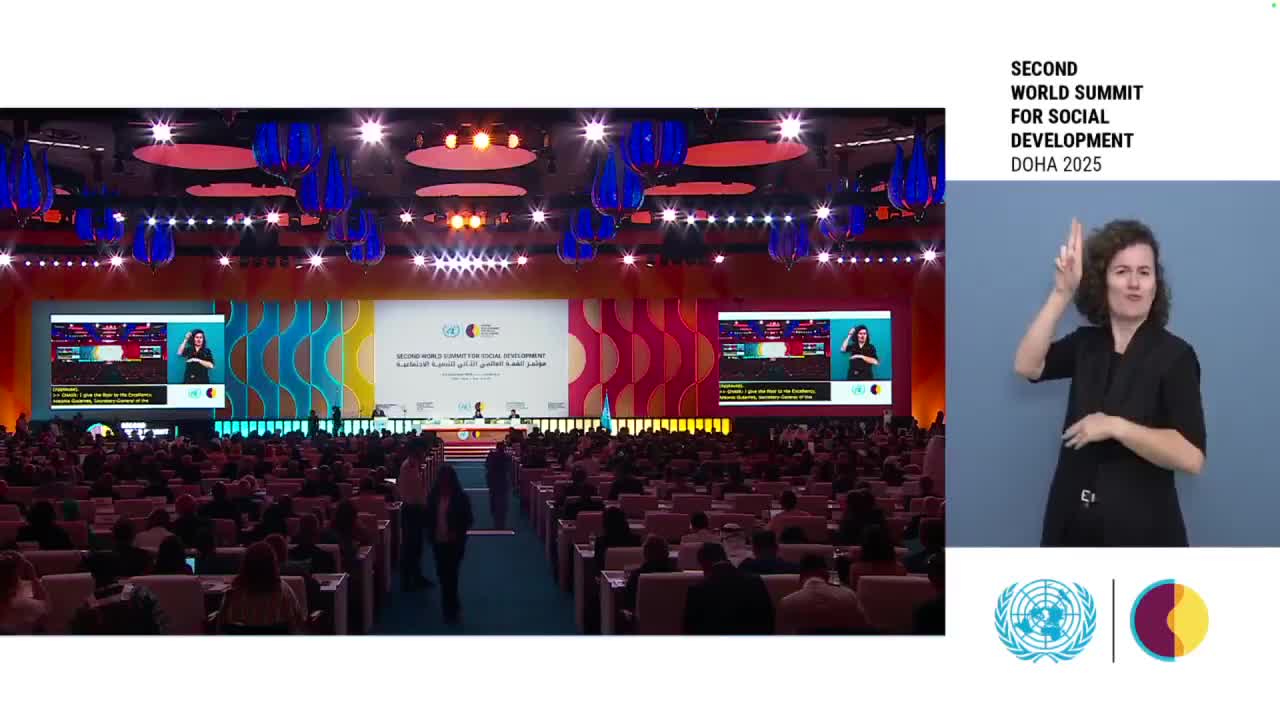
United Nations Secretary-General António Guterres, speaking at a Doha summit, urged world leaders to adopt a "people's plan" to accelerate reductions in poverty, expand social protection and mobilize the finance needed for climate and development transitions. "The Doha political declaration represents a booster shot for development," he said, and outlined four priority areas: fighting poverty and inequality, job creation, financing and inclusion.
Guterres said the summit recalls the 1995 Copenhagen meeting and the progress since: "Since then, over 1,000,000,000 people have escaped extreme poverty. Global unemployment is at the near historic low." He also warned that gains are fragile: "People are still facing hunger, poverty, displacement, and unemployment. Developing countries are not getting the level of support they need, and we are not moving fast enough to mitigate the volatility and outright destruction wrought by a warming planet. And we are falling short on the sustainable development goals."
He highlighted gaps in social protection and basic services, calling for country-led investments in "food systems that can reach all people with affordable, nutritious, sustainably produced foods," universally accessible health systems, clean water and sanitation, adequate affordable housing, clean and reliable energy, and education backed by well-trained teachers. Guterres said almost 4,000,000,000 people lack access to any form of social protection.
On climate finance, Guterres urged concrete commitments ahead of COP 30 in Brazil, asking developed countries and multilateral institutions to scale up support. He called for mobilizing $1,600,000,000,000 annually by 2035 for developing-country climate finance, doubling adaptation finance to at least $40,000,000,000 this year, and capitalizing loss-and-damage funds with "significant contributions." "Developing countries still lack the finance and technologies needed to support their transitions," he said.
Guterres pressed for job creation and skills development, citing the Global Digital Compact and the need to close the digital divide and expand lifelong learning. "Creating and sustaining jobs also requires countries to diversify their economies and enhance local processing and innovation to add value and compete in global trade," he said, and called for stronger labor protections and measures to ensure women have equal access to jobs and support for the care economy.
He urged reform of the global financial architecture, saying multilateral development banks must be "bigger and bolder" and that debt-relief instruments should be used to lower borrowing costs and speed support for countries facing distress. He also said developing countries deserve stronger participation at decision-making tables across global financial institutions.
Guterres closed by stressing inclusion for vulnerable groups, saying many people "are subject to prejudice, threats, poor treatment, and even demonstrable acts of violence," and urging governments to defend democratic values and eliminate discrimination and gender-based violence. He warned against algorithms entrenching bias: "There is a need for AI algorithms not to become bastions of male chauvinism." He concluded by commending the Doha Declaration and inviting the next speaker.
Guterres said the summit recalls the 1995 Copenhagen meeting and the progress since: "Since then, over 1,000,000,000 people have escaped extreme poverty. Global unemployment is at the near historic low." He also warned that gains are fragile: "People are still facing hunger, poverty, displacement, and unemployment. Developing countries are not getting the level of support they need, and we are not moving fast enough to mitigate the volatility and outright destruction wrought by a warming planet. And we are falling short on the sustainable development goals."
He highlighted gaps in social protection and basic services, calling for country-led investments in "food systems that can reach all people with affordable, nutritious, sustainably produced foods," universally accessible health systems, clean water and sanitation, adequate affordable housing, clean and reliable energy, and education backed by well-trained teachers. Guterres said almost 4,000,000,000 people lack access to any form of social protection.
On climate finance, Guterres urged concrete commitments ahead of COP 30 in Brazil, asking developed countries and multilateral institutions to scale up support. He called for mobilizing $1,600,000,000,000 annually by 2035 for developing-country climate finance, doubling adaptation finance to at least $40,000,000,000 this year, and capitalizing loss-and-damage funds with "significant contributions." "Developing countries still lack the finance and technologies needed to support their transitions," he said.
Guterres pressed for job creation and skills development, citing the Global Digital Compact and the need to close the digital divide and expand lifelong learning. "Creating and sustaining jobs also requires countries to diversify their economies and enhance local processing and innovation to add value and compete in global trade," he said, and called for stronger labor protections and measures to ensure women have equal access to jobs and support for the care economy.
He urged reform of the global financial architecture, saying multilateral development banks must be "bigger and bolder" and that debt-relief instruments should be used to lower borrowing costs and speed support for countries facing distress. He also said developing countries deserve stronger participation at decision-making tables across global financial institutions.
Guterres closed by stressing inclusion for vulnerable groups, saying many people "are subject to prejudice, threats, poor treatment, and even demonstrable acts of violence," and urging governments to defend democratic values and eliminate discrimination and gender-based violence. He warned against algorithms entrenching bias: "There is a need for AI algorithms not to become bastions of male chauvinism." He concluded by commending the Doha Declaration and inviting the next speaker.
View the Full Meeting & All Its Details
This article offers just a summary. Unlock complete video, transcripts, and insights as a Founder Member.
✓
Watch full, unedited meeting videos
✓
Search every word spoken in unlimited transcripts
✓
AI summaries & real-time alerts (all government levels)
✓
Permanent access to expanding government content
30-day money-back guarantee
