Maricopa County supervisors accept 27 recommendations to streamline septic permitting
November 03, 2025 | Maricopa County, Arizona
This article was created by AI summarizing key points discussed. AI makes mistakes, so for full details and context, please refer to the video of the full meeting. Please report any errors so we can fix them. Report an error »
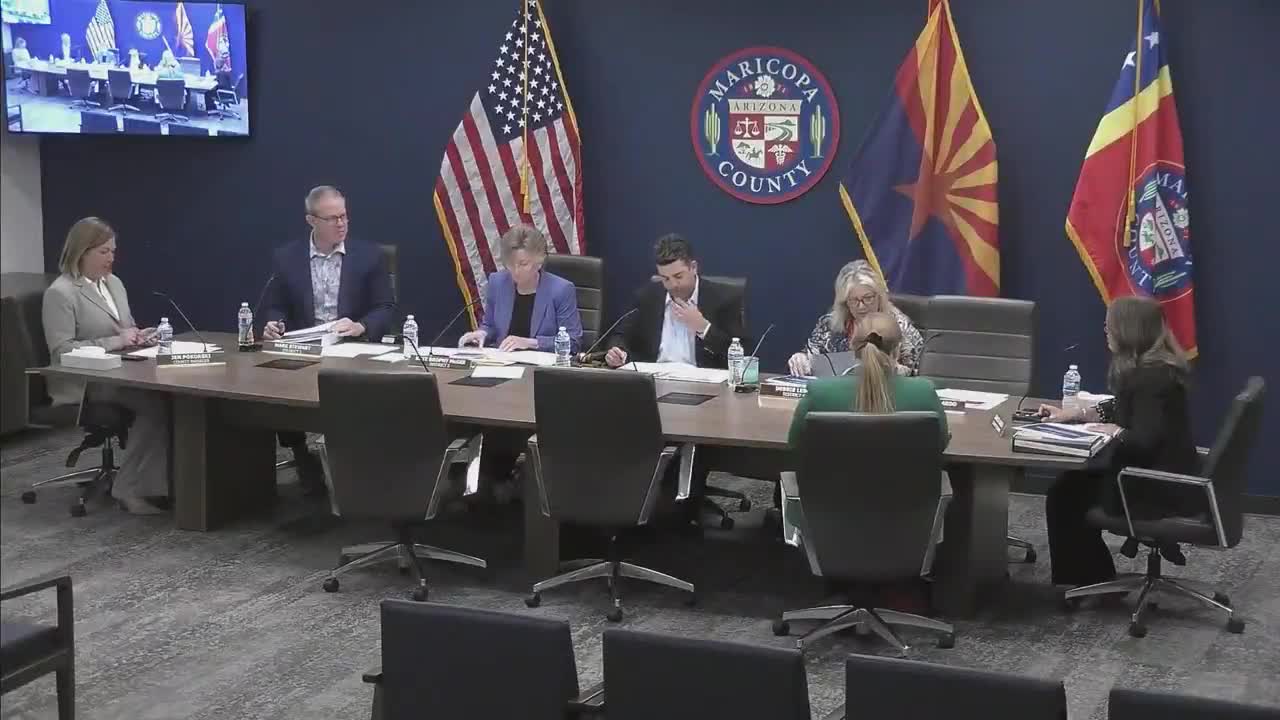
The report, chaired by professional engineer David Pounders, calls for seven broad changes including clearer written interpretations that county staff use when reviewing alternative septic systems, harmonizing county mapping with the Arizona Department of Environmental Quality (ADEQ) GIS map for alluvial basin determinations, authorizing virtual reinspections for minor issues, streamlining resubmittals, notifying original designers when projects change engineers, reconsidering reserve-area rules for some older parcels and asking ADEQ to prioritize updates to the Arizona Administrative Code governing on-site wastewater.
"The septic community here is a small community, very tight knit," said David Pounders, the task force chair and a professional engineer with Pounders Engineering. "The voice that you're hearing is the voice of all of us, throughout Arizona." Pounders told the board the group met every two weeks after a July 31 kickoff and reached consensus at a final meeting Oct. 10.
Andy Linton, director of the Maricopa County Environmental Services Department (MCESD), told supervisors staff had worked closely with the task force and ADEQ during the review. "A lot of the process improvements that were identified by the stakeholder group were tied to the rules in the Arizona Administrative Code," Linton said, noting the county is bound by a delegation agreement with ADEQ and that ADEQ plans to open the on-site wastewater rules for revision next summer.
Stakeholders asked the county to use the publicly available ADEQ GIS map rather than an internal, nonpublic county map for screening where certain alternative systems can be installed. Pounders said the difference has caused confusion in permitting decisions; Linton said MCESD is coordinating with ADEQ to add the county's additional layer to the state's online GIS and is working with county IT to publish more interactive internal layers.
The task force recommended permitting changes intended to reduce repeated review cycles. It asked that wastewater bulletins publish common application errors and that any resubmission include an annotated hold letter so reviewers can focus on previously noted deficiencies rather than adding new comments in later reviews. The group also recommended allowing virtual reinspection for minor items and additional staff training on alternative systems so common operational checks can be completed remotely.
The committee also urged the county to request that ADEQ consider statute- or rule-level changes, including a statutory mechanism to extend expired septic permits and clearer statewide guidance on when sewer service is considered "available" (stakeholders described variability in local sewer-availability standards, such as 300 feet versus 500 feet). Pounders said some changes are technical and others require rulemaking, and he asked the board to lend weight to a letter urging ADEQ to prioritize updates.
During discussion, supervisors pressed county staff on public-health protections. "My bottom line is, does the system work? Is it gonna work? And is it safe?" Supervisor Lesko asked. Linton replied that county staff and the task force reached recommendations that staff believe preserve public-health protections while improving customer service and permitting efficiency.
Votes at a glance
- Motion to accept the report and direct staff to implement the recommendations: passed unanimously. Motion text: "I move to accept the report from the Maricopa County Environmental Services on-site wastewater ad hoc stakeholder task force and direct staff to proceed with implementation of the recommendations as contained in the report." The motion was moved and seconded and approved with all voting aye; no opposition was recorded.
- Motion to convene an executive session immediately following the meeting: passed unanimously.
The board asked staff to track performance measures tied to implementation. Linton said the department will measure inspection turnaround and expects virtual reinspections to reduce reinspection travel time and move routine inspection waits from several days toward a one- to two-day target. He also said MCESD will follow up with exact complaint counts related to septic failures.
Chairman Galvin closed the item by thanking the task force and naming participating members. The board's action directs county staff to implement the county-level recommendations and to pursue a letter to ADEQ urging prioritization of rule updates; changes that require ADEQ rulemaking will proceed through ADEQ's formal stakeholder and rule-drafting process.
Don't Miss a Word: See the Full Meeting!
Go beyond summaries. Unlock every video, transcript, and key insight with a Founder Membership.
30-day money-back guarantee
Sponsors
Proudly supported by sponsors who keep Arizona articles free in 2025

