Sierra Leone, as Security Council president, lays out November program with focus on climate, food security, small arms and youth inclusion
November 04, 2025 | United Nations, Federal
This article was created by AI summarizing key points discussed. AI makes mistakes, so for full details and context, please refer to the video of the full meeting. Please report any errors so we can fix them. Report an error »
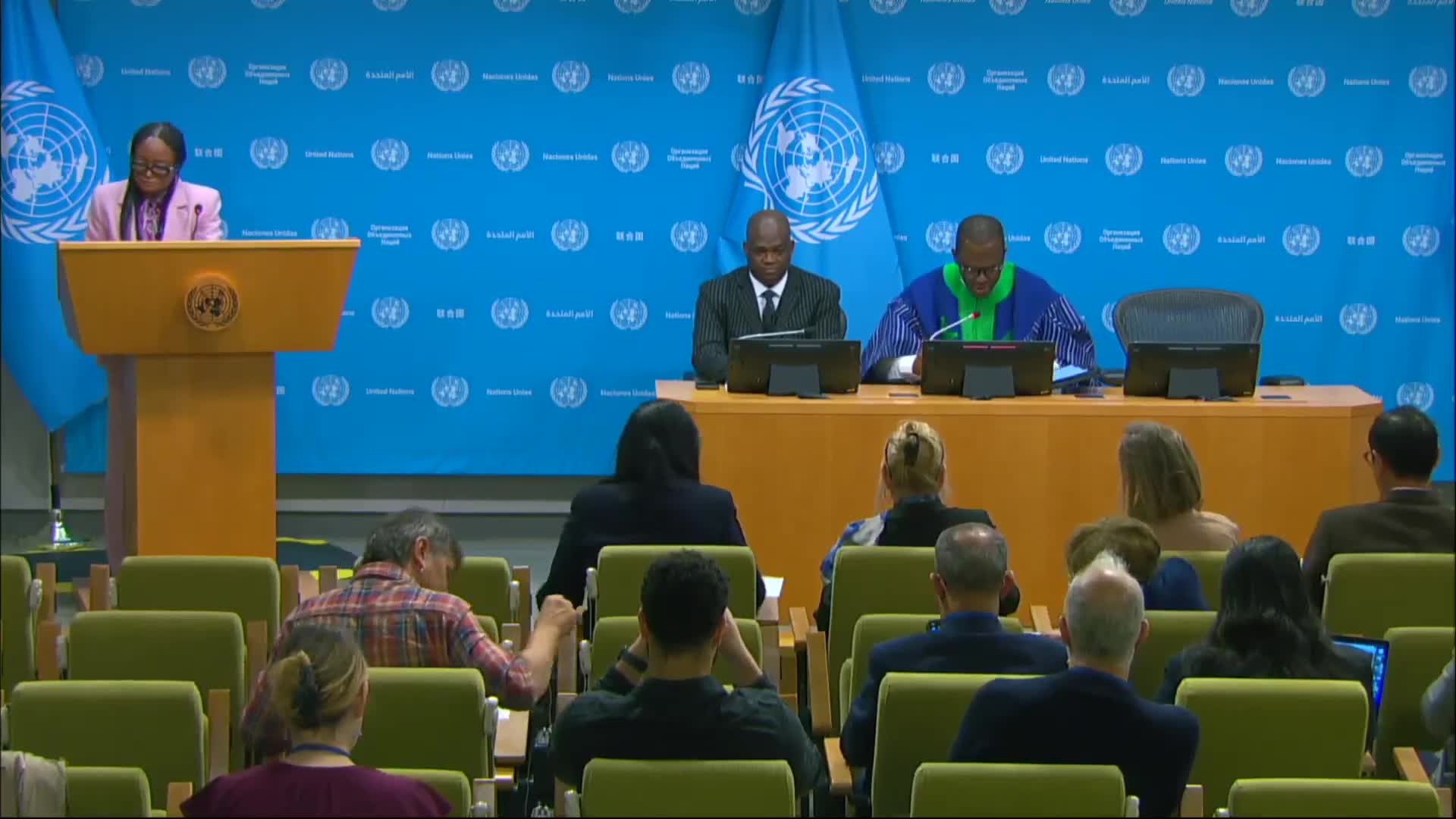
Ambassador Michael Imran Kanu, Permanent Representative of Sierra Leone to the United Nations and president of the Security Council for November 2025, told reporters that the Council's program of work "has been adopted this morning" and that the presidency will concentrate on four interlinked challenges: conflict-related food insecurity, climate-related security risk, the proliferation of small arms and light weapons, and the inclusion of young people in peace and security decision making.
Sonia Karim, deputy political coordinator for Sierra Leone's permanent mission, opened the briefing and asked journalists to identify themselves before asking questions. "My name is Sonia Karim, and I am the deputy political coordinator for the permanent mission of Sierra Leone to the UN," she said.
Why it matters: the monthly program sets which country-specific and thematic issues the Council will formally take up, including debates and briefings that can shape UN system priorities and member-state diplomacy. Sierra Leone framed the month as a continuation of an Africa-focused agenda and said it would pursue greater transparency, inclusivity and civil-society participation in Council work.
Key events and themes: Kanu announced a thematic briefing on climate and security for 6 November that will examine the environmental impact of armed conflict and practical mitigation measures, and said briefers would include environment and legal experts. On 10 November the Council will hold an open debate on small arms and light weapons, centering on illicit flows and their links with transnational crime and terrorism. A working-methods debate is scheduled for 14 November to review implementation of established practice and discuss transparency, penholdership and participation by non-Council members; the president said Council members are likely to address the selection process for the next U.N. secretary-general during that discussion.
Sierra Leone and Guyana are negotiating a draft resolution on youth, peace and security that the presidency said would seek to close institutional gaps by establishing an informal expert group and an annual Council debate on youth issues. The presidency described a high-level open debate on conflict-related food insecurity as a principal signature event for the month; Sierra Leone said the debate will treat food insecurity as both a driver and a consequence of conflict and will emphasize humanitarian law, resilience-building and the humanitarian-development-peace nexus. The President of Sierra Leone is expected to preside over that high-level debate.
The program also lists numerous country-specific meetings and consultations across the month, including briefings and committee meetings on Yemen, UN missions in South Sudan and the Sahel, Libya, Lebanon, DPRK-related consultations, counterterrorism committee briefings and anticipated mandate renewals for peacekeeping and political missions. The presidency said it will endeavour to produce press elements after closed consultations where members agree to do so.
What Sierra Leone said about process and priorities: Kanu said the presidency will "uphold transparency, inclusivity, and efficiency" and will work in close consultations with all Council members. He emphasized that where Council items implicate broader development or legal questions there are other fora, but said the Security Council should address the security implications of conflict-related environmental harm. On the secretary-general selection, he said the Council will work to respect the General Assembly's revitalization framework and to transmit the letter inviting nominations as early as practicable.
Next steps: Kanu said the presidency will continue consultations with Council members, support civil-society participation where appropriate and follow up on contested or outstanding mandates. He thanked the Secretariat and his mission staff and opened the floor to reporters.
Sonia Karim, deputy political coordinator for Sierra Leone's permanent mission, opened the briefing and asked journalists to identify themselves before asking questions. "My name is Sonia Karim, and I am the deputy political coordinator for the permanent mission of Sierra Leone to the UN," she said.
Why it matters: the monthly program sets which country-specific and thematic issues the Council will formally take up, including debates and briefings that can shape UN system priorities and member-state diplomacy. Sierra Leone framed the month as a continuation of an Africa-focused agenda and said it would pursue greater transparency, inclusivity and civil-society participation in Council work.
Key events and themes: Kanu announced a thematic briefing on climate and security for 6 November that will examine the environmental impact of armed conflict and practical mitigation measures, and said briefers would include environment and legal experts. On 10 November the Council will hold an open debate on small arms and light weapons, centering on illicit flows and their links with transnational crime and terrorism. A working-methods debate is scheduled for 14 November to review implementation of established practice and discuss transparency, penholdership and participation by non-Council members; the president said Council members are likely to address the selection process for the next U.N. secretary-general during that discussion.
Sierra Leone and Guyana are negotiating a draft resolution on youth, peace and security that the presidency said would seek to close institutional gaps by establishing an informal expert group and an annual Council debate on youth issues. The presidency described a high-level open debate on conflict-related food insecurity as a principal signature event for the month; Sierra Leone said the debate will treat food insecurity as both a driver and a consequence of conflict and will emphasize humanitarian law, resilience-building and the humanitarian-development-peace nexus. The President of Sierra Leone is expected to preside over that high-level debate.
The program also lists numerous country-specific meetings and consultations across the month, including briefings and committee meetings on Yemen, UN missions in South Sudan and the Sahel, Libya, Lebanon, DPRK-related consultations, counterterrorism committee briefings and anticipated mandate renewals for peacekeeping and political missions. The presidency said it will endeavour to produce press elements after closed consultations where members agree to do so.
What Sierra Leone said about process and priorities: Kanu said the presidency will "uphold transparency, inclusivity, and efficiency" and will work in close consultations with all Council members. He emphasized that where Council items implicate broader development or legal questions there are other fora, but said the Security Council should address the security implications of conflict-related environmental harm. On the secretary-general selection, he said the Council will work to respect the General Assembly's revitalization framework and to transmit the letter inviting nominations as early as practicable.
Next steps: Kanu said the presidency will continue consultations with Council members, support civil-society participation where appropriate and follow up on contested or outstanding mandates. He thanked the Secretariat and his mission staff and opened the floor to reporters.
Don't Miss a Word: See the Full Meeting!
Go beyond summaries. Unlock every video, transcript, and key insight with a Founder Membership.
✓
Get instant access to full meeting videos
✓
Search and clip any phrase from complete transcripts
✓
Receive AI-powered summaries & custom alerts
✓
Enjoy lifetime, unrestricted access to government data
30-day money-back guarantee
