Court approves one Waxhaw Premier variance, denies two; launches review of family‑conveyance and easement rules
November 03, 2025 | Walker County, Texas
This article was created by AI summarizing key points discussed. AI makes mistakes, so for full details and context, please refer to the video of the full meeting. Please report any errors so we can fix them. Report an error »
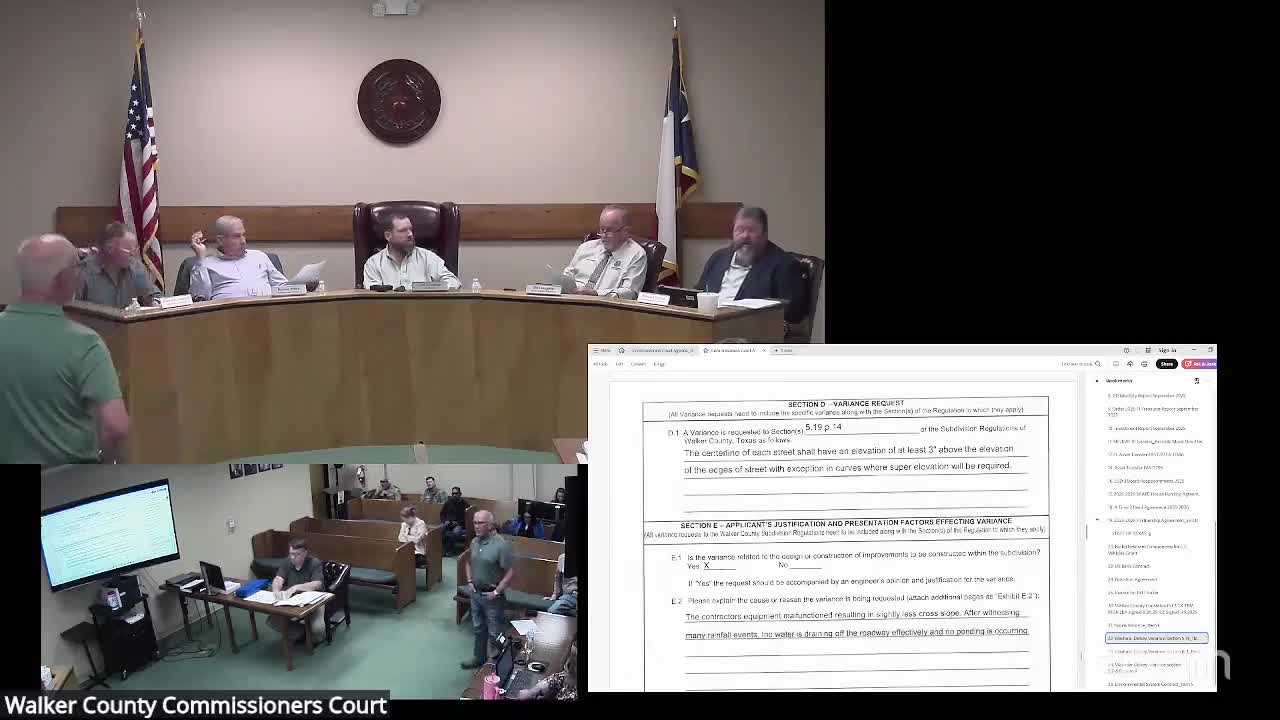
On the developer’s request for a reduced road centerline‑to‑edge elevation (cross‑slope) variance, county engineering staff said they “offer no objection” so long as the absolute minimum cross slope meets 1%. Stephanie, a county reviewer, told court staff that the developer’s engineer certified cross‑slope values generally above the county’s absolute minimum. The court approved that variance while conditioning final acceptance on inspections that confirm the crown and drainage performance in the field.
Two other variances — for ditch depth/use depth and a reduction in the front slope — were denied with the ability to return. Commissioners and county staff said the developer must submit maps identifying specific locations for any reduced ditch sections or slope exceptions so engineering can inspect and verify that those reductions will not create runoff or drainage failures. Court action on those two items was recorded as denials with leave for the applicant to return with targeted documentation.
Following the variances, a lengthy, countywide policy discussion covered the long‑standing rule that new rural tracks must have minimum frontage (commonly 50 feet for flag/flag‑lot frontage), the county’s family‑conveyance exceptions and the complications created when family transfers or court‑ordered partitions later leave property in nonfamily hands. Commissioners asked staff to compare other counties’ language, consider a limited exception for family conveyances that would allow shared easement access, and draft model code language for court review.
Commissioners expressed competing priorities: one view favored strict, uniform frontage rules to avoid ad hoc exceptions, while others supported a narrowly defined family easement pathway to allow older landowners to convey small parcels to relatives without forcing costly frontage acquisitions. Staff said any change would require legal review (state exceptions apply) and the court agreed to have planning draft proposed language for future consideration.
The net result: Waxhaw’s cross‑slope variance was approved with inspection contingencies; the remaining variances were denied but the applicant may return with location‑specific engineering documentation; staff will research other jurisdictions and draft family‑conveyance/easement code options for the court to review.
Don't Miss a Word: See the Full Meeting!
Go beyond summaries. Unlock every video, transcript, and key insight with a Founder Membership.
30-day money-back guarantee
Sponsors
Proudly supported by sponsors who keep Texas articles free in 2025

