Covington council backs one‑year funding to keep part‑time community care navigator
October 31, 2025 | Covington, King County, Washington
This article was created by AI summarizing key points discussed. AI makes mistakes, so for full details and context, please refer to the video of the full meeting. Please report any errors so we can fix them. Report an error »
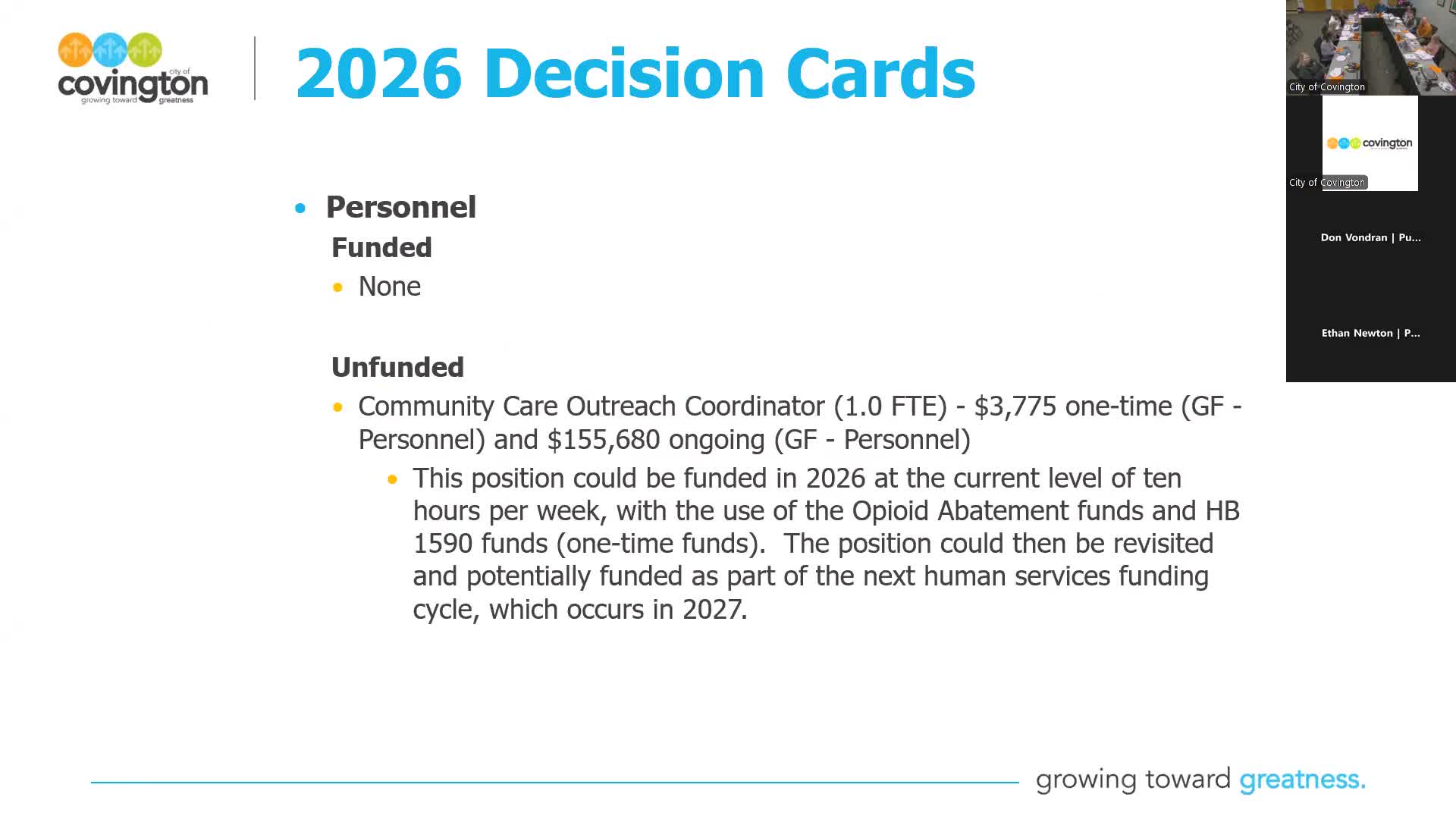
City staff said the position, now filled on a short‑term contract by Carrie, has strengthened the Community Care program and that keeping the 10‑hour weekly position will cost about $24,500 for 2026. Staff told the council the city has received roughly $16,000 in opioid‑abatement settlement funds that can be applied to the role; staff proposed drawing about $8,300 from a House Bill 1590 one‑time pot that the city has set aside, bringing the total to the needed amount for a one‑year continuation.
Council members asked about the role’s duties and whether the work can be absorbed by existing staff. Staff and council members said the position provides specialized recovery navigation and case management that materially improved outcomes and coverage; they described different specialties among the Community Care navigators and said keeping two people provides more specialized response (for example, housing‑related issues versus recovery navigation).
Council direction and next steps
Council members signaled unanimous support to include the 10‑hour/week continuation in the coming year’s budget, contingent on the one‑time funding plan described by staff. Staff said they would include the change on the council’s changes worksheet and return the formal budget language and accounting for the HB1590 draw. Council members also asked staff to discuss longer‑term options with the Human Services Commission so future funding need not rely on one‑time pots.
Why it matters
Officials said the position has reduced staff time spent per case, boosted partnership capacity, and improved continuity of service for residents with complex needs. Staff cautioned that the proposed HB1590 draw is a one‑time source, and further council discussion will be needed in future budget cycles to make the position ongoing.
Evidence: Council discussion
The proposal and funding math were described by staff during the workshop. At 00:05:17, a staff presenter said the full‑time position previously proposed had not been funded; at 00:11:10 staff explained the $16,000 opioid‑abatement funds and the potential $8,300 draw from HB1590. After discussion council members indicated they were “good with bringing Carrie back for 10 hours a week” and staff said they would return the position on the changes worksheet.
Ending note
Council members asked staff to include the item in the draft budget and to explore more durable funding through the Human Services Commission for the position beyond 2026. The council did not approve any ongoing, multi‑year commitment at the meeting; council members approved the one‑year continuation funded as described above.
Don't Miss a Word: See the Full Meeting!
Go beyond summaries. Unlock every video, transcript, and key insight with a Founder Membership.
30-day money-back guarantee
Sponsors
Proudly supported by sponsors who keep Washington articles free in 2025

