Governor's office urges committee to back DRIVE Act to protect Massachusetts research economy
October 31, 2025 | Office of the Governor, Executive , Massachusetts
This article was created by AI summarizing key points discussed. AI makes mistakes, so for full details and context, please refer to the video of the full meeting. Please report any errors so we can fix them. Report an error »
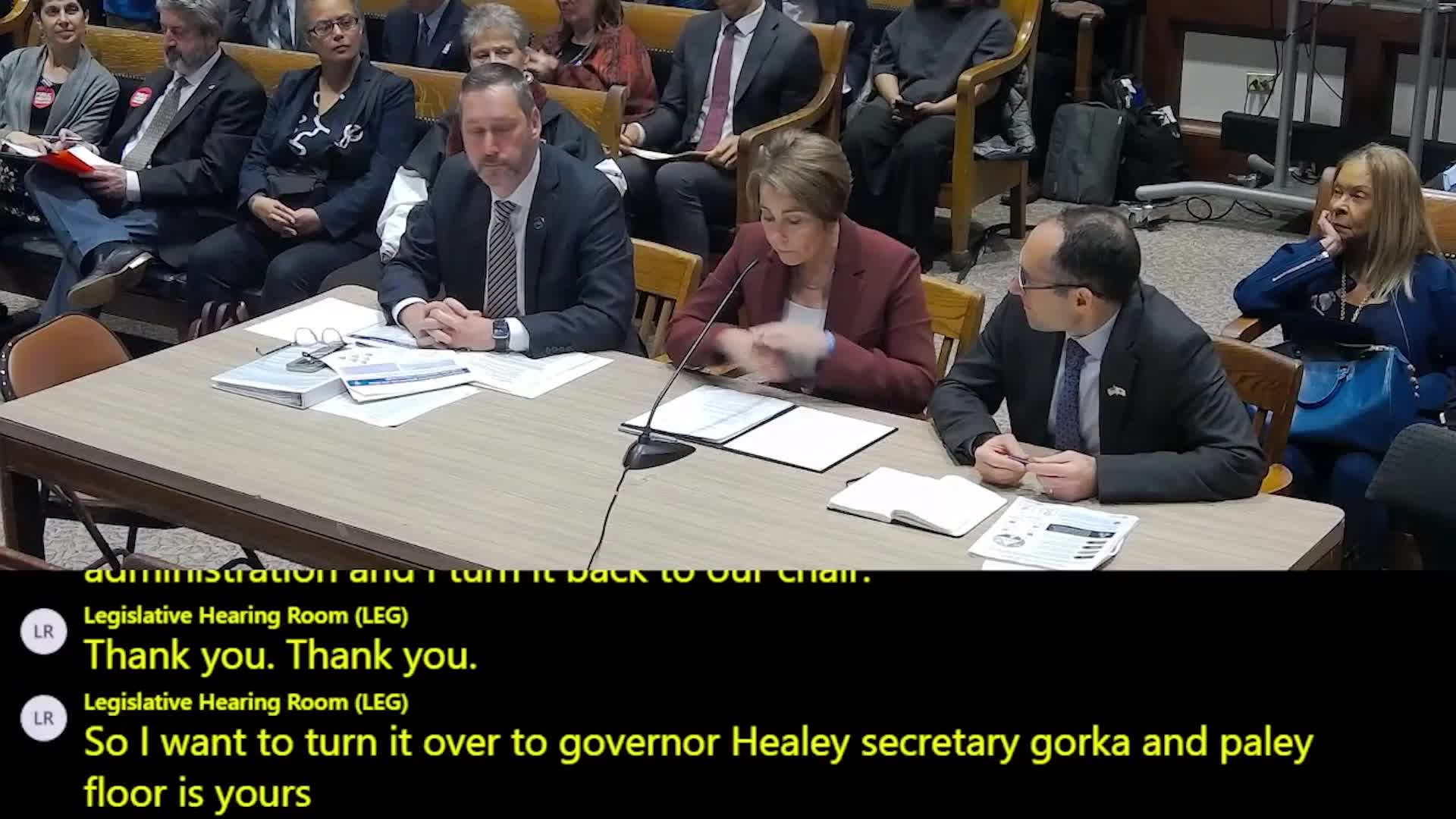
The witness said the plan would direct $400 million in state funds to research and innovation, leverage private-sector matching and dedicate $200 million specifically to public higher-education institutions and regional partnerships. "Without new taxes," the witness said, the bill would "direct 400,000,000 in state funds and leverage more from private sources to retain talent, create jobs, and drive the Massachusetts innovation economy forward."
Proponents say the DRIVE Act matters because Massachusetts' economy is tightly linked to research and development. The testimony cited state figures including about 1 in 10 U.S. R&D jobs located in Massachusetts, roughly 1,700 life-sciences companies in the state, and an estimated 160,000 people employed in the life-sciences sector. The witness added that higher-education and health-care institutions generate about $156,000,000,000 in annual economic output that supports roughly 900,000 jobs and contributes about $4,100,000,000 in tax revenue to the state.
The witness attributed recent disruptions to federal research funding cuts and outlined specific local impacts, saying the UMass system faced "100 suspensions or cancellations of federal grants that total 35,000,000," that "UMass Amherst alone saw 34 cancellations," and that "UMass Chan had to make a 134 furloughs and layoffs." The testimony warned those losses could reduce research, commercialization and related jobs across construction, maintenance, food service and other sectors that support research campuses.
Under the DRIVE Act as described in testimony, $200,000,000 would be dedicated to public higher-education institutions for research, regional partnerships and job-creating ventures. Another $200,000,000, described as funds the legislature previously authorized to pursue federal grants, would be repurposed into a research funding pool funded by interest on the state's stabilization fund, "without touching the principle," the witness said. The proposal would also create a research catalyst fund through MassDevelopment to accept philanthropic and industry matching contributions.
The witness said the measure would expand the eligible use of matching federal funds to include the health safety net and certain human services and would extend the window for using those funds "out from 26 to 29" (units not specified in testimony). The remaining half of the DRIVE funding would be distributed by a selection committee charged with prioritizing projects that drive public benefit and jobs, the witness said.
The testimony included examples of commercialized research and local employers that the witness said depend on the research pipeline, naming UMass Chan Medical School, Voyager Therapeutics, Apic Bio, Atalanta Therapeutics, Via Scientific, Comanche Bio and Moderna's Norwood manufacturing facility. The witness also cited NOAA funding cuts affecting marine-technology businesses in Fall River and New Bedford and said more than half of DRIVE funding would go to public colleges and universities including the University of Massachusetts Dartmouth School for Marine Science and Technology.
In closing, the witness framed the DRIVE Act as a way to preserve Massachusetts' competitive edge so companies spun from local research "plant their roots here, grow jobs here, not somewhere else," and asked the committee to support the legislation. The witness offered to answer members' questions following the testimony.
Details provided in testimony were specific to the witness's presentation and reflect figures and examples the witness attributed to state institutions and recent administrative actions.
View the Full Meeting & All Its Details
This article offers just a summary. Unlock complete video, transcripts, and insights as a Founder Member.
30-day money-back guarantee
Sponsors
Proudly supported by sponsors who keep Massachusetts articles free in 2025

