Nebraska board raises near-term revenue forecast after October receipts; trims corporate outlook
October 31, 2025 | Economic Forecasting Advisory Board, Standing, Committees, Legislative, Nebraska
This article was created by AI summarizing key points discussed. AI makes mistakes, so for full details and context, please refer to the video of the full meeting. Please report any errors so we can fix them. Report an error »
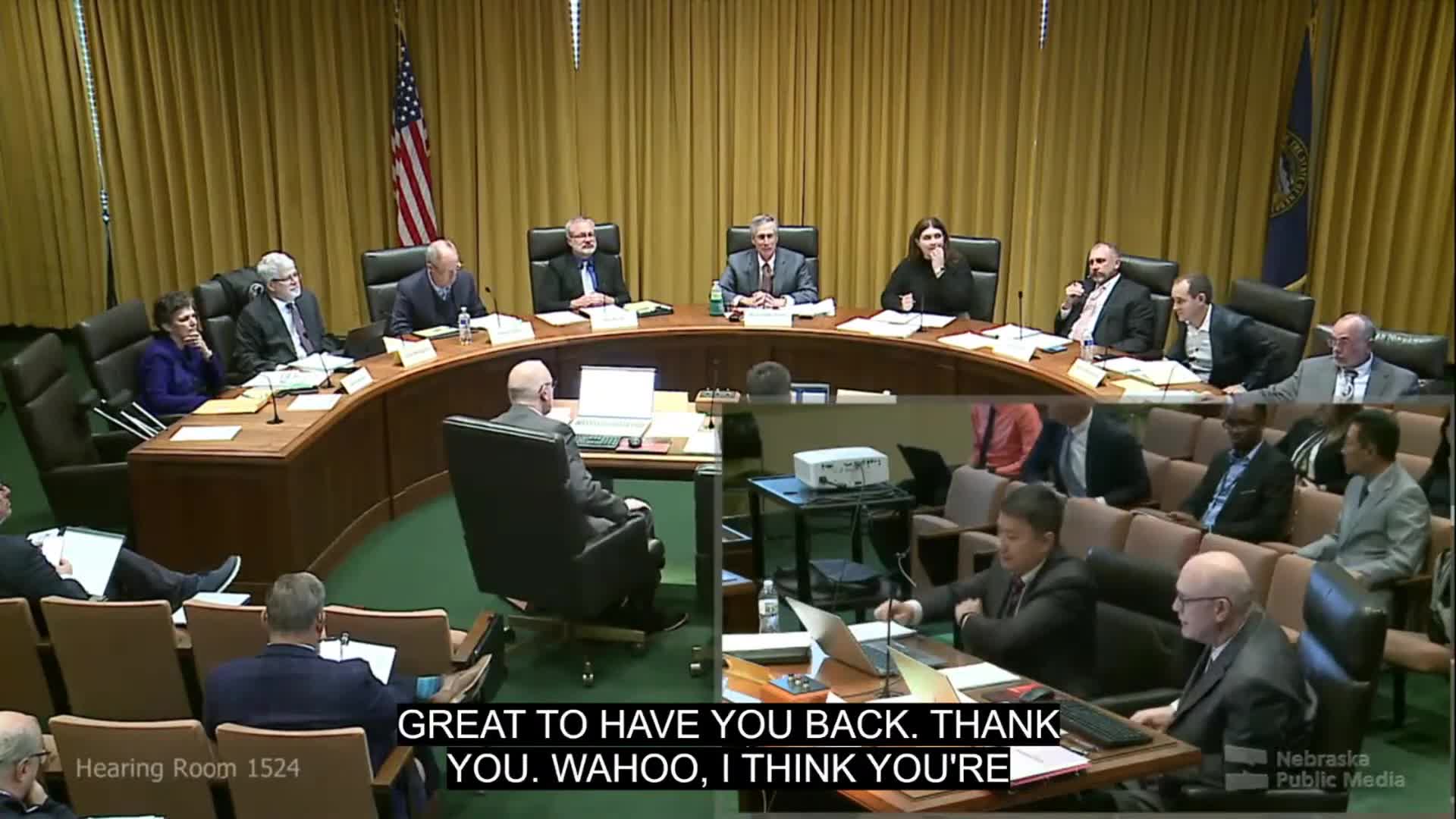
Board staff told members that net sales and use tax receipts came in above the April forecast, with staff reporting a roughly $731,000,000 take versus an earlier projection around $659,000,000. “That gives you a $72,000,000 ahead of projection for sale,” staff said during the presentation. Individual income tax collections were also reported higher than expected in October after withholding and final payments, while corporate income tax receipts were well below the earlier projection for the first quarter.
On corporate taxes the presenter reported, “We collect a 160,000,000 versus the forecast of $2.25 for the first 3 months,” and said some of the September corporate payments may reflect timing or tariff-driven pricing effects rather than sustained profitability. Staff also flagged PTE-related refunds: approximately $76,000,000 of PTE refunds had already been processed and additional refunds were expected to be paid in early November, creating timing uncertainty for net receipts.
The board heard that the receipts picture is driven by several discrete factors: (1) large incentive or project-related payments and subsequent refunds tied to business investment; (2) irregular large corporate estimated payments in September; and (3) the state’s adoption of recent tax law changes (discussed in the presentation as OB3-related adjustments). Staff said the revised consolidated forecast for FY2025-26 is roughly $80 million higher than the April adjusted forecast, largely because of stronger early-year sales and individual receipts offset partially by weaker corporate collections and increased expected refunds.
Votes at a glance
- Approval of minutes (April 25, 2025): approved (motion and second recorded).
- Sales and use tax line: adopted (motion passed 6–2).
- Individual income tax line: adopted (motion passed 7–1).
- Corporate income tax and miscellaneous tax lines: adopted (motion and roll calls recorded; amounts set as part of the consolidated forecast).
- FY2025-26 general fund forecast: adopted at $6,950,000,000 (motion adopted).
- FY2026-27 general fund forecast: adopted at $6,800,000,000 (motion adopted).
Board members pressed staff on the causes of the October surprises and the durability of the adjustments. Staff said some high receipts reflect payment timing for large projects and that refunds (including PTE-associated refunds) can materially reduce net receipts in later months. Staff and a guest presenter also discussed the process for audits and qualification for refunds, noting that audits and qualification determinations can take months and that some refunds may be claimed in later fiscal years.
Members emphasized uncertainty. One member described the recent data as “noise” around structural trends, while others noted that construction and large data-center projects can create large, lumpy use-tax and refund flows that complicate short-run forecasting. Staff repeatedly cautioned that the October numbers should be interpreted as timing and collection phenomena that may not indicate a permanent structural shift.
What the board adopted were staff’s best estimates given available data and current statutory and policy assumptions. The board’s vote establishes the revenue baseline that budget offices and policymakers will use until further scheduled revisions or extraordinary updates.
View the Full Meeting & All Its Details
This article offers just a summary. Unlock complete video, transcripts, and insights as a Founder Member.
30-day money-back guarantee
Sponsors
Proudly supported by sponsors who keep Nebraska articles free in 2025

