House Appropriations subcommittee advances FY2026 Interior and Environment bill after partisan debate
July 16, 2025 | Appropriations: House Committee, Standing Committees - House & Senate, Congressional Hearings Compilation
This article was created by AI summarizing key points discussed. AI makes mistakes, so for full details and context, please refer to the video of the full meeting. Please report any errors so we can fix them. Report an error »
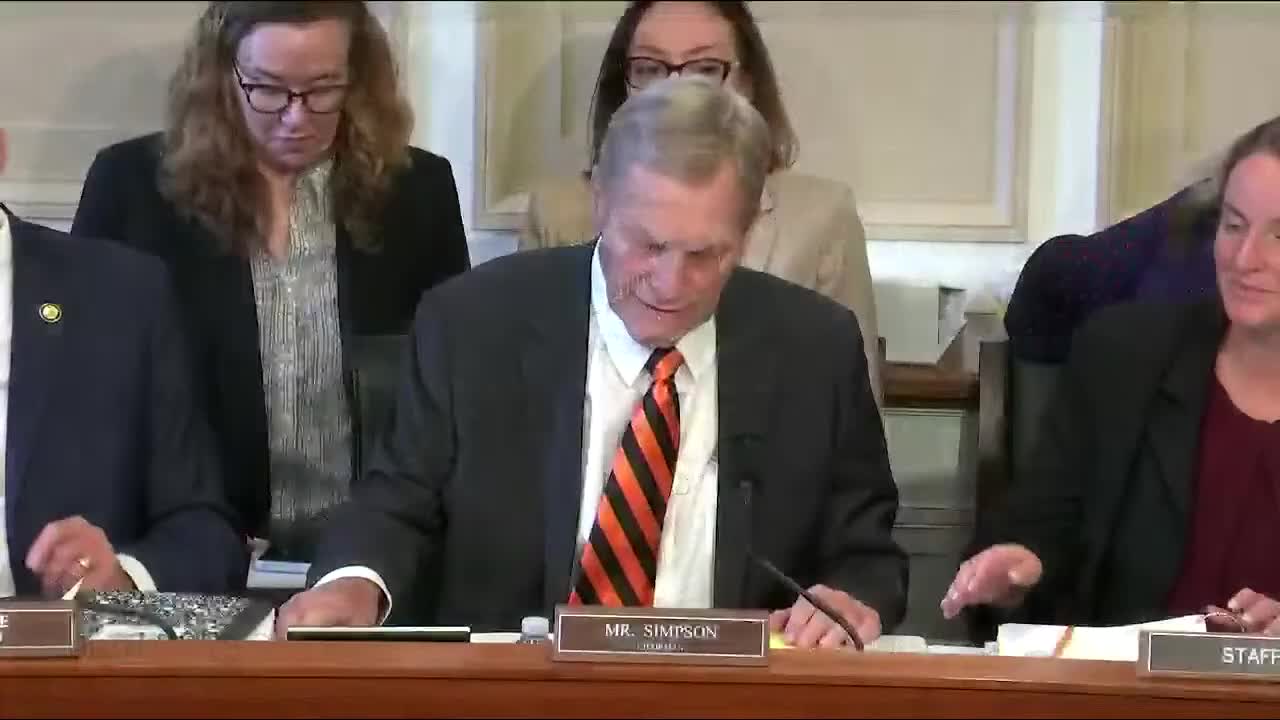
The House Appropriations Subcommittee on Interior, Environment, and Related Agencies voted 8–5 to favorably report the fiscal year 2026 Interior and Environment appropriations bill to the full committee after a contentious markup that split along party lines.
The vote came after more than an hour of opening statements in which members praised sustained funding for tribal programs while sharply criticizing large cuts to environmental protection, national parks and cultural agencies. Subcommittee leaders and members debated reductions to the Environmental Protection Agency, cuts to the National Park Service and proposed policy riders that members said would limit regulatory action on PFAS and other issues.
Chairman Simpson, who opened the markup, said the bill “provides 37,970,000,000,” and highlighted targeted investments for tribal programs and wildfire response. The bill, he said, includes $8,400,000,000 for the Indian Health Service, $1,500,000,000 for the Bureau of Indian Education and $2,900,000,000 for the Bureau of Indian Affairs, including $771,840,000 for public safety and justice programs and $31,000,000 for the missing and murdered indigenous women initiative. Simpson also noted the measure fully funds the Payment in Lieu of Taxes (PILT) program and the federal wildland firefighter pay fix enacted last Congress.
Ranking Member Chellie Pingree criticized the bill’s cuts to the Environmental Protection Agency and cultural agencies, saying the reductions would “harm the quality of life for Americans in years to come.” Pingree said the bill cuts funding to EPA operating programs by roughly 23% and reduces grants for state water infrastructure. She also opposed riders in the bill that would block the EPA from finalizing a draft risk assessment on PFAS in sewage sludge, calling PFAS contamination “a crisis facing the entire country.” Pingree concluded her remarks by saying, “I oppose the bill. I urge my colleagues to oppose the bill.”
Full committee Ranking Member Rosa DeLauro and Rep. Betty McCollum echoed concerns about cuts to parks, the EPA, and cultural programs. DeLauro said the bill would “raise utility bills and energy prices, worsen the climate crisis, put polluters over public health, and abandon the stewardship of our national parks,” and warned it would increase costs for working families. Rep. Jim Clyburn said he “respectfully and regretfully oppose[d] this bill as written,” highlighting cuts to the National Park Service operational budget that, he said, would force staff reductions.
Republican leaders defended the bill’s priorities. House Appropriations Committee Chairman Tom Cole commended the subcommittee for preserving tribal funding and said the bill “reduces regulatory burdens, protect[s] American jobs, and lower[s] energy costs” while targeting resources to “where they are needed most.” Members on the majority side said reductions were required to reallocate funds to higher-priority accounts.
The markup also included discussion of programmatic priorities: continued funding for state and tribal water infrastructure grants under the Clean Water Act and Clean Air Act authorities, support for contract support costs for tribes, and full funding for PILT. Members on both sides noted that community project funding for EPA clean and drinking water projects was included but that requests exceeded available funds.
On procedural action, Representative Malloy moved to report the bill favorably to the full committee. A roll-call request produced the recorded vote: the clerk read members’ votes individually; the chairman pronounced the ayes 8, the noes 5, and the motion carried. The committee granted staff authority to make technical and conforming changes and directed that copies of the bill and report, with those changes, be delivered to full committee members’ offices no later than three business days before the full committee consideration.
The bill now proceeds to the House Appropriations Committee for consideration. If reported by the full committee, it would move next through House floor and conference procedures before any final enactment.
The vote came after more than an hour of opening statements in which members praised sustained funding for tribal programs while sharply criticizing large cuts to environmental protection, national parks and cultural agencies. Subcommittee leaders and members debated reductions to the Environmental Protection Agency, cuts to the National Park Service and proposed policy riders that members said would limit regulatory action on PFAS and other issues.
Chairman Simpson, who opened the markup, said the bill “provides 37,970,000,000,” and highlighted targeted investments for tribal programs and wildfire response. The bill, he said, includes $8,400,000,000 for the Indian Health Service, $1,500,000,000 for the Bureau of Indian Education and $2,900,000,000 for the Bureau of Indian Affairs, including $771,840,000 for public safety and justice programs and $31,000,000 for the missing and murdered indigenous women initiative. Simpson also noted the measure fully funds the Payment in Lieu of Taxes (PILT) program and the federal wildland firefighter pay fix enacted last Congress.
Ranking Member Chellie Pingree criticized the bill’s cuts to the Environmental Protection Agency and cultural agencies, saying the reductions would “harm the quality of life for Americans in years to come.” Pingree said the bill cuts funding to EPA operating programs by roughly 23% and reduces grants for state water infrastructure. She also opposed riders in the bill that would block the EPA from finalizing a draft risk assessment on PFAS in sewage sludge, calling PFAS contamination “a crisis facing the entire country.” Pingree concluded her remarks by saying, “I oppose the bill. I urge my colleagues to oppose the bill.”
Full committee Ranking Member Rosa DeLauro and Rep. Betty McCollum echoed concerns about cuts to parks, the EPA, and cultural programs. DeLauro said the bill would “raise utility bills and energy prices, worsen the climate crisis, put polluters over public health, and abandon the stewardship of our national parks,” and warned it would increase costs for working families. Rep. Jim Clyburn said he “respectfully and regretfully oppose[d] this bill as written,” highlighting cuts to the National Park Service operational budget that, he said, would force staff reductions.
Republican leaders defended the bill’s priorities. House Appropriations Committee Chairman Tom Cole commended the subcommittee for preserving tribal funding and said the bill “reduces regulatory burdens, protect[s] American jobs, and lower[s] energy costs” while targeting resources to “where they are needed most.” Members on the majority side said reductions were required to reallocate funds to higher-priority accounts.
The markup also included discussion of programmatic priorities: continued funding for state and tribal water infrastructure grants under the Clean Water Act and Clean Air Act authorities, support for contract support costs for tribes, and full funding for PILT. Members on both sides noted that community project funding for EPA clean and drinking water projects was included but that requests exceeded available funds.
On procedural action, Representative Malloy moved to report the bill favorably to the full committee. A roll-call request produced the recorded vote: the clerk read members’ votes individually; the chairman pronounced the ayes 8, the noes 5, and the motion carried. The committee granted staff authority to make technical and conforming changes and directed that copies of the bill and report, with those changes, be delivered to full committee members’ offices no later than three business days before the full committee consideration.
The bill now proceeds to the House Appropriations Committee for consideration. If reported by the full committee, it would move next through House floor and conference procedures before any final enactment.
View the Full Meeting & All Its Details
This article offers just a summary. Unlock complete video, transcripts, and insights as a Founder Member.
✓
Watch full, unedited meeting videos
✓
Search every word spoken in unlimited transcripts
✓
AI summaries & real-time alerts (all government levels)
✓
Permanent access to expanding government content
30-day money-back guarantee
